AI Marketing Tools for Vets: Which Ones Actually Fit Your Practice
AI MARKETING AND LEAD NURTURE TOOLS FOR VETERINARY PRACTICES: WHICH TOOLS FIT YOUR PRACTICE TYPE AND WHY THE GENERIC ADVICE IS WRONG
You're running a veterinary practice, and you know something is off. Your patient acquisition costs are climbing, your team is drowning in manual follow-ups, and when you look at the AI tools everyone's talking about, none of them seem built for how your practice actually works. That's because they aren't. The generic marketing platforms and one-size-fits-all AI solutions flooding the market ignore the fundamental differences between small animal clinics, equine practices, and emergency hospitals. This report shows you exactly which tools fit your practice type and why the standard recommendations are costing you money.
Where Your Money's Actually Leaking
If you run a small animal clinic, your biggest leak isn't new patient acquisition. It's patient retention and service depth. You're missing wellness visit follow-ups. Clients book once, come in, and disappear until their pet is sick again. You're losing upsell opportunities on preventative care, dental procedures, and nutrition consultations that your existing patients need but never hear about. A mid-size small animal practice doing $1.2M in annual revenue can leave $150K–$300K on the table annually by not systematically following up with patients on recall schedules and wellness services.
If you run an equine practice, your leak is different: relationship tracking and referral management. Seventy percent of your new work comes from trainer relationships, not broad marketing. You're losing visibility into which trainers refer the most cases, which referrals become repeat business, and which relationships need nurturing. That's money that walks to your competitor because you don't have a system tracking it. Emergency hospitals have their own leak: missed after-hours calls. When a call comes in after hours and you miss it, you're not just losing one visit. You're losing $400–$1,200 in immediate revenue and damaging a client relationship at the moment they're most anxious about their pet.
The Tools That Actually Fit Veterinary Practices
The tools that work for veterinary practices depend almost entirely on your practice type and revenue size. For small animal clinics running $800K–$2.5M in annual revenue, NectarVet and Otto are the platforms that fit because they're built on patient lifecycle automation and native PMS integration. They automate recall sequences, wellness upsells, and behavioral triggering based on actual patient records. Mailchimp, by contrast, is a generic email platform. It works fine if you're just blasting monthly newsletters, but it has no native integration with your practice management system, so you can't automate based on patient data.
For equine practices, StableTrack fits because it's built as a CRM first. It tracks trainer relationships, referral sources, case history, and follow-up tasks in a way that reflects how equine medicine actually generates revenue. For 24-hour emergency hospitals, NectarVet's AI reception agent fits specifically because it captures after-hours calls that your team can't take, eliminating that $400–$1,200 leak per missed call.
Here's the critical constraint: if your PMS is Shepherd, ezyVet, or Cornerstone, you need native integration with any tool you buy. Behavioral triggering—the automation that actually drives the ROI—requires direct patient data connection. Without it, you're manually feeding data to a tool that was supposed to save you time. That kills the math.
The full report covers the specific conditional logic for each practice type, the implementation sequence that actually sticks, the compliance traps specific to veterinary AI tools, and the cost-benefit matrix that tells you whether you're at revenue scale to implement these platforms at all.
- Every tool named and evaluated — NectarVet, Otto, Mailchimp, Deelo, StableTrack
- Which tools fit Veterinary practices specifically and which quietly fail
- The compliance traps and implementation risks specific to your slice
- A sequenced recommendation — what to buy first, what to wait on, what to avoid
- Confidence ratings on every finding so you know what's solid
Delivered as a PDF immediately after purchase. No subscription. No upsell.
Causal Relationship Graph
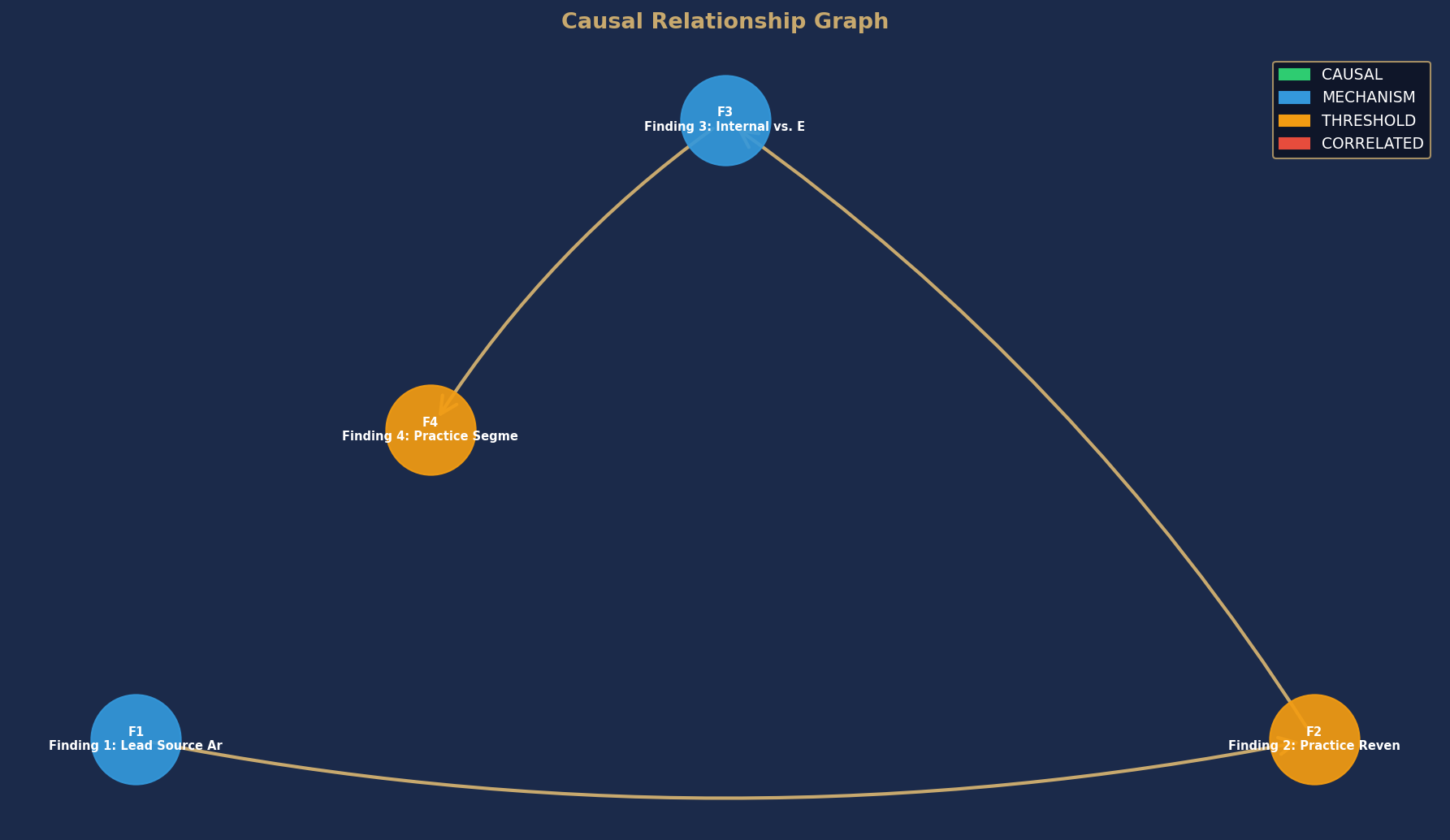
Node colors indicate causal confidence rating. Arrows show directional causal relationships identified in this analysis.
- Every AI tool named and evaluated — not placeholders, actual product names
- Which tools fit Veterinary Practices specifically and which ones quietly fail
- The compliance traps and implementation risks specific to your practice area
- Conditional recommendations — which tool fits your specific operation and why
- Confidence ratings on every finding so you know what's solid and what needs validation
Delivered as a PDF immediately after purchase. No subscription. No upsell.
Full report PDF emailed to you immediately after purchase.