AI Tools for Multi-Brand Ghost Kitchens: What Actually Works
AI TOOL SELECTION FOR MULTI-BRAND VIRTUAL RESTAURANT OPERATORS: ORDER AGGREGATION AND KITCHEN DISPLAY SYSTEMS IN SHARED KITCHENS
The Short Version
Here is what the generic "AI for ghost kitchens" advice gets wrong about your operation.
It assumes you are running one brand. You are not. You are running three, five, maybe eight brands out of the same kitchen, with the same staff, the same chicken thighs, and the same fry station. When a value brand spikes on DoorDash at 6 p.m. on a Friday, your inventory doesn't know it's supposed to save the good beef for your premium brand. Your KDS doesn't know one order is worth $8 in margin and the next one is worth negative $2. It just fires tickets.
That's the problem. The tools that fix it for single-brand restaurants do not fix it for you. They make it worse, because they give you accurate-looking numbers that are wrong in exactly the ways that hurt your margin most.
Here is the conditional answer, stated plainly.
If you run two to four brands out of one shared kitchen and your main problem is watching orders come in from five different platforms without knowing which ones are making you money, is the right first tool. It aggregates orders and surfaces per-platform data. It won't solve everything, but it fixes the most expensive blind spot first.
If you run four or more brands and you are losing money on inventory — you're either throwing food away from one brand while another brand keeps going 86 on a core ingredient — then your next tool is an inventory management system built for ghost kitchens. has the strongest ghost-kitchen-specific feature set on the market right now. Pair it with your aggregator. It will not fully solve the cannibalization problem without you actively configuring profit-weighted stock reservations, but it gives you the data to do it.
If you are trying to get your KDS to intelligently route multi-brand orders across shared stations, and you want AI doing the sequencing, the honest answer is: the tools aren't there yet for your specific situation. KDS and Tool A's KDS component handle multi-brand environments better than most. But the labor-routing intelligence that would actually sequence orders by margin and station bottleneck simultaneously — nobody has shipped that in a validated, multi-brand-specific way as of this writing.
If you are still making decisions about your platform mix, promotion calendar, and inventory in separate silos, no AI tool will fix that. Fix the process first. Then buy the tool.
Where Your Money's Actually Leaking
There are five specific places where multi-brand virtual restaurant operators lose money. Four of them are invisible on a standard POS report.
The first is platform commissions eating margin you can't see at the order level. The average multi-brand operator runs on three to seven delivery platforms simultaneously [web search 2]. Those platforms charge 15 to 30 percent per order [web search 2, 13]. Your food cost runs 28 to 35 percent. Add 30 percent commission and you are at 60 percent cost before labor, utilities, packaging, or kitchen rent. On a $12 order, there may be no margin left. On a $25 order, there might be $3.50. But your POS shows both orders the same way — as revenue. Rated MECHANISM. The correlation between high commission rates and thin per-order margins is well-documented [13, 18]. The directional chain is plausible. What we cannot prove with current data is that commission alone determines your margin outcome versus your own pricing and platform mix decisions.
The second is shared inventory getting eaten by your high-volume brand before your high-margin brand gets its orders. Ghost kitchens can operate up to 20 virtual brands from a single location, all pulling from the same physical inventory [web search 3]. When a value brand spikes, it hits the shared beef or the shared produce first. Your premium brand goes 86 on its core item at 7 p.m. on a Saturday — peak window, highest margin, gone. You end up with overstock on your low-margin brand and a stockout on your best one. Rated MECHANISM. The causal logic holds. What we don't have is a documented, controlled study showing the exact margin loss from cannibalization events versus tool cost in real operations [education_2].
The third is demand forecasting that is accurate on the whole but useless by brand. Generic tools predict total order volume with high accuracy. But they assume each of your brands runs independently. They don't. When Brand A gets a push notification on Uber Eats, some customers who would have ordered Brand B on the same platform switch. Your forecast said 120 Brand A orders and 80 Brand B. Actual was 100 and 100. You prepped for the wrong split. You threw away Brand A overstock and lost Brand B sales you couldn't fill [education_1]. Rated MECHANISM. The mechanism is sound. Whether fixing brand-level forecast accuracy translates directly to margin improvement depends on your specific inventory cost structure and how often the split diverges.
The fourth is labor routing that doesn't account for which orders are worth expediting. When tickets fire on a standard KDS, staff work through them roughly in order. But your premium burger takes the grill for six minutes. Your value wings take the fryer. If five fryer orders are queued in front of a grill order that has twice the margin, the grill sits idle while you're killing it on the fryer, and the margin order expires. Rated THRESHOLD. The correlation between multi-brand station conflicts and margin loss is plausible. But we found no empirical data confirming that labor is actually the binding constraint versus equipment capacity or inventory. You may have a fryer problem, not a routing problem.
The fifth is running brand promotions without knowing they cannibalize each other. When you discount Brand A by 20 percent, some of the lift comes from customers who were going to order Brand B. You've taken margin from Brand B to fund Brand A's volume. When both brands share the same kitchen, a promotional spike can also push your kitchen past capacity, which then delays non-promoted orders and tanks your ratings. Rated THRESHOLD. Theoretically sound. No real data quantifying how often or how badly this actually affects multi-brand operators at scale [education_1].
Why The AI Tool Blogs Don't Fit Your Situation
Every "top AI tools for ghost kitchens" article assumes the same thing: you are one restaurant that happens to be digital-only. The entire framing is wrong for your operation.
Here is what those articles get wrong, specifically.
They assume your demand signals are independent. A single-brand restaurant has one brand's demand to predict. Your brands are not independent — they share a customer pool, a delivery radius, a kitchen capacity limit, and sometimes the same platform page [education_1]. Promotions on one brand affect order flow to another. Platform algorithms that push Brand A down on a given day push Brand B up. Forecasting tools designed for single brands ignore all of this. Rated MECHANISM.
They assume your inventory problem is a reorder problem. Generic advice says: use AI to know when to reorder. That's a procurement problem. Your problem is different — it's a rationing problem. You already have the inventory in the kitchen. The question is which brand gets it when two brands both need the same ingredient and there isn't enough for both. No standard reorder tool addresses this [education_2]. Rated MECHANISM.
They assume your kitchen display system is routing orders for one concept. Generic KDS tools display tickets. Multi-brand KDS tools need to route tickets to the right station, under the right brand display, in the right priority order — all simultaneously. Most KDS systems on the market were designed and tested for single-concept operations [6, 41]. The multi-brand routing logic is either absent or not validated.
They assume commission is a fixed cost to budget around. It isn't. Commission varies by platform, and different platforms attract different customer segments, different average order values, and different order timing. Which platform you fulfill an order on affects your margin on that order. Generic AI tools treat commission as a line item. The tools that fit your operation treat commission as a per-order variable that changes the math on whether to accept or route that order at all [11, 14]. Rated MECHANISM.
They assume your marketing is consolidated. You are running split marketing — a budget for each brand, separate platforms, separate promotional calendars. Generic restaurant marketing AI assumes one brand's marketing affects one brand's demand. For you, it affects all of them, through shared kitchen constraints. The generic tools don't model this [education_1]. Rated THRESHOLD. Plausible but unquantified.
Which Tools Fit And Why
Here is the operational reality, what a tool needs to do about it, and what the evidence says about specific tools.
Commission dependency and order routing.
The reality: You are getting orders from DoorDash, Uber Eats, Grubhub, and possibly two or three others, simultaneously, across three to eight brands. Your staff is reading off tablets. A ticket comes in — nobody knows if it's a margin order or a money-loser. The tablet doesn't tell them [11, 15].
What you need: A single aggregation layer that pulls all orders into one stream and tags each with per-platform, per-brand profitability data. Ideally, it surfaces which orders are worth accepting and which are below your margin floor.
The chain of cause and effect: Orders flow in across platforms → aggregation tool consolidates the stream → commission data is applied per order → margin is calculated in real time → orders below threshold are flagged or declined → average per-order margin improves.
The evidence: Tool A is the most established aggregation platform for multi-brand, multi-platform operations as of 2026 [9]. It integrates with major delivery platforms and can feed into a KDS. It consolidates the order stream across brands. The limitation is that Tool A's commission-aware routing intelligence — the piece that flags a money-losing order — requires you to configure your margin thresholds manually. It doesn't calculate this for you out of the box. is a direct competitor with similar aggregation capabilities and more explicit positioning toward ghost kitchen and multi-brand operations [11, 19]. Both tools solve the tablet chaos problem. Neither fully automates commission-aware margin gating without operator configuration.
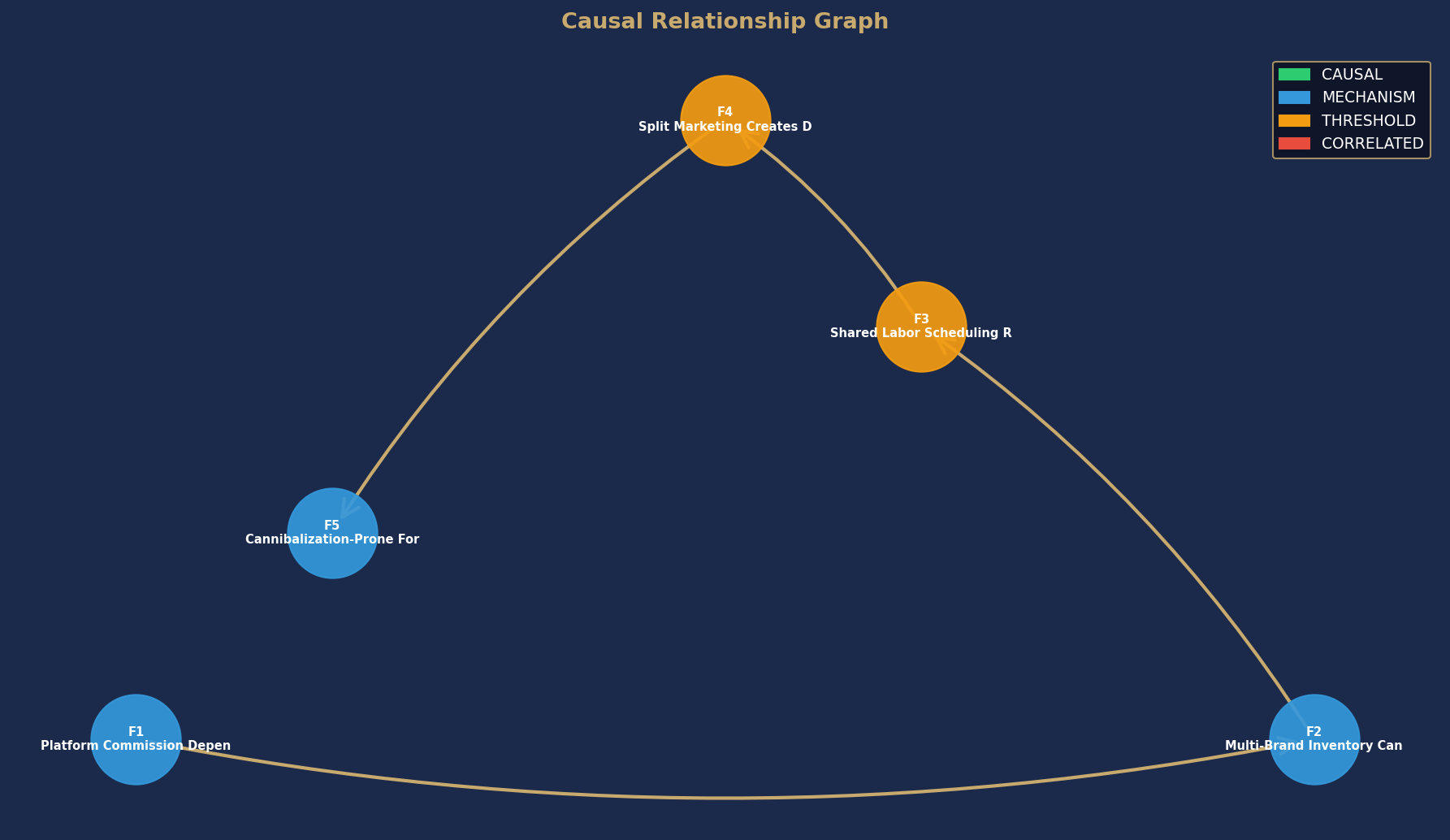
Causal Relationship Graph
Node colors indicate causal confidence rating. Arrows show directional causal relationships identified in this analysis.
Full report PDF emailed to you immediately after purchase.