Novo Navis Intelligence

AI Compliance Tools for Build-to-Rent: Which Ones Actually Fit Your Scale

May 15, 2026·Report ID: smb_150526_5511

AI COMPLIANCE TOOL SELECTION FOR BUILD-TO-RENT AND INSTITUTIONAL SINGLE-FAMILY RENTAL BROKERAGES: WHY GENERIC ADVICE FAILS AND WHICH TOOLS FIT

The Short Version

Here is the thing nobody in the "AI for real estate" space will tell you straight: the compliance tools that work for a 20-unit apartment complex, or even a mid-size residential brokerage, are built for a different problem than yours. If you are managing a Build-to-Rent portfolio or an institutional Single-Family Rental operation, you have three overlapping compliance obligations that generic tools were never designed to handle simultaneously. Buying the wrong tool does not just waste money. It creates a false sense of coverage while your actual exposure quietly grows.

The three obligations are these. First, your institutional investors — whether that is a pension fund, a private equity sponsor, or a REIT structure — need audit trails that document how compliance decisions connect to portfolio holdings. They need this for their own SEC reporting cycle and their internal governance requirements. Generic tools record what happened. They do not record the institutional context of why it happened and when, relative to reporting dates. [40][41]

Second, you are managing Fair Housing risk at a scale where individual transactions look clean while the portfolio-level pattern may not be. A single lease denial has a justifiable reason. Across five thousand units, a seven-point approval-rate gap by race is a disparate-impact case waiting to happen. Generic tools look at individual transactions. They do not aggregate outcomes across your whole book and flag the pattern before a plaintiff's attorney does. [31][62]

Third, your units are scattered. You are almost certainly running more than one property management system, and your compliance data lives in all of them. Any tool that cannot pull from multiple systems in real time will give you audit documentation that lags your operational reality by days or weeks. That gap is where liability lives. [21][22]

If your operation looks like this — institutional equity behind it, five hundred or more units, scattered across multiple geographies and multiple PMS platforms — then the tools that fit are purpose-built for institutional real estate compliance, not adapted from general-purpose compliance software or scaled-up from residential property management features. , , and each cover a different piece of this. None of them covers all three alone. The right setup is a stack, not a single tool.

If you are under five hundred units, not yet institutionally backed, and running a single PMS, you do not need institutional-grade compliance architecture yet. or will handle what you actually need. Do not let a vendor sell you institutional infrastructure at the wrong scale.

Read on for the full breakdown.

Where Your Money's Actually Leaking

The compliance cost in a BTR or institutional SFR brokerage is not where most operators look for it. It is not the fine you already paid. It is the liability you are building without knowing it, and the manual labor you are paying for to close gaps that a better tool architecture would close automatically.

Here is where the money actually goes.

Investor reporting preparation burns staff hours every quarter. Form 13F filing dates for 2026 are February 17, May 15, August 14, and November 16. [50][52] Institutional investment managers overseeing $100 million or more in qualifying securities hit all four deadlines. Your job is to make sure the compliance documentation your investors need — decisions made, sequence documented, portfolio events recorded — is audit-ready before those dates, not assembled in a scramble after them. When you are doing that work manually, you are paying a compliance officer or outside counsel to pull data from multiple systems, reconcile it, and format it for investor review. That costs real money every cycle. The irony is that every hour spent on manual reconciliation is an hour spent creating documentation that is still less reliable than automated, time-stamped audit logs would be. [40][41]

Rated MECHANISM. The investor reporting burden is real and documented. The specific architectural requirement — that AI compliance tools must embed institutional-grade data governance tied to reporting cycles — is a well-grounded causal hypothesis. We have not found SEC enforcement actions demanding this specific architecture, so it does not reach full CAUSAL. It is still a strong lean, and the operational cost of ignoring it is real.

Fair Housing exposure at portfolio scale is the sleeper risk. HUD issued guidance in 2024 that explicitly addresses AI use in tenant screening and housing advertising. [58][62][65] That guidance is still operative in 2026, and HUD is actively monitoring how institutional operators use algorithmic tools to evaluate applicants and target marketing. The regulatory focus is not only on whether an individual decision was discriminatory. It is increasingly on whether the aggregate pattern across your portfolio reveals disparate impact. [31][59] If you are running three thousand or more units and your only compliance tool is a transaction-by-transaction decision log, you have a gap that a plaintiff's attorney can drive a truck through.

Rated MECHANISM. HUD guidance is cited and clear that AI-assisted screening is under scrutiny. [62][65] Regulatory mandate for portfolio-level systemic aggregation specifically is not yet evidenced in enforcement actions. The architectural argument is sound and the liability exposure is real. Treat this as a strong lean and not yet a confirmed regulatory floor.

Multi-PMS data fragmentation is where your audit trails actually break. The 2026 landscape for SFR management is built around scattered-site operations with open API connectivity as the standard. [21][22] In May 2026, Tenant Inc. and SafeLease announced integration through Nectar API, with Hummingbird PMS connecting to 40 or more third-party platforms as a baseline expectation. [66][75] The problem for your compliance operation is that data living in multiple systems with no standardized flow means your audit documentation is only as fresh as your last manual export. That staleness is exactly where regulatory review finds gaps.

Rated MECHANISM. Market adoption of open API standards is documented. [21][66][75] Technical necessity for compliance — as opposed to operational convenience — is a strong hypothesis without enforcement precedent to confirm it fully.

The January 2026 executive order created a split regulatory environment. Build-to-Rent developments that are planned and permitted are explicitly exempted from the order targeting institutional investors in the single-family market. [18][45] Institutional SFR acquisitions are not. If you manage both asset types in the same portfolio, you are now operating under two different regulatory risk profiles. Generic tools do not distinguish between them.

Rated MECHANISM. Order is confirmed and documented. [18][45] Enforcement patterns and practical tool implications are still emerging. The mechanism is plausible; the operational consequence is not yet fully specified.

Why The AI Tool Blogs Don't Fit Your Situation

Every "top AI tools for property management" list you have read in the last six months was written for a different business than yours. Here is exactly why.

Generic advice assumes a single-owner, single-PMS operation. The standard review piece compares tools on leasing automation, maintenance ticketing, and tenant communication. Those are real features. They are also the wrong filter for your situation. Your compliance problem is not how fast you can send a lease renewal. It is whether the decision trail across five hundred lease renewals, across three property management platforms, across six states, holds up to regulatory review. [22][23] No review article is asking that question.

Generic advice assumes the compliance audience is your tenant, not your investor. Consumer-facing real estate compliance tools are built to document what you told the tenant and whether you followed the right procedure. Institutional investor compliance is a different layer entirely. Your LP or REIT investor needs documentation that portfolio-level compliance decisions are independent of securities reporting events, that audit trails are time-stamped and tamper-evident, and that Fair Housing controls were applied consistently across the whole book. [40][41][50] That is not a property management feature. It is a data governance architecture requirement.

Rated MECHANISM. The distinction between consumer-facing and investor-facing compliance documentation is a genuine and plausible causal driver of tool failure for institutional operators. Specific investor prospectus language mandating this was not found in the knowledge base, so this is a strong operational hypothesis, not a confirmed regulatory floor.

Generic advice assumes small portfolio scale. Most comparison guides are calibrated for operators running 20 to 200 units. At that scale, transaction-level compliance — reviewing individual decisions — is sufficient because portfolio-level statistical patterns do not become meaningful until you have enough volume to detect them. [31] When you are at 500, 1,000, or 5,000 units, the statistical floor crosses. Systemic disparate impact becomes detectable, and therefore actionable against you, in ways that are invisible at 50 units. A tool calibrated for 50 units cannot surface what matters at your scale.

Generic advice ignores the January 2026 regulatory split. Almost no tool blog has processed the operational consequences of the executive order distinguishing BTR from institutional SFR. [18][45] If you are running both asset types, or if you are advising clients across both types, applying a uniform compliance framework is now a liability. Rated MECHANISM for the same reasons stated above.

Which Tools Fit And Why

Work through each operational reality and what it actually requires in a tool.

On investor reporting and audit trail documentation, the requirement is that your compliance tool produces timestamped, locked decision records that your institutional investors can map to their reporting cycles. The tool needs to document not just what decision was made, but when it was made and in what context, so it can survive scrutiny from an LP's counsel or an SEC examination. [40][41][55][56]

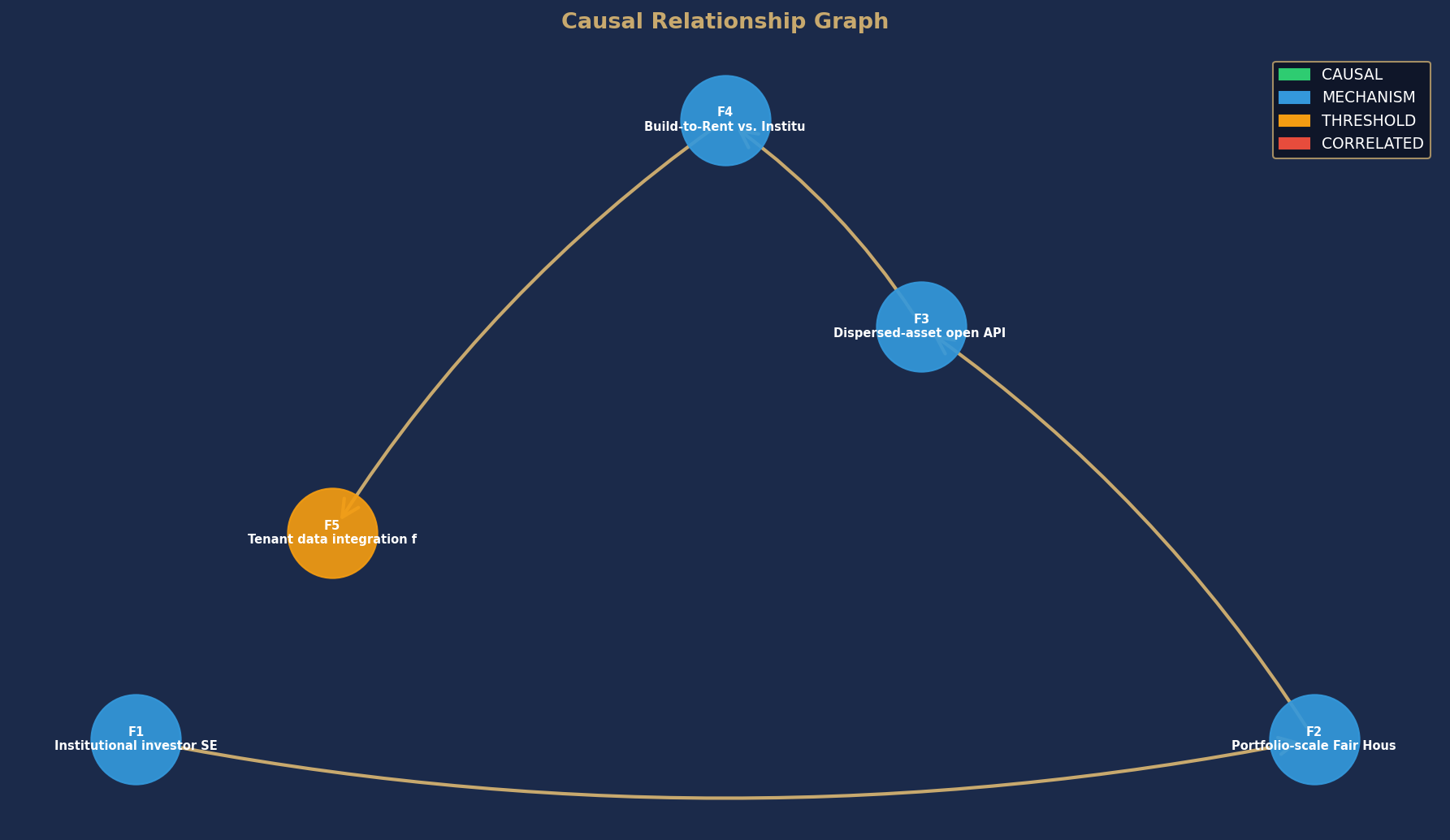
Causal Relationship Graph

Causal DAG

Node colors indicate causal confidence rating. Arrows show directional causal relationships identified in this analysis.

Unlock Full Report — $29

Full report PDF emailed to you immediately after purchase.

© 2026 Novo Navis, LLC · Fidelis Diligentia

Privacy Policy · Terms and Conditions · FAQ · About

This report is published for general informational purposes only and does not constitute financial, legal, or technology procurement advice.

Ask us anything!