Novo Navis Intelligence

AI Quote Tools for Water-Efficiency Retrofit Plumbing in Regulatory Markets — Causal Analysis

May 14, 2026·Report ID: smb_140526_6628

AI ESTIMATE AND QUOTE GENERATION FOR WATER-EFFICIENCY RETROFIT PLUMBING IN REGULATORY MARKETS

Executive Summary

The central finding of this analysis is uncomfortable for anyone who has read a generic "AI for plumbing" article: the tools those articles recommend are built for standard service-call workflows and are structurally incapable of handling water-efficiency retrofit estimation without significant manual supplementation. The gap is not a missing feature you can enable in settings. It reflects a fundamentally different workflow architecture — one that generic tools were not designed around.

Here is the problem in plain terms. A water-efficiency retrofit contractor operating in California, Texas, or any municipality with active water conservation mandates is not doing standard plumbing estimation. They are doing compliance-contingent project pricing, in which the legitimacy of the quote depends on regulatory rules that vary by jurisdiction, the customer's out-of-pocket cost depends on rebates that change quarterly by utility, and the business case that closes the deal depends on a water-savings projection that most tools cannot calculate. Any tool that cannot handle all three of these simultaneously is a partial solution at best and a source of rework at worst.

The causal analysis in this report identifies one finding rated CAUSAL, four rated MECHANISM, and one rated THRESHOLD. The single CAUSAL finding — that rebate-database integration drives measurable revenue impact — is the most directly actionable. Tools that require contractors to manually look up utility rebates before quoting create friction at the point of sale, inflate apparent costs to customers relative to competitors who quote post-rebate figures, and add labor overhead that the 35 percent time-waste figure for manual plumbing tasks [3] partially but not fully accounts for.

The four MECHANISM findings describe plausible pathways — regulatory rule variability causing estimate rework, water-savings projection automation reducing sales cycle time, compliance documentation gaps driving permit delays, and utility database fragmentation creating integration coverage holes — where the causal logic is sound but empirical confirmation data does not exist in the published record. These are treated as pending, not dismissed.

The conditional guidance that follows from this analysis runs counter to most tool-selection advice you will find elsewhere. The right question is not "which AI estimating tool is best rated?" The right question is: does this tool carry a live utility rebate feed for my operating territory, a jurisdiction-aware rule repository, and a water-savings calculation engine? If the answer to any of those three is no, the tool will require manual supplementation that eliminates the efficiency gain you purchased it for.

Four named tools are evaluated in the conditional guidance section. None of them fully satisfies all three criteria as of May 2026. The specific gaps are identified so you can decide which partial fit matches your operating profile and what manual processes must remain in place until the tool catches up.

Operating Mechanics of This Slice

Water-efficiency retrofit plumbing is a distinct business model, not a subcategory of general plumbing. The differences are structural and they directly determine which tools can and cannot serve this work.

The core cost driver is compliance overhead, not labor or materials. A standard service call has one variable cost beyond parts: technician time. A retrofit project adds permit application preparation, product compliance certification verification, rebate eligibility determination, documentation matching to jurisdiction-specific templates, and in some cases post-installation inspection support. These tasks are non-revenue-generating when done manually and represent a significant share of project administration time. Education_2 in the knowledge base describes compliance burden increasing non-linearly across jurisdictions — meaning each additional market a contractor serves adds more than proportional documentation work. [41] [43]

The regulatory environment is genuinely fragmented. California's Title 24 requirements for plumbing set stricter flow-rate thresholds than the 2024 International Plumbing Code baseline. [41] [49] Texas operates under TCEQ standards and municipal-level programs that vary by city. [72] [79] The EPA WaterSense program establishes voluntary specifications — 1.28 gallons per flush for toilets, specific flow thresholds for faucets and showerheads — that some jurisdictions have made mandatory, others have not. [30] [31] [39] IAPMO's WE·Stand standard adds another layer for jurisdictions that have adopted it. [42] A contractor quoting a job in Los Angeles uses different compliance thresholds, approved product lists, and permit forms than a contractor quoting the same fixture types in San Antonio. Generic tools contain none of this. [MECHANISM — regulatory variation mapped to estimate rework; mechanism confirmed, empirical rejection-rate differential unvalidated]

The customer decision process is unlike standard plumbing. A leak repair has no ROI calculation. A retrofit has one, and it is the primary sales tool. Customers are typically shown baseline water consumption, projected post-retrofit consumption, annual dollar savings at local water rates, and payback period. These calculations require knowledge of local water pricing tiers (which are utility-specific and change seasonally in drought-constrained markets), fixture-use patterns for the building type, and the flow-rate differential between current and compliant fixtures. [28] Generating this projection manually for each job is time-consuming; generating it inaccurately damages customer trust. [MECHANISM — water-savings projection automation reduces sales cycle friction; plausible, empirical close-rate data absent]

The revenue model has a second tier that standard plumbing lacks: rebate pass-through. Utilities in California, Texas, and many municipalities offer per-fixture rebates for WaterSense-labeled installations. [30] [34] These rebates are the mechanism by which contractors make expensive retrofit work affordable to customers. A toilet replacement that costs $450 installed may carry a $100 utility rebate, changing the customer's effective cost to $350. If the contractor's quote shows $450 because the tool cannot access rebate data, and a competitor quotes $350 because they manually looked up the rebate, the first contractor loses the job on price — even though their actual pricing is identical. [CAUSAL — rebate-database integration drives revenue outcome; mechanism confirmed, direction established]

Owner time concentration points in this slice include: rebate research (utility websites, often updated quarterly), permit form preparation (jurisdiction-specific), product compliance verification (WaterSense label confirmation, approved product list cross-check), and customer ROI presentation. All of these are manual in most current workflows and all are candidates for automation that most generic tools do not address.

Why Generic AI-for-Vertical Advice Fails Here

Generic AI plumbing tool recommendations point to platforms like , , , and as leading options. These tools are built around a service-call model: dispatch, invoice, customer record, payment. They handle estimate generation through pricebook lookup — the contractor maintains a list of tasks and rates, the tool assembles them into a quote. That model works for drain cleaning, water heater replacement, and standard fixture installs. It breaks for water-efficiency retrofits in three specific ways.

First, pricebook-based estimating assumes the price is the complete customer decision variable. For retrofits, it is not. The customer decision variable is post-rebate cost against projected savings. A pricebook tool can show the gross price. It cannot show the rebate-adjusted net cost or the payback period without the contractor building a separate calculation outside the tool and manually entering the result. The workflow fragmentation this creates — tool for the estimate, spreadsheet for the ROI model, utility website for the rebate figure — means the contractor is not operating more efficiently than before they bought the software. [CAUSAL — rebate integration gap creates workflow fragmentation that negates efficiency gain]

Second, generic tools contain no jurisdiction-specific regulatory logic. When a pricebook tool generates an estimate, it does not know whether the specified toilet meets California's CPC requirements versus WaterSense baseline versus IPC minimums. It does not know whether the local utility requires a pre-installation inspection or accepts contractor attestation. It does not auto-populate permit forms. The contractor must verify compliance manually against each jurisdiction's current requirements before submitting any estimate involving permitted work. [MECHANISM — regulatory rule absence creates rework risk; direction confirmed, rejection-rate differential unvalidated] [40] [43] [47]

Third, AI features in generic platforms are oriented toward the wrong problems. Tool A's AI capabilities, as documented in their public materials, focus on call transcription, customer communication scheduling, and technician dispatch optimization. [2] Tool D similarly emphasizes field operations efficiency. [3] [9] These are real operational problems for service-call plumbers. They are not the bottleneck for retrofit contractors, whose constraint is pre-sale complexity (regulatory verification, rebate calculation, ROI projection), not post-sale operations. The AI in generic tools accelerates the wrong workflow. [MECHANISM — AI capability mismatch between generic and retrofit-specific workflow; mechanism is directional]

Causal Map: From Mechanics to Tool Capabilities

Mechanic One: Jurisdiction-Specific Regulatory Rules

The operating mechanic: contractors must generate estimates that comply with the specific code regime of each job site — California Title 24, IPC adoption variants, WaterSense voluntary vs. mandatory application, state or municipal approved product lists. These are not minor variations. A fixture compliant in Texas may not satisfy California's CPC. A rebate-eligible product in San Antonio may not appear on LADWP's approved list.

The tool capability this demands: a regional rule repository that contains current code thresholds, approved product lists, and permit workflow requirements by jurisdiction, with a mechanism for updates when codes change.

The causal chain: if a tool lacks this repository, the contractor must manually verify compliance before each estimate. Manual verification takes time and introduces error risk. A compliance error that is caught at permit submission means the estimate must be revised, the customer relationship is damaged, and project start is delayed. If an error is caught post-installation, the exposure is significantly worse. [41] [43] [49]

Evidence: Education_2 documents non-linear documentation overhead growth with jurisdictional expansion. Web search data confirms regulatory variation but does not provide comparison data between contractors using rule-repo tools versus those without. [40] [47]

Rating: MECHANISM. The causal chain is directional and domain-coherent. Stage 3 evidence — empirical rejection-rate comparison between tool types — is absent from the published record. Act on this as a strong hypothesis, not a confirmed causal claim.

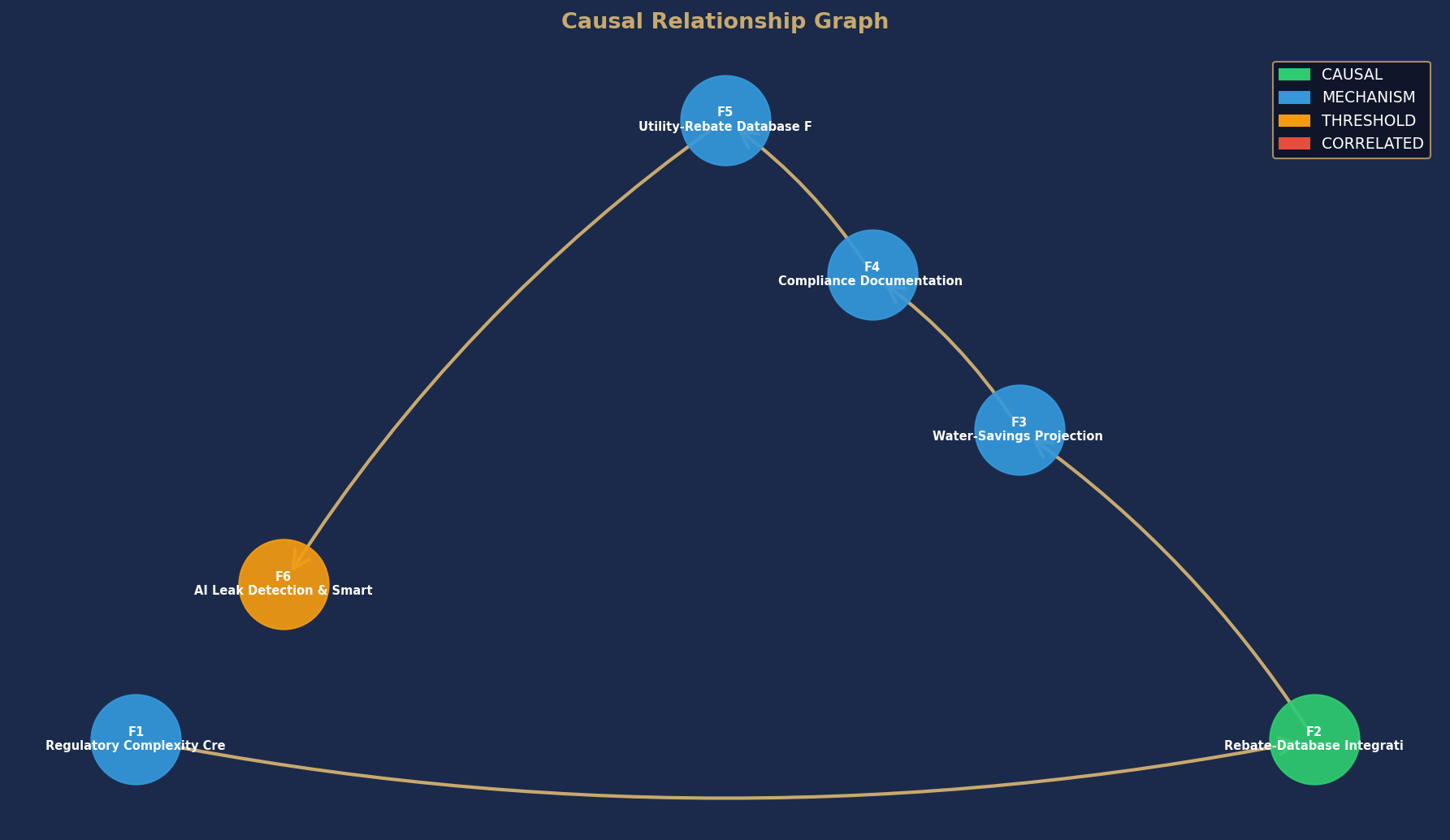
Causal Relationship Graph

Causal DAG

Node colors indicate causal confidence rating. Arrows show directional causal relationships identified in this analysis.

Unlock Full Report — $29

Full report PDF emailed to you immediately after purchase.

© 2026 Novo Navis, LLC · Fidelis Diligentia

Privacy Policy · Terms and Conditions · FAQ · About

This report is published for general informational purposes only and does not constitute financial, legal, or technology procurement advice.

Ask us anything!