AI Review Tools for PT Clinics: Which One Won't Waste Your Money
AI REVIEW AND REPUTATION MANAGEMENT TOOLS FOR PHYSICAL THERAPY CLINICS: WHICH ONE FITS YOUR OPERATION AND WHY
Your front desk is drowning in manual tasks after every patient leaves, and review requests aren't making it out the door. Meanwhile, negative reviews sit unanswered online, and Google's 2026 policy changes are quietly deleting reviews you've spent months collecting. This report cuts through the noise and tells you exactly which reputation and review management tool actually fits your clinic size and workflow — and which ones will waste your money.
Where Your Money's Actually Leaking
Most physical therapy clinics lose patient acquisition revenue every single day because review requests never get sent. Your front desk staff are already handling check-outs, billing questions, and scheduling the next appointment. Adding "send a review request" to that stack means it doesn't happen. The result: you're invisible to patients searching Google for PT clinics in your area, because you're not collecting reviews fast enough to build credibility. One negative review sitting unanswered for a week doesn't just hurt your rating — it signals to every prospective patient reading it that you don't care about feedback.
The second leak is compliance. Google enforced new rules in 2026 that actively remove reviews collected via physical kiosks or incentivized campaigns. If your clinic has been running a "leave a review, get a discount" campaign or collecting reviews through a tablet in your waiting room, those reviews are being deleted by Google's algorithm right now. You're spending time collecting feedback that disappears, and you're not building the kind of review pipeline that actually influences local search rankings.
The third leak is data chaos. If your reputation tool doesn't talk to your EMR or practice management system, someone on your team is manually entering patient contact information twice — once into your patient records and again into the review software. By month two, this process breaks down. The tool gets abandoned. You're back to square one, and you've paid for software you're not using.
The Tools That Actually Fit Physical Therapy Clinics
Eight tools compete for your attention: Birdeye, Podium, RepuGen, Reputation.com, WebPT, Clinicient, Empower EMR, and Jane App. But they don't all fit your operation. If you're a solo owner-operator running one location with no dedicated office admin, Birdeye's standard tier, Podium's base plan, or RepuGen are your best bets. All three automate review requests without requiring you to manage a complex workflow, and they include compliance templates built for 2026 Google rules. RepuGen adds an approval step before reviews go live — useful if you want human oversight without adding labor.
If you run two to four locations with an office manager, Birdeye or Podium's mid-tier plans let you centralize review responses and reputation monitoring across all your clinics from one dashboard. You can see which location is lagging on reviews, respond to negative feedback at scale, and keep your brand voice consistent. Reputation.com is built for five or more locations and includes enterprise-level automation and compliance management. If your practice relies heavily on physician referrals rather than Google search visibility, a reputation tool is defensive maintenance — it protects your rating but won't drive patient acquisition the way it would for a search-dependent clinic.
The decision between these tools comes down to three factors: how many locations you run, whether your EMR integrates smoothly with the tool, and whether you have the bandwidth to review and approve AI-generated responses before they go public.
The detailed comparison matrix, the specific EMR compatibility chart, the 2026 compliance traps that cost clinics money, and the implementation sequence that prevents tool abandonment are in the full report.
- Every tool named and evaluated — Birdeye, Podium, RepuGen, Reputation.com, WebPT
- Which tools fit Physical Therapy Clinics specifically and which quietly fail
- The compliance traps and implementation risks specific to your slice
- A sequenced recommendation — what to buy first, what to wait on, what to avoid
- Confidence ratings on every finding so you know what's solid
Delivered as a PDF immediately after purchase. No subscription. No upsell.
Causal Relationship Graph
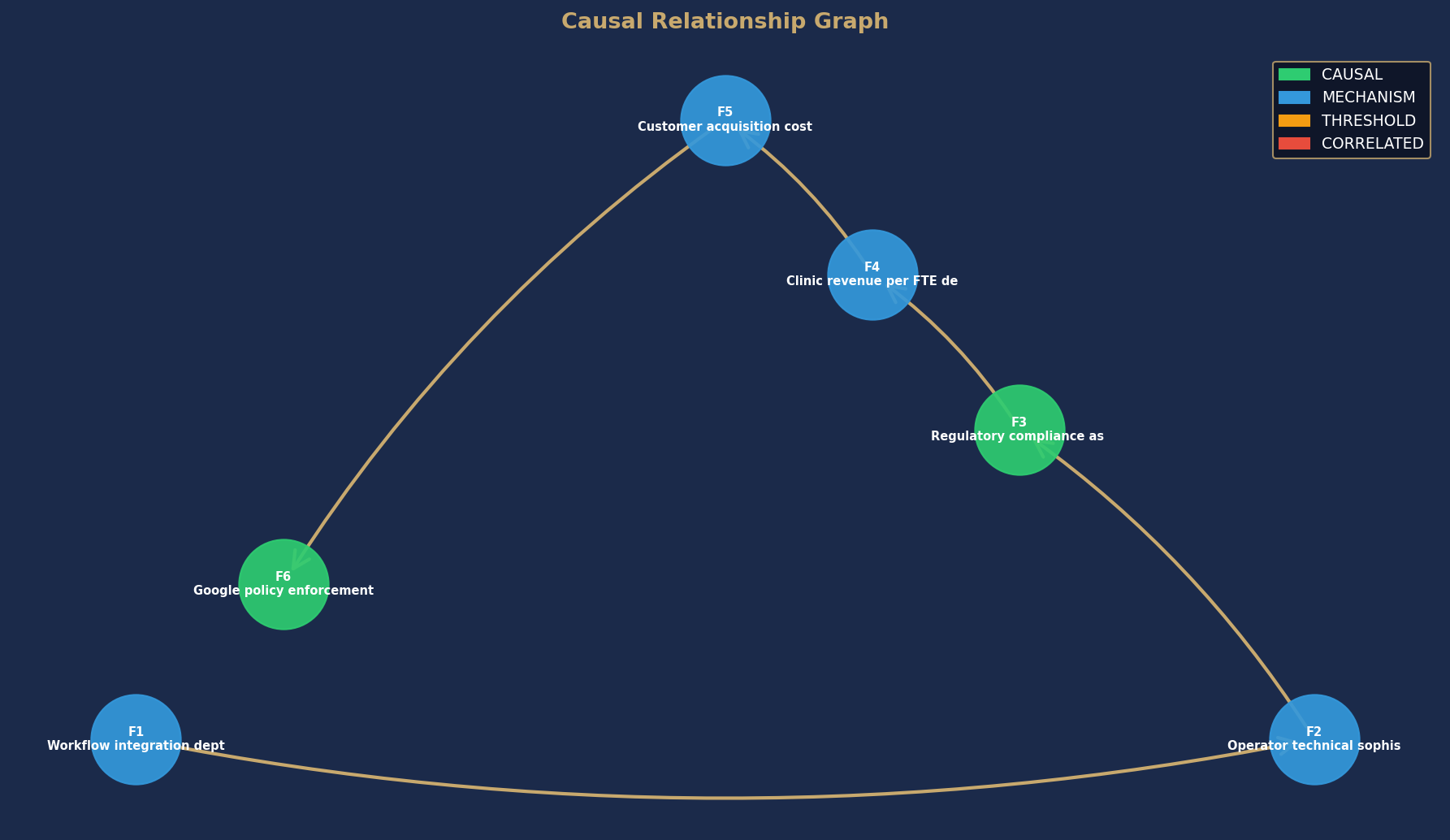
Node colors indicate causal confidence rating. Arrows show directional causal relationships identified in this analysis.
- Every AI tool named and evaluated — not placeholders, actual product names
- Which tools fit Physical Therapy Clinics specifically and which ones quietly fail
- The compliance traps and implementation risks specific to your practice area
- Conditional recommendations — which tool fits your specific operation and why
- Confidence ratings on every finding so you know what's solid and what needs validation
Delivered as a PDF immediately after purchase. No subscription. No upsell.
Full report PDF emailed to you immediately after purchase.