AI Quote Tools for Termite Prevention in New Construction — Causal Analysis
AI QUOTE AND ESTIMATE TOOLS FOR SMALL PEST CONTROL BUSINESSES SPECIALIZING IN TERMITE PREVENTION FOR NEW CONSTRUCTION: A CAUSAL FIT ANALYSIS
Executive Summary
The non-obvious finding in this analysis is that the usual question small pest control businesses ask — "which AI quote tool is best?" — is the wrong question. The right question is: "which tool accounts for the fact that pre-construction termite work is not a pest control scheduling problem, it is a construction sequencing problem?" Most generic AI-for-pest-control recommendations fail to make this distinction. The failure is not cosmetic. It is structural.
Pre-construction termite prevention imposes a constraint that is absent from virtually every other pest control service line: treatment timing is determined by when the general contractor reaches specific construction phase gates, not by when the customer is available. Treatment must occur after footing approval but before the pour, then again before framing, then again at closeout. A quote tool that does not encode these phase dependencies does not produce a wrong quote in the sense of mispriced labor. It produces a quote that may be completely unexecutable in the field because the recommended treatment sequence cannot be mapped to a real construction schedule. [11][15][36]
This analysis rated six operational findings across the causal framework. The causal filter found zero CAUSAL-rated findings, one MECHANISM-rated finding, one THRESHOLD-rated finding, and four CORRELATED-rated findings. The implication is significant: the evidence base for any tool recommendation in this slice is thinner than vendor marketing suggests, and small business owners should treat pilot testing as a non-optional step before committing to any platform.
The one MECHANISM-rated finding — construction phase gate integration as a hard requirement — is the load-bearing constraint that separates fit-from-unfit tools. The mechanism is sound: phase-unaware tools produce quotes that misalign with construction reality. Empirical validation at Stage 3 is absent because no published case study traces execution failure directly to a tool's missing phase-gate feature. That absence of evidence does not make the mechanism wrong; it means the smart owner tests for it explicitly before signing a subscription.
The THRESHOLD finding — that building code compliance automation is a meaningful but unsolved operational gap — tells a different story. The gap is real. Termite prevention mandates vary by state, county, and local jurisdiction. [20][53][55][56] No tool currently in the market demonstrably automates compliance checking for termite prevention across jurisdictions. Small business owners should budget for manual code verification rather than assuming any tool handles it.
Conditional guidance in plain terms: If your business does primarily new construction termite prevention work, is the only tool in the current market with documented termite-specific inputs. But whether those inputs produce better quotes than a well-configured generic tool is unvalidated. and are general-purpose pest control platforms. They can produce quotes. They cannot be assumed to handle construction phase dependencies or termite-specific specification logic without manual overlay. The cost of that overlay in operator time is unknown but non-zero.
Operating Mechanics of This Slice
Pre-construction termite prevention for new construction is operationally unlike any recurring pest control service. Understanding the mechanics that make it distinct is prerequisite to evaluating which tools fit.
Treatment timing is controlled by the general contractor, not the pest control operator. The standard treatment sequence involves three or more site visits keyed to construction phase gates: after footing approval, before the foundation pour, before or during framing, and at closeout. [11][15][36][37] A missed phase window can require rework if concrete is poured over untreated soil, or can result in a failed inspection if treatment documentation is not available at permit closeout. This is not a scheduling preference problem. It is a fixed-sequence constraint imposed by construction physics and building code requirements. [MECHANISM]
Building code compliance is jurisdiction-specific and non-trivial. Termite prevention in new construction is mandated by Florida Building Code Section R318, the International Residential Code Section R305, and by HUD requirements in 34 states. [20][53][57] State-level mandates are further amended at county and municipal levels. South Carolina maintains independent structural pest control regulations. [54] Florida defines acceptable treatment methods and required documentation. [56] The practical consequence for a small business operating across multiple counties is that quote specifications must vary by location, and a quote generated with the wrong chemical class, treatment depth, or documentation format may fail inspection. [THRESHOLD]
Soil composition and foundation type drive treatment specifications independently of code requirements. Sandy soils drain termiticide faster, shortening effective barrier life and affecting re-treatment intervals. Clay soils retain chemical treatment longer but may require different application depths due to cohesion properties. Foundation type — slab, crawlspace, pier-and-beam — determines access points, application method, and barrier geometry. These are not aesthetic differences; they determine how much termiticide is used, how it is applied, and what the labor time looks like per job. [17][41] A quote that applies a single specification to all soil and foundation types will systematically over- or under-price work depending on local conditions. [CORRELATED, pending mechanism validation]
Builder relationships are the primary sales channel for this slice. Small businesses doing new construction termite work operate on builder accounts, not homeowner retail. The general contractor or builder is the customer of record; the homeowner is often not involved until permit closeout. This means the sales cycle is B2B with repeat volume, and quote generation must produce documentation that satisfies both the builder's administrative process and the permit inspector's requirements. A quote format optimized for homeowner retail — with price comparisons, promotional offers, or consumer-facing language — is structurally mismatched to this customer type. [38][39][CORRELATED]
Revenue is lumpy and phase-dependent. A single new construction project generates multiple invoices across weeks or months. The initial quote may be generated in advance of treatment, but the actual billable events occur at phase-gate intervals. Tools that assume one-quote-to-one-invoice workflows create accounting and receivables friction for this service model. [43][CORRELATED]
Owner time-sink in this slice tends to concentrate at the coordination layer: confirming construction phase timing with GCs, tracking which sites are at which phase, and managing documentation for permit closeout. Tools that reduce coordination overhead between pest control scheduling and construction timeline are more valuable in this slice than tools that optimize for customer-facing quote presentation. [51][52][CORRELATED]
Why Generic AI-for-Vertical Advice Fails Here
Generic pest control AI articles share a common structure: list the top platforms, describe their features, note that AI improves scheduling and routing, and recommend the highest-rated option by review count. For most pest control service lines — recurring general pest, bed bug treatment, wildlife exclusion — this advice is adequate because those services are driven by customer availability, geography, and price competition. For pre-construction termite prevention, the advice is structurally wrong because it misidentifies the constraint. [MECHANISM]
The first failure mode is treating construction phase gates as a scheduling feature rather than a structural dependency. Generic tools like Tool B and Tool C are built on a customer-availability model: a customer requests service, the tool schedules a technician, the job is completed. Pre-construction work inverts this logic. The "customer" (the GC) does not schedule by availability; they schedule by construction progress. A quote tool that presents treatment as a bookable appointment rather than as a phase-dependent trigger generates documentation that does not reflect how the work is actually executed. [7][50][MECHANISM]
The second failure mode is assuming that pest control knowledge is transferable across service types. An AI tool trained on data from recurring general pest contracts learns customer churn rates, seasonal demand patterns, and price sensitivity. None of that training is relevant to a pre-construction termite quote, which is determined by square footage, foundation type, soil conditions, chemical application rates, and treatment phase count. Generic tools that claim AI-powered quoting are drawing on training data that does not reflect pre-construction termite mechanics. [3][4][CORRELATED]
The third failure mode is ignoring the builder-as-customer dynamic. Generic reviews evaluate tools on homeowner-facing features: online booking portals, consumer-friendly invoices, automated text reminders. Small pest control businesses serving builders need B2B documentation: treatment certificates, compliance documentation for permit offices, and line-item breakdowns that match a builder's cost accounting structure. A tool that excels at consumer experience design is poorly positioned for this use case. [30][31][CORRELATED]
The fourth failure mode is treating building code compliance as a static feature. Generic articles note that pest control software can include compliance documentation. What they do not address is whether the documentation is jurisdictionally accurate — whether the chemical application rates, treatment depths, and inspection intervals in the generated document match the specific mandate in the jurisdiction where the building permit was issued. [13][THRESHOLD]
Causal Map: From Mechanics to Tool Capabilities
The following maps each load-bearing operating mechanic to the specific tool capability it demands, with causal chain, evidence basis, and rating.
Mechanic 1: Treatment timing is controlled by construction phase gates, not customer availability.
Demanded capability: Phase-gate-aware scheduling and quote templates that link treatment line items to construction triggers (footing approval, pour, framing, closeout).
Causal chain: When a quote is generated without phase-gate linkages, the document presents treatment as a standalone appointment. When the treatment is actually scheduled, the pest control operator must re-coordinate with the GC to identify which construction phase applies and whether the treatment window is still open. If the window has passed (pour has already happened), the treatment cannot be completed as quoted without rework or code violation. The mechanism is directional: construction sequence determines treatment eligibility; no tool changes this direction. [11][36][MECHANISM]
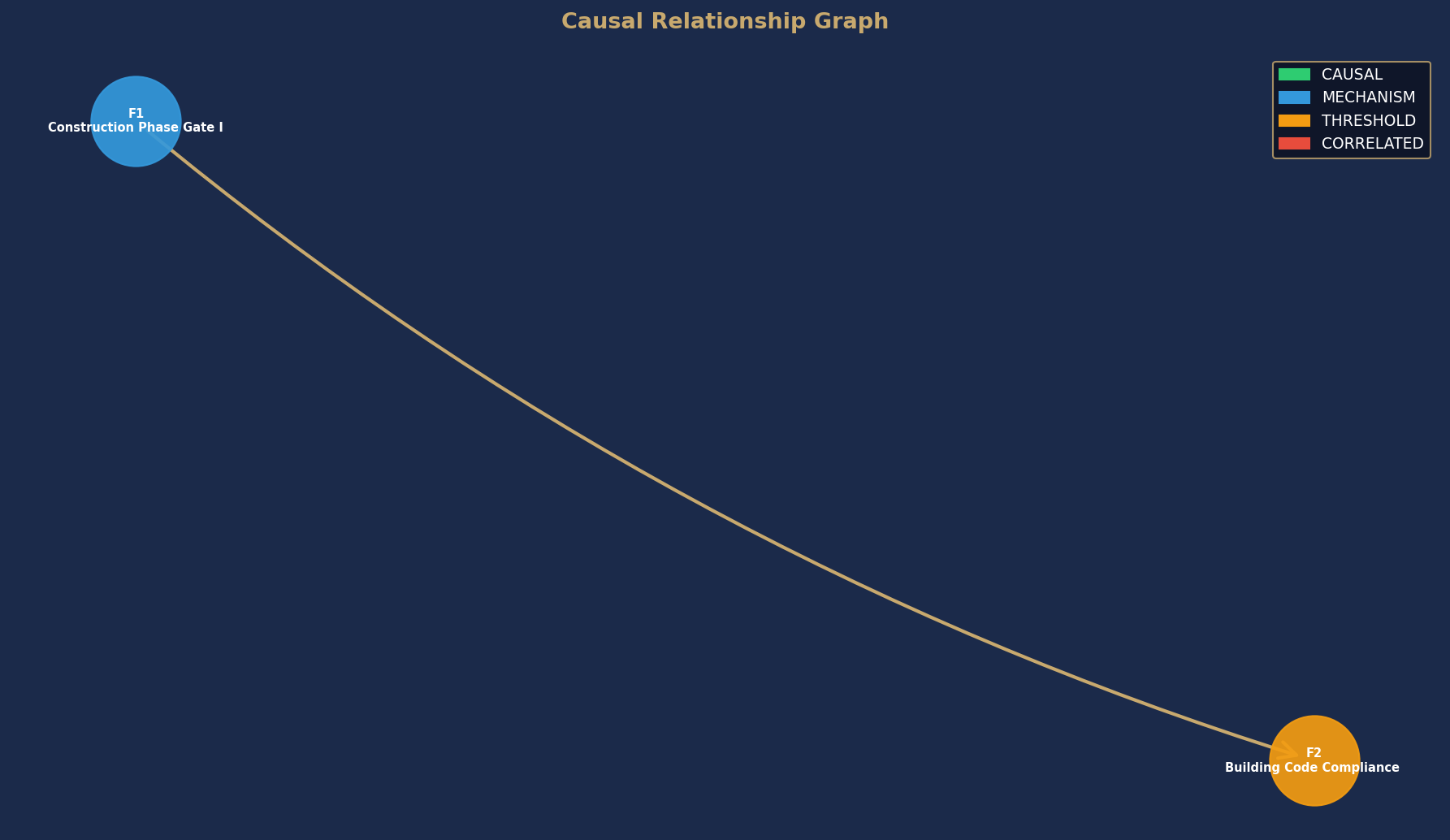
Causal Relationship Graph
Node colors indicate causal confidence rating. Arrows show directional causal relationships identified in this analysis.
Full report PDF emailed to you immediately after purchase.