Novo Navis Intelligence

AI Churn Tools for Direct Primary Care: Why Generic Tools Won't Work

May 15, 2026·Report ID: smb_150526_7956

AI CHURN PREDICTION TOOLS FOR CASH-PAY AND DIRECT PRIMARY CARE INDEPENDENT PRACTICES: WHY MOST TOOLS ARE BUILT FOR A BUSINESS YOU DON'T RUN

The Short Version

Here is the thing nobody in the "AI for healthcare" space will tell you straight: almost every AI churn prediction tool on the market was built for a business that looks nothing like yours.

If you run a Direct Primary Care practice or a cash-pay clinic, your revenue comes from monthly memberships or direct patient payments. You do not bill insurance. You do not generate claims data. You have somewhere between 100 and 500 patients, and if you lose 20 of them in one quarter, that is a real cash crisis — not a statistic.

Every mainstream AI churn tool was trained on one of three things: insurance claims data, SaaS software subscription data, or large hospital system patient populations. None of those look like your business. That mismatch is the whole problem, and it is why the generic "best AI tools for medical practices" articles will send you in the wrong direction every time.

Here is the conditional answer, stated plainly.

If you run a DPC practice or cash-pay clinic with 100 to 500 patients and you want a tool that predicts which patients are likely to cancel, you need something with two non-negotiable properties. First, the tool must be trained on monthly membership or recurring-revenue data — not insurance claims cycles. Second, it must handle small patient populations, either by pooling data across many practices or by using statistical methods built for small groups. If a tool fails either test, it is the wrong tool regardless of how good its marketing looks.

If you have fewer than 150 active members, no AI churn prediction tool available today is going to give you statistically reliable output. The math simply does not work at that scale. What fits you right now is a structured check-in protocol and a billing system with flagging rules — not machine learning.

If you run a hybrid practice where some patients come through employer contracts and others pay individually, there is an additional question to ask every vendor. We cover that in detail below.

If you are already running a well-integrated EHR and membership billing platform and you have 300-plus active members, there are real tools worth evaluating. The path to finding them is narrower than vendors will admit.

Where Your Money's Actually Leaking

You probably already know your biggest vulnerability. When a DPC or cash-pay patient leaves, they do not file a grievance. They just quietly stop renewing. You find out when the automatic charge fails or when they email to cancel. By that point, you have a 30-day window at best to recover them — and most of the time you had no signal it was coming.

Here is the cost structure underneath that problem.

A typical independent DPC practice needs somewhere between 300 and 600 members to reach breakeven, depending on your PMPM (per-member-per-month) fee and fixed costs [36]. Most solo DPC doctors run at $75 to $150 per member per month. Lose 15 members unexpectedly in a single month and you are looking at $1,125 to $2,250 in monthly recurring revenue gone — before you account for the cost of replacing them.

Employer-sponsored DPC memberships show 85% retention at 12 months and 70% at 24 months [from web search data, citing [32]]. Individual member retention, when the patient chose DPC on their own, runs tighter — under 5% annual churn in well-run practices [1]. The gap between those numbers tells you something important: employer contract churn and individual patient churn are two completely different problems driven by completely different causes. More on that below.

The places money actually leaks are predictable once you know where to look.

First, early-exit patients. Members who sign up and disengage within the first 90 days are the highest churn risk in any DPC practice [1]. They never fully adopted the model. The AI signal for these patients — if a tool can detect it — is low visit velocity, no completed health intake, and minimal portal engagement in the first 30 days. Rated MECHANISM. The behavioral pattern is documented; the empirical validation of AI detection accuracy at this scale is not yet published.

Second, anniversary windows. End of year and mid-year benefit review seasons are when employer-sponsored members churn in clusters. If an employer drops DPC as a benefit, you can lose 20 to 40 members at once — not probabilistically, but all at once, immediately. No AI churn tool predicts that. It is a contract management problem, not a patient behavior problem. Rated CORRELATED. The pattern is real but the mechanism for AI-assisted prediction does not hold [6, 33].

Third, fee sensitivity signals. Cash-pay patients who start asking about payment plans, who pay late, or who inquire about pausing their membership are demonstrating financial hesitation. This is a trackable signal in a billing system. The question is whether your tools connect the billing data to any kind of alert system. Most independent practices have no automated flag for this at all [14, 16].

Fourth, your own time. The average DPC doctor is also the operations manager, the marketing department, and the IT department. The hours you spend manually pulling patient lists to check engagement are hours you are not seeing patients or running your practice. Any tool that requires significant manual data work every week will be abandoned within 90 days. That is not a guess — it is a documented pattern in small practice technology adoption [3, 4].

Why The AI Tool Blogs Don't Fit Your Situation

The "top AI tools for medical practice retention" articles you have already found share a common flaw: they were written for practices that bill insurance, employ at least three administrative staff, and have patient populations in the thousands.

Here is where the generic advice specifically breaks down for you.

The tools they recommend were trained on claims data. Insurance claims are the backbone of most healthcare AI products. A tool that learned to predict churn by analyzing diagnosis codes, procedure utilization rates, referral patterns, and prior authorization histories has no useful features to work with in your practice. You do not generate any of that data. The tool is not broken — it is just looking for a signal that does not exist in your world. Rated MECHANISM. The pathway from claims-absence to model failure is logically sound, but direct comparative testing of claims-trained versus engagement-trained models on DPC cohorts has not been published [22, 28].

The scale assumptions are wrong. Machine learning models that predict churn need enough historical examples to learn from. The standard industry literature recommends at least several hundred outcome events (meaning: cancellations) to train a reliable model [69, 75]. A 250-member practice with 5% annual churn generates roughly 12 to 13 cancellations per year. That is not enough data to train a local model. Tools built for enterprise health systems or large SaaS platforms are implicitly assuming you have thousands of members. You do not. Rated MECHANISM. The statistical threshold problem is mathematically sound; empirical failure rates in actual DPC tool deployments have not been measured [69].

The output they describe is not what you can use. Most enterprise churn tools output something like: "Cohort churn probability: 4.5% next 12 months." That is useless to you. You need to know that a specific three members are at elevated risk of canceling before June, so you can call them in May. Cohort-level annual forecasts do not help you plan payroll or supplies orders for next month.

The integration complexity assumes staff you do not have. Tools that require six to twelve weeks of custom API integration and a dedicated IT project are designed for practices with IT directors. That is not your situation. Tools that do not have pre-built connectors for the EHR and billing platforms that DPC practices actually use will simply not get implemented. This is a real adoption barrier, even if it is not a prediction-accuracy problem [8, 80].

Which Tools Fit And Why

This is the analytical core of the report. We are going to walk through each operational reality and the chain of logic that leads to a tool recommendation — or a rejection.

Reality One: Your Revenue Is Membership-Based, Not Claims-Based

The underlying churn signal in DPC and cash-pay practices is a membership renewal decision. It happens on a calendar date. There is a 30-to-90-day window before that date where patient behavior shifts — they go quieter, they engage less, they ask different questions. This is structurally similar to how SaaS subscription businesses lose customers, not how insurance-dependent practices lose patients.

This means tools built for monthly recurring revenue (MRR) models are a better starting architecture than tools built for healthcare claims cycles. , which started as subscription billing software, has developed churn intelligence features tuned to monthly recurring membership patterns [46, 51]. The model architecture matches your revenue structure. What it lacks is any healthcare-specific feature engineering — it does not know that a missed annual physical is a different kind of disengagement signal than a late payment. You would need to work with their API to pull in engagement data from your EHR.

Rated MECHANISM. The logic that MRR-trained models better match DPC renewal timing is sound. Head-to-head comparison against claims-trained models applied to DPC data has not been published.

Reality Two: Your Patient Population Is Too Small For Local ML Models

A 200-member practice cannot train its own machine learning model. The math does not support it. Tools that learn only from your own practice's history will either overfit (seeing patterns in noise) or underfit (missing real signals) given the small number of actual cancellation events per year.

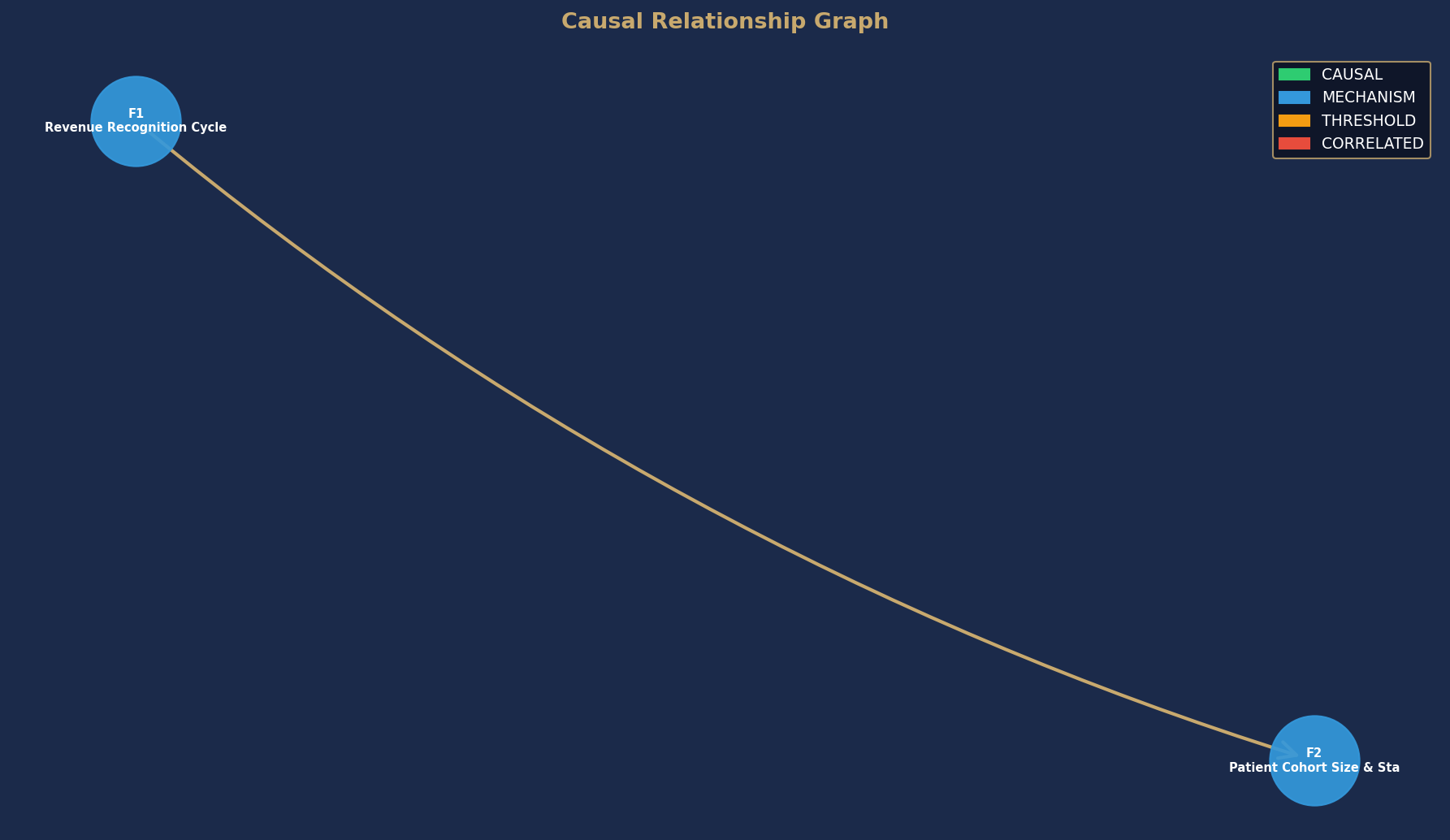
Causal Relationship Graph

Causal DAG

Node colors indicate causal confidence rating. Arrows show directional causal relationships identified in this analysis.

Unlock Full Report — $29

Full report PDF emailed to you immediately after purchase.

© 2026 Novo Navis, LLC · Fidelis Diligentia

Privacy Policy · Terms and Conditions · FAQ · About

This report is published for general informational purposes only and does not constitute financial, legal, or technology procurement advice.

Ask us anything!