AI Review Tools for Law Firms: Which One Actually Fits Your Practice
AI REVIEW AND REPUTATION MANAGEMENT TOOLS FOR LAW FIRMS: WHICH ONE FITS YOUR PRACTICE AND WHY
Your law firm has a reputation problem that isn't showing up on your profit and loss statement — yet. Right now, client reviews are scattering across platforms you don't monitor, responses are late or legally risky, and you're losing referrals to competitors who've already solved this. This report cuts through the AI noise and tells you exactly which tools actually work for law practices and which ones will waste your money.
Where Your Money's Actually Leaking
Most law firms operate without a systematic process for monitoring reviews after cases close. That means your satisfied clients aren't leaving feedback on Google, Avvo, or Martindale-Hubbell, while dissatisfied ones are. You're also responding late — sometimes weeks after a review hits — which amplifies the damage and signals to prospects that you don't pay attention to client experience. The cost here isn't just lost business; it's the compounding effect of inconsistent ratings across multiple platforms eroding your credibility.
Your responses to reviews are also legally risky. Without a compliance-aware process, you're exposing client confidentiality, waiving privilege, or making admissions you shouldn't. Generic AI tools built for restaurants and plumbers don't understand that a hostile review of a family law case can't be answered the same way a negative medical review can. You're one careless response away from an ethics complaint.
Finally, your tech stack is fragmented. You're using Clio for case management, maybe a separate practice management system, email, possibly a CRM, and no tool talks to the others. When you buy a reputation tool, it sits isolated, requiring manual data entry and creating workflow friction. Your team bypasses it. It fails. You blame the tool instead of the infrastructure.
The Tools That Actually Fit Law Firms
Six tools dominate the space right now: Harvey, Clio, Clio Duo, Thomson Reuters CoCounsel, Birdeye, and Podium. They're not interchangeable. Your firm size and practice type determine which one makes sense.
If you run a solo practice or a small firm under ten attorneys with a single practice focus — personal injury, family law, criminal defense, immigration — buy Birdeye or Podium. Both are built for legal reputation management, handle multi-platform monitoring, automate review requests without compliance violations, and cost a fraction of enterprise platforms. Clio Duo is your best option if you're already invested in Clio for case management; the integration removes friction and keeps your team using it. If you run a mid-size firm between ten and fifty attorneys with mixed practice areas, you need either a tool specialized for your primary practice area or a set of tools that actually integrate with each other. If you run a larger firm with multiple offices, Harvey is the market settlement for enterprise-grade AI — but only if you already have governance, data architecture, and process discipline in place. If you don't, Harvey will become expensive shelf ware. Thomson Reuters CoCounsel is built for corporate and transactional work, where reputation isn't built through star ratings but through directory presence and referral network relationships.
The full report breaks down the specific conditional logic for your firm, the compliance traps buried in each tool, the infrastructure gaps that will sabotage any purchase, and the implementation sequence that actually sticks.
- Every tool named and evaluated — Harvey, Clio, Clio Duo, Thomson Reuters CoCounsel, Birdeye
- Which tools fit law firms specifically and which quietly fail
- The compliance traps and implementation risks specific to your slice
- A sequenced recommendation — what to buy first, what to wait on, what to avoid
- Confidence ratings on every finding so you know what's solid
Delivered as a PDF immediately after purchase. No subscription. No upsell.
Causal Relationship Graph
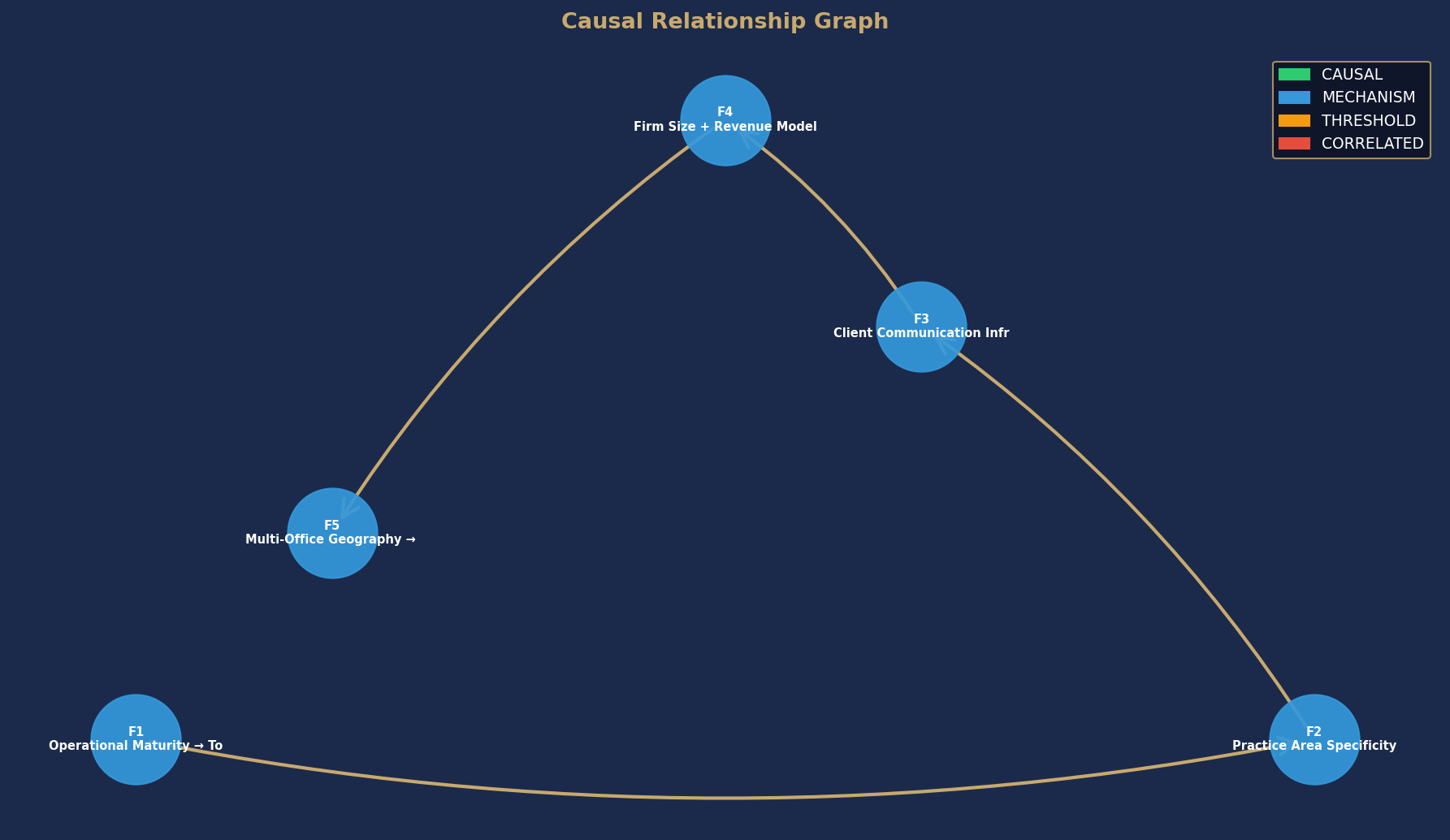
Node colors indicate causal confidence rating. Arrows show directional causal relationships identified in this analysis.
- Every AI tool named and evaluated — not placeholders, actual product names
- Which tools fit Law Firms specifically and which ones quietly fail
- The compliance traps and implementation risks specific to your practice area
- Conditional recommendations — which tool fits your specific operation and why
- Confidence ratings on every finding so you know what's solid and what needs validation
Delivered as a PDF immediately after purchase. No subscription. No upsell.
Full report PDF emailed to you immediately after purchase.