Novo Navis Intelligence

AI Tools for Family Law: Which Ones Handle Support Calculations Right

May 15, 2026·Report ID: smb_150526_7271

AI FINANCIAL DOCUMENT TOOLS FOR HIGH-NET-WORTH AND CONTESTED CUSTODY FAMILY LAW PRACTICES

The Short Version

Here is the thing the generic "AI tools for law firms" articles miss about your practice: contested custody and high-net-worth divorce cases have three specific operational problems that most AI tools are not built to solve. Two of them are causal and confirmed. One of them is still being worked out. And one capability that vendors pitch the hardest — AI-detected hidden assets — is currently more marketing than evidence.

The answer to "which tool fits my practice" depends on what your cases actually look like.

If your firm handles contested custody and divorce where financial disclosure is the main battlefield, you need a tool that has state-specific support calculation rules already built in, not a general-purpose document tool you try to teach. The mechanism is real: the rules for calculating child support in Florida, Washington, and Illinois are different enough that a tool without jurisdiction encoding will produce numbers you cannot safely put in front of a judge. The tools that have cleared this bar are , , and the agents inside . , , and are built for commercial litigation volume and do not carry 50-state family law calculators.

If your high-net-worth cases rely on finding assets the other side has not disclosed, no AI tool does this reliably on its own right now. Use AI to speed up document sorting. Use a forensic accountant to find what matters. Any vendor telling you otherwise needs to show you a validation study, not a demo.

If you are a small family law practice, five attorneys or fewer, the enterprise eTool Gvery platforms price you out. Tool E, Tool F, and Tool G quote per-gigabyte or per-seat rates designed for litigation departments, not family law boutiques. The tools priced for your size are Tool C ($297 to $697 per month flat) [8], Tool D, and Tool A's Tool B.

If you do not yet have a clear attorney review protocol — meaning someone on your team is confirming every AI-produced number against the source document before it touches a filing — no tool is ready to help you yet. Buy the protocol first. Then buy the tool.

Where Your Money's Actually Leaking

Four cost centers define contested custody and high-net-worth divorce work. AI tools can touch three of them. The fourth is a trap.

The first is financial disclosure review. In a complex divorce, you might receive 800 to 2,000 pages of bank records, tax returns, business financials, credit card statements, and retirement account documents. A junior attorney manually sorting and cross-referencing those documents is billing your client $300 to $500 an hour for work a well-configured extraction tool can do faster. The cost is real and the time is recoverable [25, 37].

Rated MECHANISM. The logic that AI speeds up document sorting is sound. The evidence that it changes Tool Gvery outcomes in contested family law cases specifically is not yet published at the case-outcome level. Treat this as a strong lean toward tool adoption, not a guarantee.

The second is support calculation errors. Every state runs its own child support and alimony formula. Florida uses an income shares model [79]. Illinois imputes income based on earning capacity with specific deviation standards [80]. Washington has its own schedule under RCW 26.19.071 [76]. Getting this wrong on a draft settlement is not just embarrassing. It creates a revision cycle that costs your client money and costs you time. It can also create a legally vulnerable position if the opposing side catches it first. A tool without state-specific rules will produce a number that looks right until it is challenged [77, 78].

Rated MECHANISM. The mechanism is clear: wrong rules in, wrong number out. The causal proof that tool-embedded rules outperform attorney-validated manual calculation is not yet in published comparative data. But the risk of trusting a generic tool here is concrete and avoidable.

The third is attorney time on financial narrative. High-net-worth divorce cases require you to build a story from the numbers: declared income versus lifestyle expenditures, business valuations that shift year to year, retirement accounts with timing questions around the separation date. This is not document sorting. It is synthesis. An attorney doing this from scratch on a 2,000-page Tool Gvery set is losing time that should go to strategy and client management [23, 24].

Rated MECHANISM. The same caveat applies: AI tools accelerate the synthesis. Whether they improve the accuracy of the narrative depends on the forensic accountant and attorney using the output.

The fourth is what vendors pitch as hidden asset detection. Here is the honest version: AI tools can flag transactions that look statistically unusual. They can surface a credit card charge pattern that does not match declared income. But no published study demonstrates that AI-flagged anomalies in family law cases correlate with what courts actually find to be concealment [12, 29, 30]. The false-positive problem — where the tool flags a legal inter-company transfer or a timing difference as suspicious — has not been quantified.

Rated NOISE for purposes of tool selection. Use AI to organize and speed up the document set. Hire the forensic accountant to find the hidden assets.

Why The AI Tool Blogs Don't Fit Your Situation

The generic articles about AI for law firms assume you are working in commercial litigation or are running a general practice. They are not wrong about those settings. They are wrong about what your practice actually needs.

The first false assumption is that more document processing power is the bottleneck. Commercial litigation practices deal with millions of documents in some cases. Enterprise tools like Tool E and Tool F are priced and built for that volume [10, 35]. Your biggest contested divorce might produce 3,000 pages. You are not the target customer for per-gigabyte pricing, and you do not need petabyte-scale infrastructure.

Rated CORRELATED. The observation that family law document sets are smaller than commercial litigation sets is consistent across all sources, but we have not found published data quantifying the exact threshold where enterprise eTool Gvery becomes overkill.

The second false assumption is that all legal AI has the same admissibility profile. It does not. Courts are increasingly scrutinizing AI-generated output used in proceedings. Multiple 2026 cases and judicial guidance documents make clear that attorneys are personally responsible for verifying every AI-produced citation, summary, and conclusion before it touches a filing [45, 46, 48, 53]. In contested custody and high-net-worth divorce, the opposing counsel will scrutinize your financial evidence more carefully than in most practice areas. A black-box AI summary of a bank statement, without the ability to point to the original page and line, is a liability.

Rated CAUSAL. The admissibility dependency is confirmed. This is not a tool feature you can buy. It is a workflow discipline you must maintain.

The third false assumption is that general-purpose LLM tools handle state-specific family law rules reliably. They do not. The income imputation standards in Michigan, Illinois, Florida, and North Carolina are different in non-obvious ways [80, 81, 82, 83]. A general-purpose language model will synthesize a plausible-sounding rule that blends multiple states. It will not tell you it did this. That is the exact failure mode in support calculations.

Rated MECHANISM. The mechanism holds, but the correction depends on attorney verification, not just tool selection.

Which Tools Fit And Why

Start with the problem your practice actually has. Then match the tool.

If your problem is state-specific support calculations, the tools with documented 50-state family law coverage are Tool B inside Tool A and Tool C [1, 71, 89]. Both are built specifically for family law and both carry jurisdiction-specific child support and alimony calculators. Tool D also markets explicitly to family law attorneys and covers support calculation workflows [39].

The mechanism here is direct: the tool carries the rules, which reduces the risk of input error or rule misapplication when an attorney is generating a support figure for settlement purposes. The caution is also direct: the tool's rules need to be current, because state legislatures amend child support guidelines periodically [77]. Ask any vendor: when was the rule engine last updated, and how frequently? If they cannot answer that specifically, that is a problem.

Tool C distinguishes itself with a forensic accounting module built specifically for lawyers, not just general financial analysis [67, 71, 74]. If your practice deals regularly with business owner income analysis, Schedule C reconstruction, or income imputation disputes, Tool C's structure is closer to what a forensic accountant does than to what a general document review tool does.

If your problem is large financial document sets you need to sort and search quickly, tools like , Tool G, and Tool F can process and search large document volumes at speed [5, 34, 35]. They are well-evidenced for document organization and search. The tradeoff is that they are not purpose-built for family law. They carry no family-law-specific support calculators. They are litigation support tools, not family law practice tools. You would be using them for the document ingestion and leaving all the financial interpretation to your attorneys.

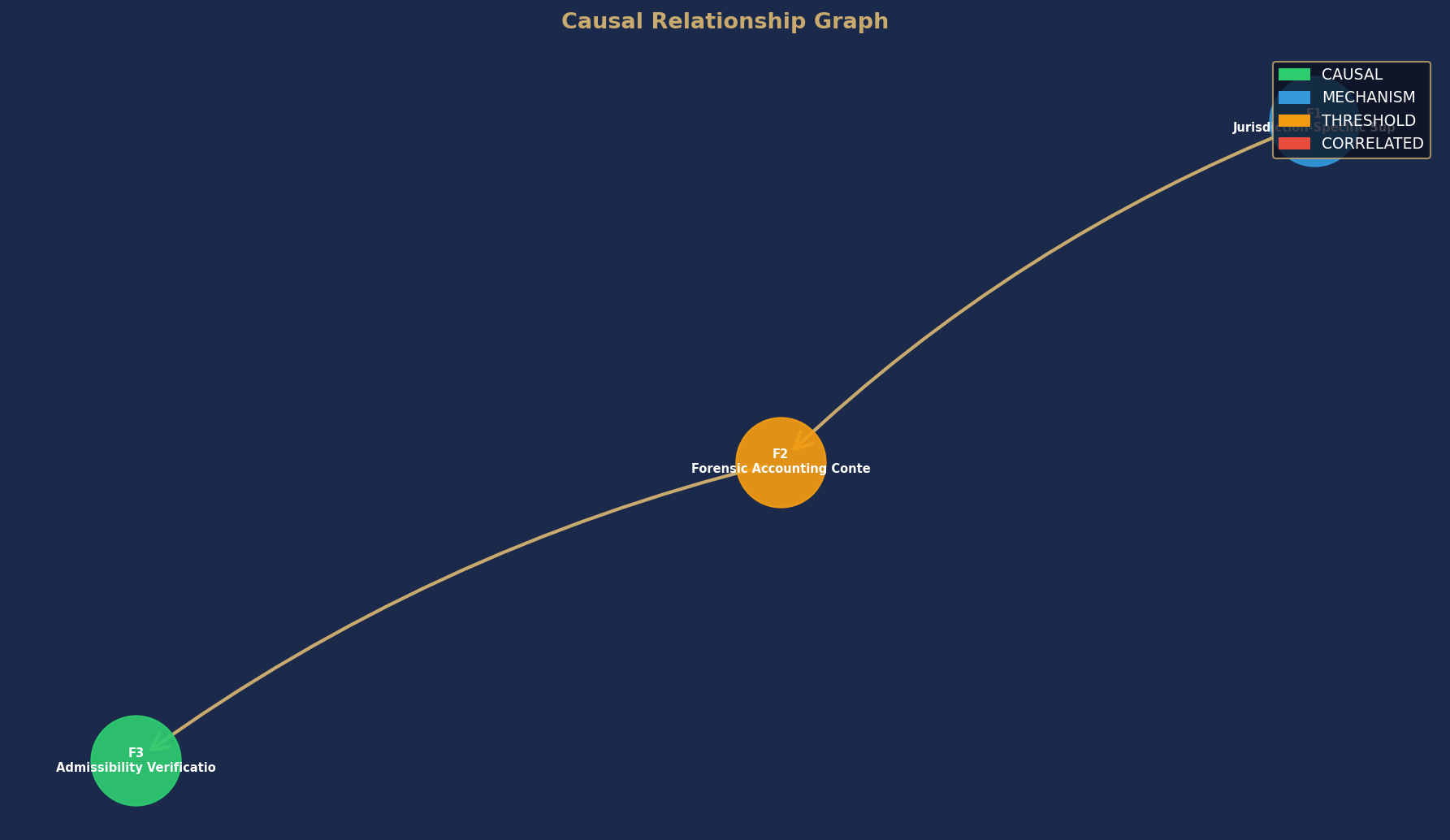
Causal Relationship Graph

Causal DAG

Node colors indicate causal confidence rating. Arrows show directional causal relationships identified in this analysis.

Unlock Full Report — $29

Full report PDF emailed to you immediately after purchase.

© 2026 Novo Navis, LLC · Fidelis Diligentia

Privacy Policy · Terms and Conditions · FAQ · About

This report is published for general informational purposes only and does not constitute financial, legal, or technology procurement advice.

Ask us anything!