AI Tools for VRF Retrofit Contractors: Which Actually Work On Your Jobs
VRF AND HEAT PUMP RETROFIT CONTRACTORS: WHICH AI TOOLS FIT SALES ENGINEERING AND LOAD CALCULATION — AND WHICH ONES WILL BURN YOUR MARGIN
The Short Version
If you specialize in VRF and heat pump retrofits for commercial buildings, the AI tool advice you have been reading was written for someone else. It was written for a residential HVAC shop with high call volume and simple swap-out jobs. It was not written for you.
Here is what the generic advice misses. Your work is fundamentally different from a new-construction install or a residential replacement. Every building you walk into has a surprise: a 200-amp panel that is already full, a mechanical room the size of a closet, a building automation system from 2003 that nobody has documentation for, or insulation that somebody added piecemeal over thirty years. None of these variables appear in the typical AI tool's logic. The tool calculates the load, spits out a system spec, and you look at the proposal thinking, "This won't work in that building" — and you are usually right.
That gap is the core problem. Most AI tools on the market right now are load calculation engines dressed up with proposal generators. They work reasonably well for new construction because the building is predictable. On a retrofit, the building is not predictable. The AI does not know that. You do.
Here is the conditional answer up front.
If you are doing fewer than four or five commercial VRF proposals a month, the tools worth your time right now are paired with a structured pre-visit checklist you build yourself, and or for faster load estimation on smaller jobs. They are not perfect for your work, but they are honest about what they do and do not cost you a fortune.
If you are doing eight to fifteen or more commercial VRF proposals a month and your team includes at least one person dedicated to estimating, then Coolsoft HAP (Hourly Analysis Program) for the load and energy modeling, and for the proposal generation side, is the combination that comes closest to fit-for-purpose right now. Neither was built specifically for VRF retrofit, but together they handle the pieces that matter most.
If you are expecting an AI tool to screen building feasibility for you — check the panel, flag refrigerant routing problems, estimate subpanel upgrade costs, tell you whether a building is a good candidate before you spend three hours on-site — that tool does not exist yet in a form built for your slice. You still have to build that screening into your own pre-visit process.
What none of these tools do well: VRF part-load modeling that accounts for zone diversity and compressor modulation across outdoor temperature ranges. That capability exists in research-grade tools and in manufacturer design software from Mitsubishi Electric (Diamond Designer) and Daikin (VRV Design Tools). Those manufacturer tools are free and are the closest thing to VRF-native calculation available to you right now.
Read this section and you have the answer. The rest of the report explains the mechanics.
Where Your Money Is Actually Leaking
The commercial VRF retrofit business has four places where time and money disappear. Two of them are costing you right now regardless of whether you use any AI tool at all.
The first is pre-proposal site time on buildings that do not close. A typical commercial VRF estimate requires two to four hours on-site before you can build a credible proposal. You are checking panel capacity, tracing existing ductwork, figuring out where the outdoor units can go, photographing nameplates, and measuring spaces. If you close twenty-five percent of those proposals, you are spending six to twelve hours in dead site time for every job you land. At a loaded cost of $75 to $100 per hour for your or your estimator's time, that is $450 to $1,200 in unrecovered cost per closed deal before you turn a single wrench. [11, 73]
The second leak is oversizing and undersizing. VRF systems cost $15,000 to $50,000 installed on light commercial applications. [5] A proposal that is wrong by ten to fifteen percent in either direction creates a problem. Oversize, and the customer balks at the price or the system short-cycles and costs you a service callback. Undersize, and you get a comfort failure call in January or August, and you are eating a compressor diagnostic and possibly a refrigerant re-charge. One warranty callback on a commercial job can run $1,500 to $4,000 in parts and labor. On a deal with a five to eight percent margin, that wipes the margin on two or three projects. [7, 25]
The third is the infrastructure surprise. VRF systems are more sensitive to existing building conditions than any other commercial HVAC technology. The outdoor unit's compressor demands a dedicated circuit. Refrigerant line routing through an existing building can easily add $4,000 to $8,000 in labor if the path is difficult. A building automation system that the customer expects you to integrate with can add another $3,000 to $6,000. A panel that needs a 60-amp dedicated breaker when there are only 20 amps available means a subpanel upgrade that was not in your bid. [5, 40, 57] When that surprise shows up after you have signed the contract, you absorb it or you have a dispute. Neither is good.
Rated MECHANISM. The logic connecting infrastructure gaps to proposal failure and margin loss is solid. The specific dollar amounts above are derived from industry cost ranges, not a controlled study on your specific jobs. Treat these as reasonable estimates, not exact figures.
The fourth leak is rebate and incentive complexity. Heat pump retrofits currently qualify for federal tax credits and utility rebates that can reduce customer out-of-pocket cost by twenty to forty percent, which is often the difference between a yes and a no. [74] But the eligibility rules vary by jurisdiction, by equipment type, by installation method, and by utility territory. If your proposal misses an available incentive, the customer does not know what they left on the table — but a competitor who caught it will win the next deal. Tracking this manually takes real time, and none of the load calculation tools do it for you automatically.
Rated MECHANISM. Incentive tracking clearly drives proposal competitiveness. The exact conversion rate improvement is not measured in available research.
Why The AI Tool Blogs Do Not Fit Your Situation
The "AI for HVAC contractors" articles you have seen make three assumptions that do not hold for your operation.
First, they assume your jobs are mostly residential replacements or light commercial with predictable building envelopes. The advice is shaped around that job type. An AI proposal tool that works great for swapping a rooftop unit on a strip mall does not help you when you are proposing a twelve-zone VRF system in a 1970s office building with mixed-use floor plates and three different owners of record. The tools in those listicles were not built for that.
Second, they assume your volume is high and your unit price is low. Tools like 's proposal features and are designed for a shop that does dozens of jobs a week, mostly residential, where the value of a tool is generating proposals fast and capturing after-hours leads. [17, 18] Your commercial VRF work may involve eight to twelve proposals a month, each worth $20,000 to $80,000. You do not need to generate proposals fast. You need proposals that are right, and that survive a facilities manager's scrutiny.
Rated MECHANISM. The mismatch between residential-oriented AI proposal tools and commercial VRF estimating workflows is structurally clear. No controlled comparison of close rates or margin outcomes between tool types is available in current research.
Third, the generic advice treats load calculation as a solved problem. It is not solved for your work. Standard Manual J is a steady-state calculation — it figures out the peak load at the worst outdoor conditions and sizes equipment to that peak. [21, 64] VRF systems do not operate primarily at that peak. They operate at part-load conditions most of the time, modulating compressor speed across a range of outdoor temperatures and zone demand combinations. [25, 27] A tool that calculates steady-state peak correctly can still produce a spec that leads to comfort complaints in real-world operation, because the system was sized to the peak without accounting for how it actually behaves at fifty percent load on a mild day with three zones calling simultaneously.
Rated MECHANISM. The part-load modeling gap is mechanically sound — the engineering literature confirms VRF behavior is fundamentally different from fixed-capacity equipment. [27, 48] Field failure data comparing warranty rates for VRF systems sized with generic tools versus VRF-native tools is not yet published in the research available for this report.
The bottom line: the generic advice was not filtered through your actual problem. This report is.
Which Tools Fit And Why
Here is how to think through each piece of your sales engineering and load calculation workflow, and which tools address each piece.
The load calculation problem. You need Manual J or equivalent methodology as the starting point, with inputs that account for existing building conditions — real infiltration rates in an older building, solar exposure through aged single-pane windows, thermal mass of concrete floor slabs. The calculation needs to produce a number you can defend in a permit submission and that reflects the actual building, not a theoretical new-construction equivalent.
Tool A handles this better than most. It runs full Manual J/S/D, allows custom infiltration inputs, and produces permit-ready documentation. [65] It is not cheap — pricing runs around $100 to $200 per month depending on tier — and it has a learning curve. But it gives you a calculation you can stand behind. [68] It does not, however, natively model VRF part-load behavior. You will still need to apply a manual modulation margin to its output.
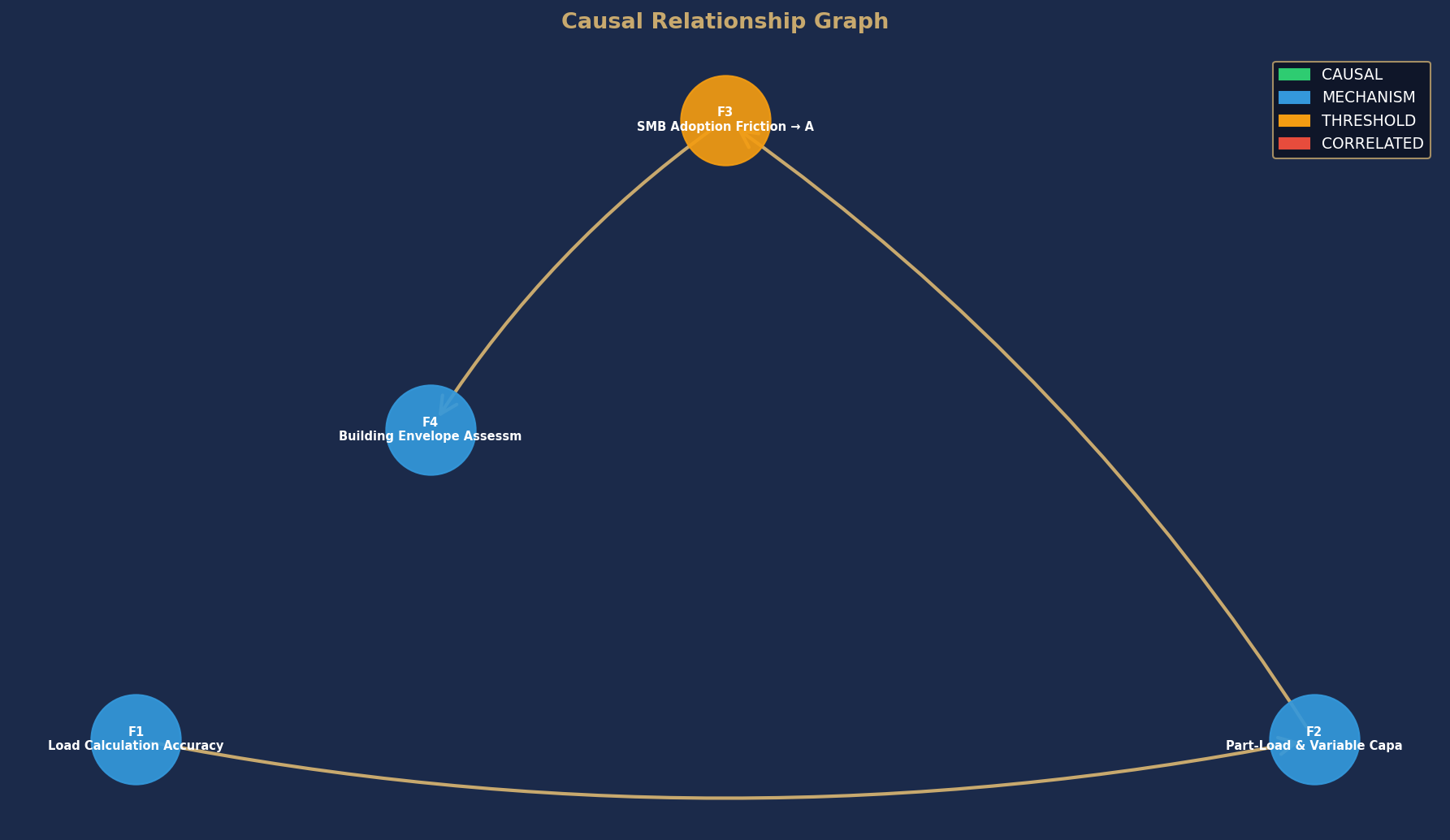
Causal Relationship Graph
Node colors indicate causal confidence rating. Arrows show directional causal relationships identified in this analysis.
Full report PDF emailed to you immediately after purchase.