AI Call Answering for HVAC: Which Tool Actually Fits Your Shop
AFTER-HOURS AI CALL ANSWERING FOR HVAC CONTRACTORS: WHICH TOOL FITS WHICH SHOP
You're losing thousands of dollars every month to calls that ring after 5 PM and on weekends. Your customers are calling competitors instead. And when you do deploy AI call answering, the wrong tool is routing jobs incorrectly, missing technical details, and sending your technicians out on non-viable service calls. This report identifies which of the ten most-used platforms actually work for your specific HVAC operation — and which ones will waste your time and money.
Where Your Money's Actually Leaking
HVAC contractors lose between $45,000 and $120,000 annually to unanswered after-hours calls — and peak-season shops can lose up to $300,000. Here's why it matters: 35 to 45 percent of service calls come in outside your business hours, exactly when emergency situations are most critical. A furnace failure at 10 PM on a winter night or an AC breakdown on a summer weekend is when customers are most willing to pay premium rates and sign maintenance agreements. When those calls go unanswered, 85 percent of customers do not call back. They call your competitor instead.
But unanswered calls are only half the problem. When you deploy the wrong AI call answering tool, it answers the phone — but then routes the job incorrectly, misses critical technical details, or fails to integrate with your dispatch system. The result is your technician gets sent to a job that should have gone to a different crew, or arrives without the information needed to diagnose the problem. That's a callback. A single misrouted callback costs you $150 to $1,200 depending on your service area and truck-roll economics. Multiply that across 10 or 20 calls per month, and you're hemorrhaging money on top of the initial revenue loss.
The Tools That Actually Fit HVAC Contractors
The market has ten viable platforms: ServiceTitan, Housecall Pro, Allo, LeadTruffle, Smith.ai, CallRail, Speechly, Voiceflow, AgentZap, and FieldEdge. But they do not all work for all HVAC shops. The fit depends entirely on what you do.
If you run a residential generalist operation — standard tune-ups, seasonal maintenance, basic service calls — plug-and-play tools like Allo, LeadTruffle, ServiceTitan's native AI, or Housecall Pro's AI work because your intake workflow is simple: three to four questions, book the appointment, done. These platforms handle standard scenarios out of the box. If you run specialty residential work — geothermal systems, ductless mini-splits, high-efficiency equipment — you need deeply scriptable platforms like CallRail, Speechly, Voiceflow, or AgentZap because your intake questions are conditional. A geothermal call requires EPA knowledge and a different dispatch path than a standard furnace repair. Generic tools lack that logic.
If you run commercial HVAC, dispatch system integration matters more than the AI tool itself. ServiceTitan and FieldEdge integrate directly with dispatch; choosing the right tool means routing calls to the correct queue the first time, preventing expensive callbacks. If you run commercial refrigeration or HVAC-R, stop here: generic tools will fail at the call stage. These operations require EPA compliance, refrigerant knowledge, and technically complex scripted workflows that most platforms cannot deliver. You either need a platform built for your vertical or a consultant to configure one.
The implementation sequence, the specific compliance traps for HVAC contractors, the risk matrix for each tool, and the detailed workflow maps for every operation type are in the full report.
- Every tool named and evaluated — ServiceTitan, Housecall Pro, Allo, LeadTruffle, Smith.ai
- Which tools fit HVAC contractors specifically and which quietly fail
- The compliance traps and implementation risks specific to your slice
- A sequenced recommendation — what to buy first, what to wait on, what to avoid
- Confidence ratings on every finding so you know what's solid
Delivered as a PDF immediately after purchase. No subscription. No upsell.
Causal Relationship Graph
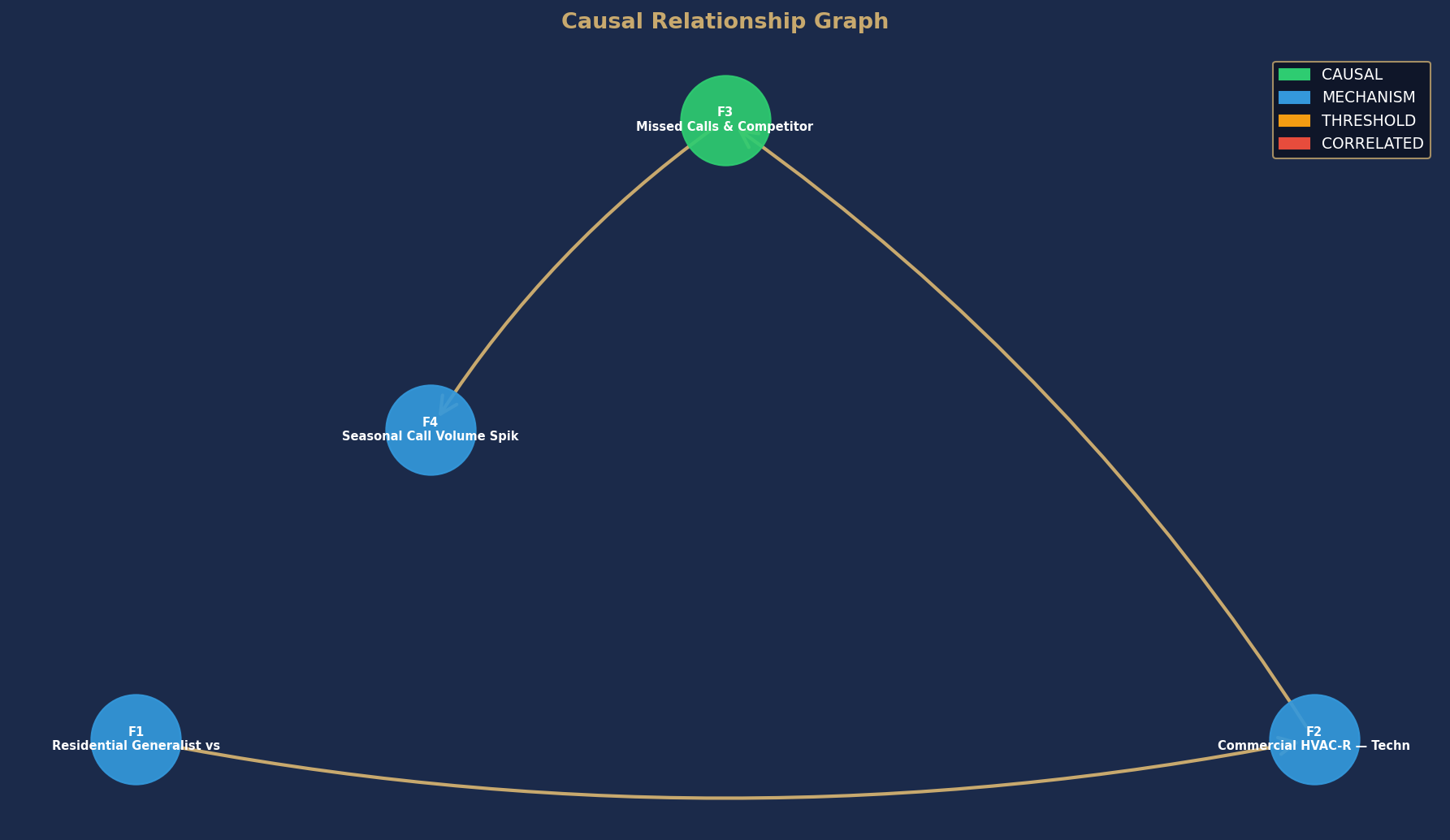
Node colors indicate causal confidence rating. Arrows show directional causal relationships identified in this analysis.
- Every AI tool named and evaluated — not placeholders, actual product names
- Which tools fit HVAC Contractors specifically and which ones quietly fail
- The compliance traps and implementation risks specific to your practice area
- Conditional recommendations — which tool fits your specific operation and why
- Confidence ratings on every finding so you know what's solid and what needs validation
Delivered as a PDF immediately after purchase. No subscription. No upsell.
Full report PDF emailed to you immediately after purchase.