AI Compliance Tools for Cold-Chain Pharma Operators: What Actually Fits
AI COMPLIANCE TOOL SELECTION FOR COLD-CHAIN PHARMACEUTICAL AND VACCINE FREIGHT OPERATORS
The Short Version
Here is the thing the generic AI articles won't tell you: the compliance problem you face is not primarily a temperature problem. It is a documentation and traceability problem that temperature monitoring feeds into. And the tools built for standard reefer freight — produce, chemicals, frozen food — were not designed with your documentation requirements in mind. When an FDA or EMA auditor walks into your operation, they are not checking whether your temperatures were perfect. They are checking whether you can prove your temperatures were acceptable, prove which lots were where, and prove who made what decision when. Those are three different problems. Most tools only solve one.
If you are a cold-chain operator moving biologics, vaccines, or temperature-sensi drugs across multiple legs and multiple jurisdictions, here is the conditional answer up front.
If you move product that must stay between 2°C and 8°C or colder, and you are covered under DSCSA (which means you are a U.S. manufacturer, wholesale distributor, or dispenser), you have a hard legal deadline. By November 2026, you must be exchanging lot-level data in EPCIS-formatted electronic records with your trading partners. If your current monitoring platform cannot export in that format and tie lot numbers to shipment records, you are already behind. This is not an AI-specific requirement — it is a data-format requirement — but the practical answer is that most platforms that meet it were built for pharmaceutical logistics, not commodity reefer.
If you move mRNA vaccines or other ultra-cold products (-20°C or -70°C), standard reefer tools will miscalibrate your risk. A product with a 2°C tolerance excursion window for two hours at -70°C is not the same problem as lettuce going above 40°F. The tools that understand potency-loss curves, product-specific stability windows, and how to calculate actual exposure versus allowable exposure are specialized. Generic tools set a single alert threshold. That will either wake your team up constantly on false alarms, or miss the events that matter.
If you do not yet have clean, documented handoff records at each transfer leg with temperature verification, an authorized signature, and a timestamp — do not buy any AI tool yet. That operational discipline has to exist first. A tool will not create it for you. It will only automate it once you have defined it.
The rest of this report explains why, with evidence.
Where Your Money's Actually Leaking
The industry-level number most often cited is that temperature excursions cause approximately $35 billion in annual pharmaceutical product losses globally [26]. Your piece of that depends on what you ship, but even at the operator level, a single recalled lot of biologics can run six figures in product write-off, plus investigation costs, plus the time of your qualified persons and operations staff.
But product loss is not where most small and mid-size cold-chain pharma operators actually feel the pain day to day. The more immediate cost is compliance labor.
Here is what that looks like concretely. Your driver completes a multi-leg delivery. You have a temperature logger in the trailer. Three days later, a customer calls with a potency question or a regulatory inspector asks for chain-of-custody documentation on that shipment. Someone on your team now has to pull the logger data, match it to the shipping manifest, identify which lot numbers were on that truck, cross-reference the receiving logs at each stop, and reconstruct the timeline. If everything is in separate systems — logger here, manifest there, lot tracking in another spreadsheet — that reconstruction takes hours or days. If it takes too long, or if any piece is missing, you have a documentation failure. Documentation failures are the second-most-common audit citation for cold-chain operators after equipment failures [domain expertise, 41].
Regulatory requirements are tightening. As of January 2026, enforcement of cold-chain monitoring requirements has increased across both FDA and EMA jurisdictions, with regulators demanding greater visibility, traceability, and documented temperature control across each transfer point [40]. DSCSA, the U.S. Drug Supply Chain Security Act, became fully enforceable for most operators in November 2024, with the final deadline for smaller dispensers in November 2026 [76, 78]. EU Falsified Medicines DirecTool F enforcement is similarly mature [34].
What this means practically: you are legally required to track products to the serialized unit level and exchange that data electronically with your partners. If your systems cannot generate an EPCIS-formatted transaction record for every lot you handle, you are non-compliant today [78]. This is rated CAUSAL. The enforcement mechanism is operational and the deadline is law. The causal chain is direct: non-compliance with DSCSA data-exchange requirements causally leads to supply disruption because wholesalers — Cardinal Health, McKesson, AmerisourceBergen — have already migrated their systems and will reject non-compliant trading partners [80].
A second cost driver is excursion investigation. When a temperature deviation occurs, you do not just fix the equipment and move on. You must assess product impact. That means determining the excursion duration, the severity, the product's stability profile, and the lot numbers involved. Then a qualified person must make a documented disposition decision [22, 27]. If your monitoring tool gives you a raw temperature graph but not a potency-impact estimate for the specific product that was on that truck, your team is doing that calculation manually. Every time. That is expensive labor on something a tool could handle — if the tool was built for pharmaceuticals, not for shipping bananas.
Third cost driver: alert fatigue. If your monitoring system does not distinguish between mRNA vaccine cargo (tolerates almost nothing) and traditional biologic cargo (tolerates more), it will alarm on the same rule for both. Your team will start ignoring alerts. One of the things they ignore will matter. This is a real operational pattern, and it is rated MECHANISM — the logic is clear, the empirical confirmation from peer-reviewed studies is not yet definiTool F, but the mechanism is sound [2, 24].
Fourth: multi-leg handoff gaps. Every time product changes hands — from your warehouse to a carrier, from a carrier to a regional hub, from a hub to a hospital receiving dock — there should be a documented temperature verification, a signature from an authorized person, and a time-stamped record [41, 43]. In practice, for many operators, this is a paper form that gets filed, sometimes incompletely, and becomes very hard to reconstruct eighteen months later when an audit occurs. This is rated CORRELATED because, as the adversarial review of this report's analysis confirmed, manual systems with proper discipline can still be compliant. The tool helps, but the discipline is what determines compliance, not the format.
Why The AI Tool Blogs Don't Fit Your Situation
The "AI tools for cold-chain logistics" articles you have already read were almost certainly written for generic reefer operations or for food safety logistics. They fail your situation for three specific reasons.
First, they treat temperature monitoring as the endpoint. For a produce shipper, it is. If the lettuce stays cold, you are done. For you, temperature monitoring is the input to a compliance documentation process that has to produce an auditable record, tie back to specific lot numbers, and be signed off by a qualified person under GxP requirements [42, 44]. The generic article does not know that 21 CFR Part 11 exists or that it governs how your electronic records must be stored, accessed, and signed. It does not know that EMA Annex 11 applies to your computerized systems. Tools built for produce don't carry those compliance features as standard.
Rated MECHANISM. The regulatory architecture divergence is real and the mechanism is clear. What we have not yet seen widely documented are enforcement actions citing generic-tool non-compliance specifically, but the regulatory text is in force now [50, 58].
Second, generic advice assumes your compliance problem is speed. "Real-time alerts" and "instant dashboards" are the selling points. Your actual problem is auditability — being able to reconstruct, months later, exactly what happened and what decisions were made. A real-time dashboard that does not write to an immutable, time-stamped, access-controlled audit log is operationally impressive and compliance-useless [4, 52].
Rated MECHANISM for the same reason above.
Third, and this is the one that will cost you real money if you miss it: generic advice does not account for product stability stratification. The advice assumes you are shipping one type of cold cargo. You are probably shipping multiple product types with different stability windows — traditional vaccines at 2-8°C, some oral biologics at 15-25°C, and potentially mRNA products at -70°C. Each of those has a different potency-loss curve when an excursion occurs. A tool that does not know the difference between those products cannot tell you whether a two-hour excursion at -65°C on your mRNA shipment matters or whether a four-hour excursion at 10°C on your 2-8°C product matters. You need a tool that knows the product profile, not just the temperature threshold [2, 29].
Rated MECHANISM. The operational logic is clear. Quantified evidence comparing alert fatigue rates between stratified and non-stratified systems in pharma distribution is not yet in the published literature.
Which Tools Fit And Why
Here is the honest state of the market as of May 2026. There is no single tool that handles every layer of this problem perfectly. There are strong tools for specific layers. You need to understand the layers, then figure out whether you need one integrated platform or two complementary ones.
Layer 1: Serialization and DSCSA Traceability
This is the non-negotiable layer. Your DSCSA clock is running. The causal rating here is CAUSAL — the enforcement mechanism is operational and the deadline is law [76, 78].
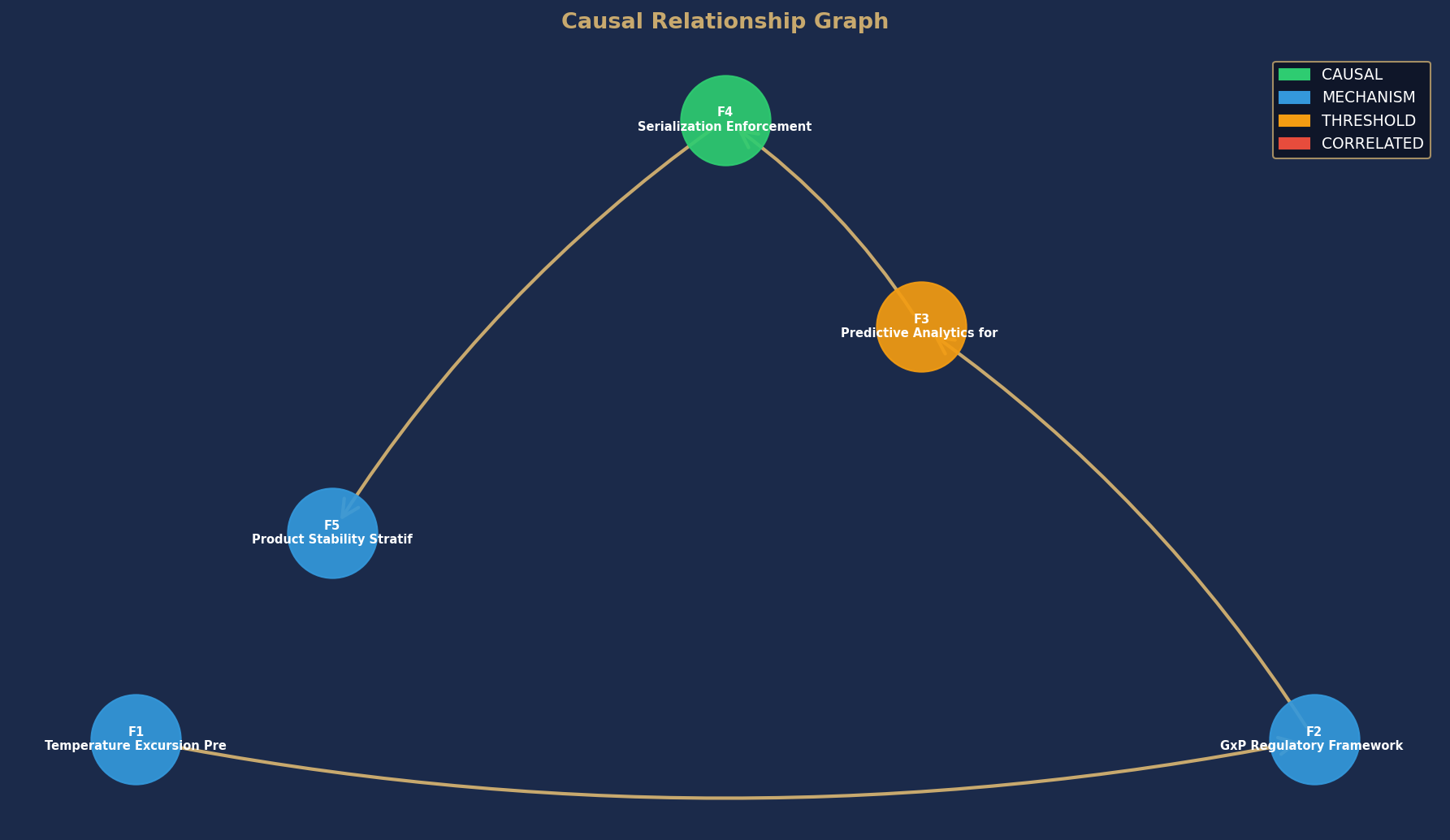
Causal Relationship Graph
Node colors indicate causal confidence rating. Arrows show directional causal relationships identified in this analysis.
Full report PDF emailed to you immediately after purchase.