Novo Navis Intelligence

AI Quote Tools for EV and Hybrid Repair Shops: What Actually Works

May 15, 2026·Report ID: smb_150526_6822

AI ESTIMATE AND QUOTE TOOLS FOR EV AND HYBRID REPAIR SPECIALISTS: BATTERY AND DRIVETRAIN FOCUS

The Short Version

If you run a shop that focuses on EV and hybrid battery and drivetrain work, the generic AI estimating tools being sold to auto repair shops right now are not built for you. That is not an opinion. It is a structural problem with how those tools were built — on ICE repair databases, ICE labor codes, and ICE fault logic. That foundation does not carry over.

Here is what this report says in plain terms.

If your shop does battery diagnostics as the core of the job — testing cell health, reading thermal patterns, evaluating state-of-charge curves before you even touch a wrench — the tool that fits you has to ingest that diagnostic data before it builds a quote. Without that, the labor estimate is a guess. Battery replacements can run anywhere from under two hours to over six hours of actual work, depending on pack condition. [57] [58] Flat-rate tables do not know that. A tool that cannot read your diagnostic data cannot close that gap.

If your shop also does drivetrain work — inverters, motors, regenerative systems — you need a tool that understands EV systems are interdependent. A fault in the inverter shows up in motor current harmonics. A motor thermal problem bleeds into regenerative braking behavior. The tool that fits this work has either been explicitly trained on EV-specific fault patterns, or it has explicit conditional logic built in for those interdependencies. A tool trained on half a million ICE repair records will still get this wrong.

If you do any high-voltage work at all, your tool selection has a legal dimension. Technician certification, OEM warranty implications, and manufacturer data access restrictions are not optional checkboxes. A tool that ignores all three exposes your shop. We rated this finding CAUSAL — the evidence is solid and you can act on it.

Here is the honest conditional answer up front.

If your shop is primarily battery diagnostic and replacement, from Electra Vehicles is the closest commercial fit we found, but only for the battery side. Drivetrain coverage and compliance automation are not confirmed from available sources.

If your shop is integrated battery plus drivetrain, no single tool in the current market clearly covers all three requirements. You are likely running a combination: a specialized EV diagnostic platform (Autel's EV-focused scanners lead this hardware category) feeding data into a shop management system, with quote generation assembled from that output. That is a workflow, not a single tool — and it takes deliberate setup.

If you do not yet have a clear diagnostic workflow with HV-rated equipment and certified technicians, do not buy any AI estimating tool yet. Fix the diagnostic foundation first. The estimating tool is only as good as the data it gets.

Where Your Money Is Actually Leaking

The core money problem in your shop is quote variance. You write an estimate, then you do the job, and the hours do not match. On EV and hybrid battery and drivetrain work, that gap is wider than almost any other repair category.

Battery replacement labor, in practice, runs from under two hours to more than six. [57] [60] The difference is driven almost entirely by what you find during diagnostics — pack condition, cell balance state, thermal profile, connector integrity. A pack that looks like a $4,000 replacement job from a customer description can turn into a $9,000 job once you have actual cell-level data in front of you. Or the reverse: a customer expecting a full pack replacement sometimes only needs module work. Flat-rate labor tables do not see any of that. They assign a number based on vehicle model and year, and that number is wrong by 40 to 60 percent in this segment more often than not. [57]

Rated MECHANISM. The logic checks out — diagnostic input depth should reduce that variance — but there is no published head-to-head comparison of a tool with full HV diagnostic inputs against one without on real shop jobs. You will need to validate this in your own bay. We will tell you how later in this report.

Drivetrain diagnostics are where you burn the most unbillable hours. Electric motor, inverter, and regenerative braking system faults do not show up in isolation. [86] [89] [90] An inverter thermal problem degrades motor current limits, which changes what the regenerative system can do, which affects what the customer describes as a braking complaint. If you chase the symptom without mapping the system, you diagnose the wrong component. That means a callback, a redo, or a job you absorb. Research on AI-driven EV drivetrain fault diagnosis shows that causal or physics-aware approaches consistently outperform symptom-to-code matching on this class of problem. [89] [93]

Rated CORRELATED. The pattern is real — EV drivetrain diagnostics behave differently from ICE diagnostics — but the exact causal mechanism connecting tool architecture to your labor hours is still mediated by your technicians' training and your diagnostic equipment. The tool matters, but it is not the only variable.

High-voltage compliance is not just a paperwork issue. Your technicians need HV certification before they touch battery pack work. Certain OEMs — Tesla and Lucid are the clearest examples — restrict diagnostic data access to authorized service networks. If your shop is independent, that affects what a diagnostic tool can even pull. And if your technician works on a high-voltage system without the right certification and something goes wrong, your E&O insurance is the next problem. [10] Generic auto repair tools do not flag any of this. They write the estimate and move on.

Rated CAUSAL. The evidence is solid. You can act on this. The regulatory structure is legally binding, and a tool that does not surface these gates creates real liability exposure.

Parts sourcing is a specific cash flow drain in this segment. Battery modules, inverter components, and motor parts for EVs still have longer lead times than ICE parts in most cases, and prices shift faster. A quote that locks in a parts price based on yesterday's data can be wrong by hundreds of dollars on a single job. Any tool you use for estimating needs live parts pricing integration or you are building an estimate on stale data.

The auto repair software market is projected at $3.4 billion in 2026 and growing at 14.2% annually. [43] The multi-brand diagnostic tester market is projected at $6.8 billion in 2026. [23] [25] Those numbers look like a healthy market. The reality is that the EV-compliant subset of that market is small. Most of that growth is in general automotive software that has not been rebuilt for high-voltage work.

Why The AI Tool Blogs Do Not Fit Your Situation

Every "AI tools for auto repair shops" article you have read in the last two years has the same problem. It was written for a shop doing oil changes, brake jobs, and engine diagnostics. You are not that shop.

Here is what the generic advice gets wrong for your operation specifically.

Generic advice assumes flat-rate databases are the foundation. The major shop management platforms — , , , — all anchor their estimating logic to flat-rate labor databases that were built on ICE repair history. [44] [46] [48] When these platforms add "AI features," they are usually adding pattern-matching on top of that same database — recommending what a similar vehicle got last time. For ICE work, that is useful. For a battery pack replacement where actual labor varies by a factor of three depending on pack condition, it is noise. The AI feature cannot fix a broken foundation.

Rated CORRELATED. Generic tools are not useless, but their core architecture does not match your diagnostic reality.

Generic advice ignores the certification gate. No article about AI estimating for auto repair shops talks about whether the tool checks if your tech is HV-certified before allowing the estimate to go out. They assume the person writing the estimate is qualified to do the work. In a general shop that is reasonable. In an HV shop it is a liability assumption you cannot afford to let a software tool make silently.

Generic advice treats all diagnostic data the same. A standard OBD2 scan gives you fault codes. EV battery diagnostics require cell-level voltage readings, thermal imaging integration, state-of-health modeling, and degradation history. [4] [10] These are structurally different data types. A tool built around OBD2 data schema is not equipped to ingest the diagnostic data that drives your quotes, no matter what the marketing materials say about "AI-powered diagnostics."

Rated MECHANISM. The data type mismatch is real and the causal logic holds, but direct measurement of how much this affects quote accuracy in real shops has not been published. Treat this as a strong lean, not a final answer.

Generic advice does not distinguish between EV system types. Hybrid battery diagnostics, pure EV battery diagnostics, and motor-inverter drivetrain diagnostics are three different workflows with three different data requirements. Advice that treats "electric vehicle repair" as a single category will send you to the wrong tool.

Which Tools Fit And Why

Start with what needs to be true before any tool can help you.

Your diagnostic workflow has to produce the right data. If you are running a standard OBD2 scanner on battery work, no estimating tool on the market can take that output and produce an accurate quote. The data simply is not there. The right foundation is a diagnostic platform that captures cell-level voltage arrays, state-of-health scores, thermal gradients across the pack, and connector integrity markers. Without that, you are handing an AI tool incomplete inputs and expecting complete outputs. [1] [4] [10]

For the diagnostic hardware layer, Autel's EV-focused scanner lineup is currently the most reviewed option in independent shops for multi-brand EV coverage. [26] handles high-voltage system diagnostics across most major EV and hybrid platforms in the U.S. market. It is not a quote generator — it is the data input stage. What matters for your workflow is whether its output can feed directly into the tool generating your estimate, or whether you are manually re-entering data, which introduces transcription errors and kills the efficiency argument.

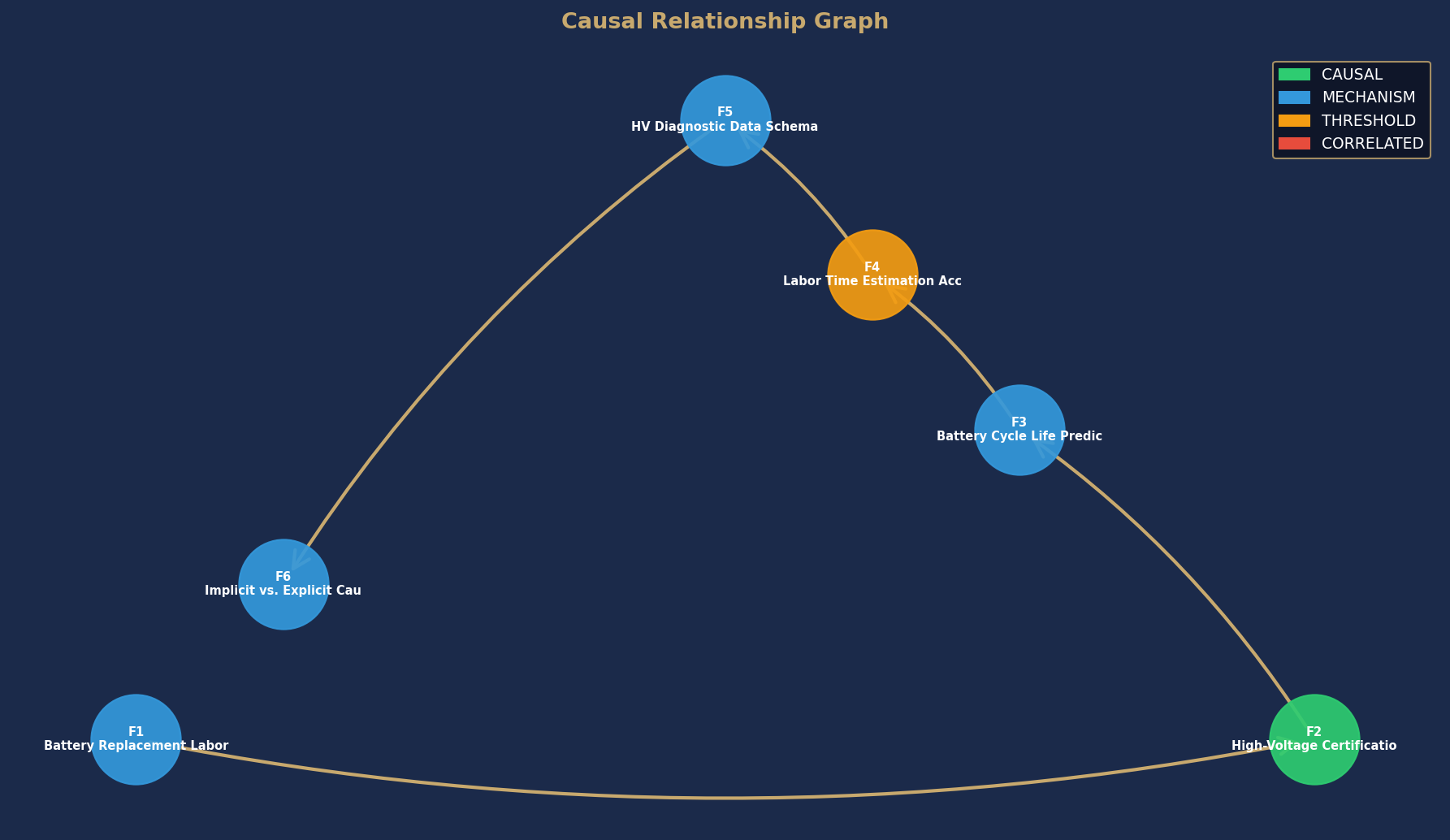
Causal Relationship Graph

Causal DAG

Node colors indicate causal confidence rating. Arrows show directional causal relationships identified in this analysis.

Unlock Full Report — $29

Full report PDF emailed to you immediately after purchase.

© 2026 Novo Navis, LLC · Fidelis Diligentia

Privacy Policy · Terms and Conditions · FAQ · About

This report is published for general informational purposes only and does not constitute financial, legal, or technology procurement advice.

Ask us anything!