OPENAI'S $1 TRILLION IPO: GPU COST STRUCTURE, COMPUTE LOCK-IN, AND THE MARGIN SUSTAINABILITY QUESTION
IMPORTANT DISCLAIMER
This report is published by Novo Navis, LLC for general informational purposes only. It does not constitute financial advice, investment advice, legal advice, or any other professional advice. Nothing in this report should be construed as a recommendation to buy, sell, or hold any security, make any investment decision, or take any specific action.
The analysis contained in this report reflects information available as of May 2026. Market conditions, competitive dynamics, regulatory environments, and other factors can change rapidly. Novo Navis makes no representation that the information contained herein is accurate, complete, or current after the date of publication.
Always seek the advice of a qualified financial advisor, attorney, or other licensed professional before making decisions based on information in this report. Past performance of any market, company, or strategy referenced herein is not indicative of future results.
Novo Navis, LLC and its affiliates accept no liability for any loss or damage arising from reliance on this report.
OPENAI'S $1 TRILLION IPO: GPU COST STRUCTURE, COMPUTE LOCK-IN, AND THE MARGIN SUSTAINABILITY QUESTION
Executive Summary
The most important finding in this analysis is not the one most analysts are discussing. The conventional framing pits OpenAI's undisclosed GPU procurement arrangements against Anthropic's very public $45 billion SpaceX compute commitment and concludes that OpenAI carries hidden cost risk. That framing is wrong in material ways, and acting on it would be a mistake.
The adversarial review process applied to this analysis overturned three of the five initial findings, rating them NOISE rather than the MECHANISM or CORRELATED labels initially assigned. The reason is consistent across all three overturned claims: the analysis conflated non-disclosure of OpenAI's procurement terms with non-existence of cost control. These are categorically different things, and the distinction matters enormously for IPO valuation.
What the evidence actually shows: OpenAI posted a 70 percent compute margin in October 2025 [56], meaning the revenue remaining after paying server costs was operating at a level inconsistent with a company exposed to uncontrolled spot-market GPU procurement volatility. Its 33 percent consolidated gross margin held steady across 2025 even as inference costs grew 68 percent from $8.4 billion to a projected $14.1 billion [57], which implies revenue grew proportionally to cost. That is not the financial signature of a firm absorbing unhedged spot-market price spikes. It is the signature of a firm with disciplined cost management, whether or not the contractual details are public.
One finding survives adversarial review with its MECHANISM rating intact: Anthropic's SpaceX deal does create a real, time-limited competitive moat through secured hardware access during a period of genuine GPU scarcity [11][13]. The moat is real. It is also shorter in duration than the contract suggests. GPU rack capacity is on track to double from 28,000 units in 2025 to 60,000 units in 2026 [25], with further compounding expected through 2027 and 2028. Scarcity-based advantages degrade as supply normalizes. The exclusive benefit of the SpaceX lock-in likely expires in real competitive terms by 2027 to 2028, well before the May 2029 contract termination.
One finding survives as THRESHOLD: Anthropic's fixed $1.25 billion per month payment to SpaceX [15] creates genuine stranded asset risk if Claude model utilization falls below the committed capacity level. The mechanism is sound. The data to verify whether it operates does not exist publicly.
The net valuation assessment is more nuanced than the conventional framing allows. OpenAI's $1 trillion target valuation [1][4] is not straightforwardly overpriced due to compute cost opacity. The 29 to 33 times valuation premium over Anthropic's private round valuation is largely explained by revenue scale, market share, and network effects rather than by hidden cost risk. However, the IPO prospectus will need to address GPU procurement structure explicitly, not because the cost base is necessarily exposed, but because investors cannot distinguish between controlled opacity and actual risk without disclosure.
The single most actionable risk is not OpenAI's cost structure. It is Anthropic's. A fixed $45 billion commitment through May 2029 to a single provider, with no public utilization disclosure, and no identifiable contractual exit mechanism, represents the more concentrated near-term financial risk in this comparison.
Situation and Context
OpenAI is preparing for what would be the largest technology IPO in history, targeting a valuation above $1 trillion and aiming for a public listing as early as September or October 2026 [4][9]. Goldman Sachs and Morgan Stanley are advising on the process [2]. The company raised $122 billion in its most recent funding round at an $852 billion valuation [70], making the $1 trillion IPO target an incremental step up rather than an implausible leap.
The financial backdrop is one of explosive revenue growth combined with persistent losses. OpenAI is projected to generate revenues approaching $30 billion in 2026 [57], up from roughly $3.7 billion in 2023, representing a compound growth rate that few technology companies have matched at this scale. The losses are equally significant. OpenAI's cash burn has been estimated at $17 billion annually [58], driven primarily by inference costs that reached $8.4 billion in 2025 and are projected to reach $14.1 billion in 2026 [57]. The company has not provided a public timeline to profitability.
The compute landscape against which this IPO is being structured is itself in flux. In early May 2026, Anthropic announced a landmark agreement with SpaceX to access compute capacity across the Colossus and Colossus II AI data center campuses [11][18]. The terms are public and specific: Anthropic will pay $1.25 billion per month, totaling approximately $45 billion over the three-year life of the agreement through May 2029, with an annualized run rate of $15 billion [15][17]. The deal was structured to give Anthropic immediate access to SpaceX's Starlink-integrated data infrastructure and announced alongside expanded usage limits for Claude users [18].
The Anthropic deal landed with strategic timing. OpenAI filed its Guaranteed Capacity program announcement within days [32][36], a customer-facing product that allows enterprise buyers to reserve one, two, or three years of AI computing resources in advance, with discounts scaling by commitment length [31][46]. This is a revenue product, not a procurement arrangement. It allows OpenAI to sell capacity certainty to customers. It does not, by itself, reveal anything about how OpenAI secures its own underlying compute.
OpenAI's procurement relationships with hardware vendors are extensive but incompletely disclosed. The company has a long-standing relationship with Microsoft through Azure [37], which has historically supplied the majority of its training and inference compute. It signed a strategic partnership with AMD in late 2025 to deploy six gigawatts of AMD GPU capacity [47][51], a deal that represents a meaningful diversification away from NVIDIA dependency. Separately, NVIDIA invested $30 billion in infrastructure commitments tied to OpenAI [49], and OpenAI's Stargate consortium with Oracle and SoftBank has committed to a $500 billion infrastructure deployment over four years [34][35]. The Oracle partnership alone involves a $300 billion data center buildout [34].
Against this backdrop, the GPU market itself is under severe capacity pressure. The data center GPU market reached $48.39 billion in 2026 [25], and cloud providers collectively committed over $450 billion in AI infrastructure spending this year [72][73]. Enterprise-grade GPU hardware runs approximately three to four dollars per GPU-hour at on-demand rates, with one to three year commitment plans bringing effective rates below two dollars per GPU-hour [44]. Hardware costs for enterprise-grade AI chips are running $30,000 to $40,000 or more per unit [40]. Morgan Stanley forecasts NVIDIA AI server rack demand growing from 28,000 units in 2025 to at least 60,000 units in 2026 [25].
The IPO valuation question is therefore not simply whether OpenAI can sustain growth. It is whether the cost structure supporting that growth is durable, predictable, and defensible at a scale that justifies a 10 to 15 times revenue multiple.
Causal Relationship Graph
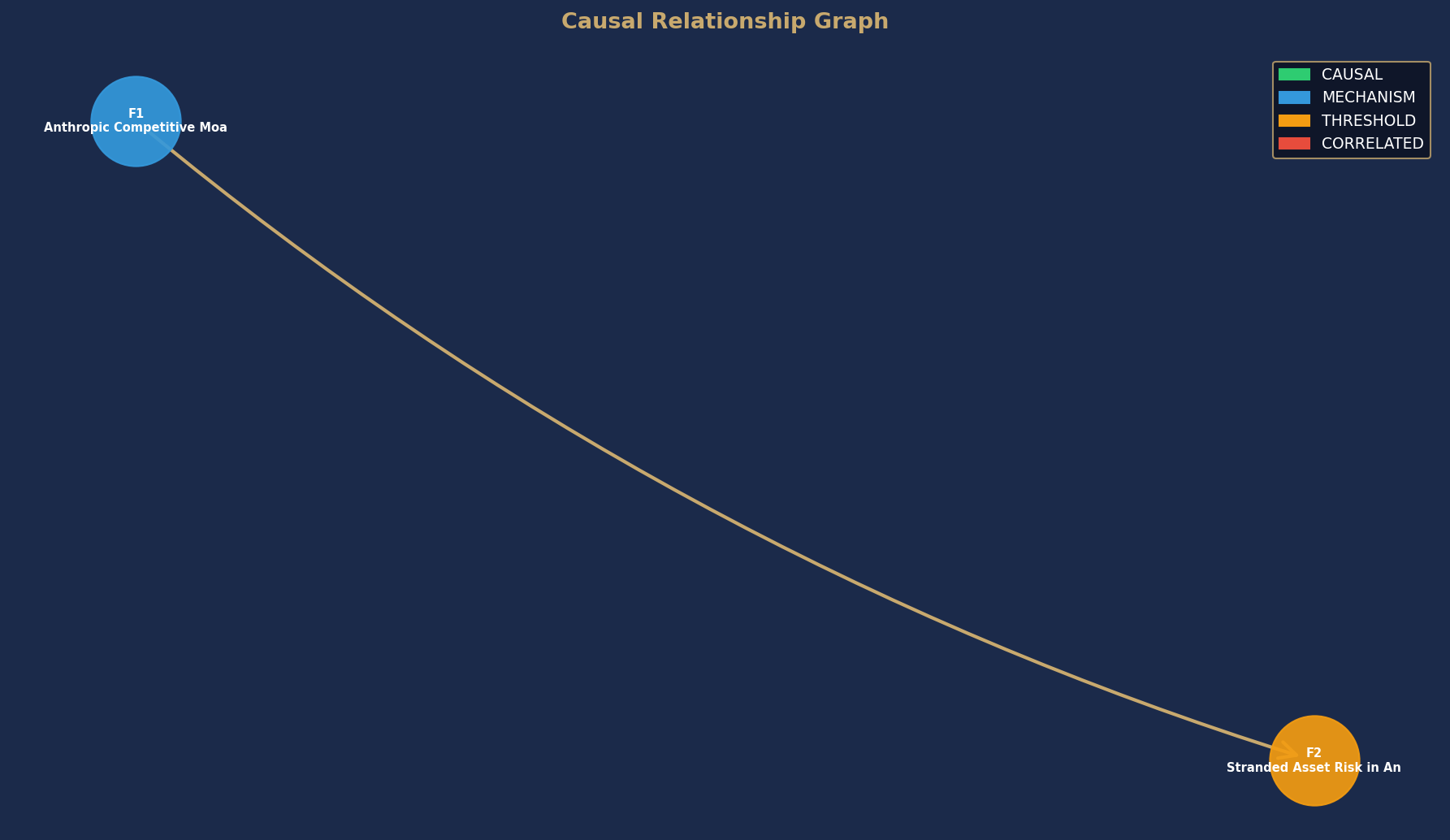
Node colors indicate causal confidence rating. Arrows show directional causal relationships identified in this analysis.
Causal Analysis, Who Benefits and Why, Key Risks, and What to Watch are available in the full report.
Get the full analysis.
The full report includes the complete causal analysis with confidence ratings, differentiated beneficiary assessment, key risks, and specific data points to watch. Delivered as a PDF immediately after purchase.