IRAN'S HORMUZ GAMBIT: PERMANENT CONTROL OR NEGOTIATION LEVERAGE?
IMPORTANT DISCLAIMER
This report is published by Novo Navis, LLC for general informational purposes only. It does not constitute financial advice, investment advice, legal advice, or any other professional advice. Nothing in this report should be construed as a recommendation to buy, sell, or hold any security, make any investment decision, or take any specific action.
The analysis contained in this report reflects information available as of May 2026. Market conditions, competitive dynamics, regulatory environments, and other factors can change rapidly. Novo Navis makes no representation that the information contained herein is accurate, complete, or current after the date of publication.
Always seek the advice of a qualified financial advisor, attorney, or other licensed professional before making decisions based on information in this report. Past performance of any market, company, or strategy referenced herein is not indicative of future results.
Novo Navis, LLC and its affiliates accept no liability for any loss or damage arising from reliance on this report.
IRAN'S HORMUZ GAMBIT: PERMANENT CONTROL OR NEGOTIATION LEVERAGE?
Executive Summary
The central analytical question is whether Iran's accelerated military reconstitution and institutional activity at the Strait of Hormuz represents a negotiation tactic designed to extract concessions, or a structural pivot toward permanent de facto control that would survive any diplomatic settlement. After rigorous causal analysis and adversarial review, the honest answer is: the evidence cannot yet distinguish between these two hypotheses with confidence. Anyone claiming certainty in either direction is outrunning the available data.
What can be stated with high confidence is that Iran has erected a set of institutional and military arrangements that are more durable than a temporary military deployment and more consequential than diplomatic posturing. The Persian Gulf Strait Authority, established on 5 May 2026 and formally ratified on 18 May, is the most significant of these. It is a statutory administrative body claiming authority over Strait transit, collecting fees, and embedding personnel inside a formal bureaucratic structure. Its legal status is disputed internationally, but it is operationally active. [14][44][45]
The non-obvious finding is this: the strategic pivot and negotiation tactic hypotheses are not mutually exclusive. Iran may have designed the PGSA and associated military posture to function as both simultaneously. Used as leverage, the PGSA becomes the concession item Iran trades for sanctions relief or U.S. recognition. Retained permanently, it becomes the institutional infrastructure for a new maritime governance reality. The architecture serves both purposes with equal facility, and Iran has made no public commitment that resolves the ambiguity. [41][42]
The causal analysis yields four MECHANISM-rated findings, two THRESHOLD findings, and one CORRELATED finding. No finding survives the evidentiary threshold for CAUSAL status. The primary reason is that the most compelling evidence of permanence, specifically the statutory formality of the PGSA, the timing of its creation during active conflict, and the budget reallocation toward asymmetric maritime systems, is subject to equally plausible competing explanations that the available data cannot eliminate. Adversarial review downgraded five of seven original findings, a significant correction that narrows analytical confidence substantially.
The practical implications for executives, investors, and policymakers are nonetheless concrete. Even under the more optimistic tactic hypothesis, the PGSA creates an institutional precedent that will not disappear cleanly. Even a negotiated settlement that nominally reopens the Strait and suspends PGSA operations leaves the legal architecture, personnel structures, and revenue logic in place for rapid reactivation. The Strait is not returning to pre-2026 governance regardless of how current negotiations conclude. [50][51]
What to watch over the next six months: whether Iran offers PGSA restructuring or dissolution as a named concession in talks; whether private technical negotiations show progress on institutional dismantling mechanisms; and whether infrastructure deployment at Hormuz continues, pauses, or begins to reverse. These observables will resolve the THRESHOLD findings and allow a confident causal rating on strategic intent.
Situation and Context
On 28 February 2026, the United States and Israel launched a combined strike campaign against Iran, targeting missile infrastructure, air defense networks, military command nodes, and leadership facilities in what open-source tracking describes as roughly 900 strikes within the first twelve hours. [52][53] The campaign caused significant degradation of Iranian conventional military capabilities, particularly air defense and ballistic missile stocks that had been Iran's primary deterrent posture. [5][8]
A temporary ceasefire was announced on 7 April 2026, following approximately thirty-eight days of active hostilities. [38][40] The ceasefire framework called for an immediate halt to hostilities and the reopening of the Strait of Hormuz, which had contracted to minimal traffic volumes by late April, with visual tracking showing the passage shrunk to a trickle. [25] A fifteen to twenty day negotiation window was specified, subsequently extended by President Trump on 21 April pending ongoing talks. [40][41]
The ceasefire has been imperfectly observed. As of mid-May 2026, violations have been reported on multiple sides, and U.S. officials announced a potential naval blockade of Iranian ports following one collapse of Islamabad-based talks in April. [21] Simultaneously, the U.S. and Iran are described as closing in on a framework for a permanent deal, with Trump renewing bomb threats even as that framework approached. [20][42] The negotiation environment is characterized by simultaneous escalation and diplomatic engagement, a pattern consistent with Iranian bargaining behavior during both the JCPOA negotiations and earlier Gulf crises. [17][19]
Within this active conflict and negotiation period, Iran took two institutional steps of significance. First, the Islamic Revolutionary Guard Corps Navy announced a redefinition of the Strait of Hormuz as a vast operational area rather than a narrow maritime passage, materially expanding the zone under which Iran asserts operational authority. [22] Second, on 5 May 2026, Iran established the Persian Gulf Strait Authority, a statutory body with a mandate to manage Strait transit, including a toll collection mechanism. [44][45][48] The PGSA was formally ratified institutionally on 18 May 2026, thirteen days before this report was compiled.
The PGSA operates practically. As of 20 May 2026, Iran claimed it had coordinated the passage of twenty-six vessels through the Strait in a twenty-four hour period, framing this coordination as evidence of the Authority's operational function. [23][26] Insurance and shipping sources report checkpoints, vetting procedures, and fee collection, though compliance is inconsistent and some vessels are transiting without engaging PGSA procedures. [27] The Authority has no international legal recognition under UNCLOS, which governs the Strait's status as an international waterway subject to transit passage rights. [13][46]
Iran's defense and security budget for fiscal year 1405 (2026-2027) proposed a 145 percent increase, a substantial escalation from recent years, though this proposal coincides with active conflict and the elevated spending should be assessed against wartime context rather than as a standalone strategic indicator. [31] Total military expenditure declined from approximately 7.9 billion dollars in 2024 to 7.4 billion dollars in 2025, the most recent confirmed figures, meaning the proposed increase represents a reversal of recent trend rather than continuation of growth. [29][35] A supplemental U.S. defense request exceeding 200 billion dollars for Iran war costs provides context for scale of the broader conflict's resource demands. [32]
Iran's overall military modernization trajectory, supported by Chinese and Russian technology transfers and domestic precision-strike development, has produced an asymmetric posture built around drones, fast attack craft, coastal missile systems, and anti-ship capabilities rather than symmetric air and naval platforms. [2][9] This evolution predates the 2026 conflict and reflects long-standing IRGC doctrine that prioritizes access denial over power projection. [7][10]
Causal Relationship Graph
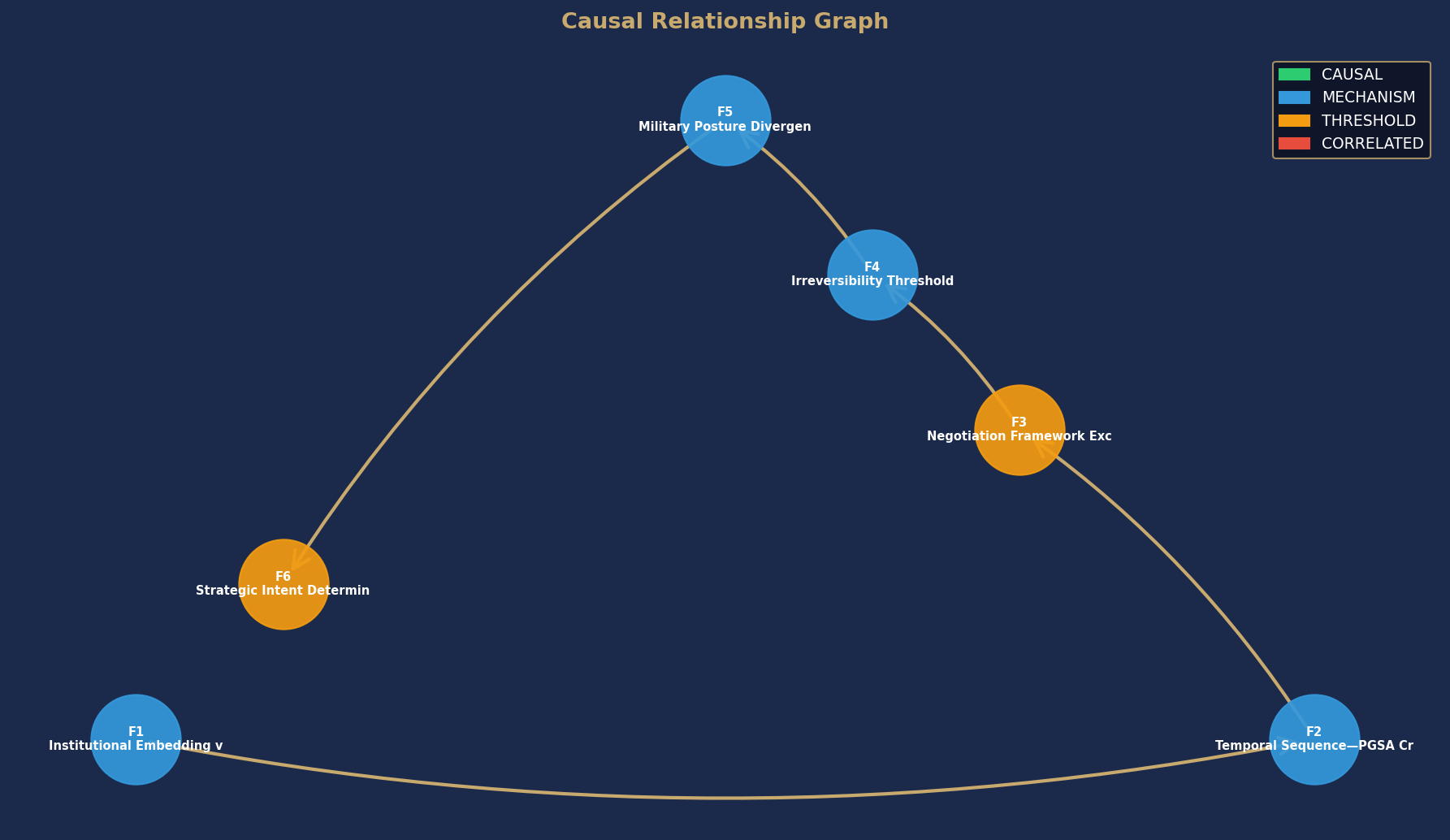
Node colors indicate causal confidence rating. Arrows show directional causal relationships identified in this analysis.
Causal Analysis, Who Benefits and Why, Key Risks, and What to Watch are available in the full report.
Get the full analysis.
The full report includes the complete causal analysis with confidence ratings, differentiated beneficiary assessment, key risks, and specific data points to watch. Delivered as a PDF immediately after purchase.