THE 70-DAY VACUUM: LIQUIDITY STRESS, SUPPLY CHAIN CASCADES, AND M&A DISRUPTION FOR MID-MARKET IMPORTERS AND JIT MANUFACTURERS DURING THE MAY 7 TO JULY 24, 2026 TARIFF AUTHORITY GAP
IMPORTANT DISCLAIMER
This report is published by Novo Navis, LLC for general informational purposes only. It does not constitute financial advice, investment advice, legal advice, or any other professional advice. Nothing in this report should be construed as a recommendation to buy, sell, or hold any security, make any investment decision, or take any specific action.
The analysis contained in this report reflects information available as of May 2026. Market conditions, competitive dynamics, regulatory environments, and other factors can change rapidly. Novo Navis makes no representation that the information contained herein is accurate, complete, or current after the date of publication.
Always seek the advice of a qualified financial advisor, attorney, or other licensed professional before making decisions based on information in this report. Past performance of any market, company, or strategy referenced herein is not indicative of future results.
Novo Navis, LLC and its affiliates accept no liability for any loss or damage arising from reliance on this report.
THE 70-DAY VACUUM: LIQUIDITY STRESS, SUPPLY CHAIN CASCADES, AND M&A DISRUPTION FOR MID-MARKET IMPORTERS AND JIT MANUFACTURERS DURING THE MAY 7 TO JULY 24, 2026 TARIFF AUTHORITY GAP
Executive Summary
The non-obvious finding in this report is not that tariff uncertainty creates liquidity pressure — that is widely understood. The non-obvious finding is the structural mismatch between where regime uncertainty costs are assumed to land and where they actually land. Policymakers, lenders, and investors reflexively focus on large importers and Tier 1 suppliers. The evidence assembled here points in a different direction: the acute liquidity crisis during the May 7 to July 24, 2026 authority vacuum concentrates not at the top of the supply chain but at the Tier 2 and Tier 3 level, transmitted through a cascade that begins with letter-of-credit covenant tightening at major trade finance banks and propagates downward through payment delays that small, specialized suppliers cannot absorb.
On May 7, 2026, a divided two-to-one panel of the U.S. Court of International Trade ruled that the 10 percent temporary global tariff imposed under Section 122 of the Trade Act of 1974 was unlawful. [51][53] The ruling suspended enforcement of that tariff authority but did not immediately resolve the underlying question of which import duties remained operative, how retroactive application would work, or when legislative or executive remediation would arrive. The resulting vacuum — conservatively estimated to extend through late July 2026 pending congressional action or appellate resolution — creates a 70-day window during which importers, their lenders, their suppliers, and prospective M&A counterparties must operate without clear duty liability. [54][57]
This report finds zero findings that have achieved full causal confirmation. All actionable findings are rated MECHANISM or THRESHOLD, reflecting a regime shock whose transmission pathways are directionally established by historical analogy and financial first principles, but whose empirical footprint in the specific May-to-July 2026 window has not yet been confirmed in real-time data. This distinction matters enormously for how actors should respond: the appropriate posture is precautionary contingency planning, not emergency intervention.
The two highest-confidence findings are rated MECHANISM. First, the operational payment delay cascade: when letter-of-credit renewal faces bank-side covenant tightening — a well-documented response to analogous uncertainty episodes — importers cannot pay suppliers on contractually agreed timelines. This is not the same as a negotiated reduction in days payable outstanding; it is an operational inability to fund the payment. Tier 2 suppliers face covenant stress within 15 to 30 days of such a delay. Tier 3 suppliers face insolvency within 5 to 15 days. [MECHANISM] Second, inventory valuation ambiguity creates a collateral underwriting problem: in-transit goods subject to disputed tariff classification cannot be reliably valued on a balance sheet, and lenders in prior analogous episodes have responded with expanded haircuts that directly reduce working capital line availability. [THRESHOLD]
The M&A channel compounds these effects. A K-shaped deal market, already documented in mid-2026, means that well-capitalized buyers concentrate in mega-deals while mid-market suppliers seeking liquidity through asset sales or full exits face widened bid-ask spreads and elevated deal termination risk. [CORRELATED] This removes the M&A escape valve precisely when mid-market suppliers most need it.
The single most important implication for practitioners: Tier 2 and Tier 3 suppliers to tariff-exposed mid-market importers — particularly those in electronics components, apparel, and industrial machinery sourced from China, Vietnam, and Mexico — face the earliest and most severe solvency risk. These firms typically lack the hedging instruments, the balance sheet depth, and the banking relationships needed to bridge a 15-to-30-day payment gap. The liquidity crisis, if it materializes in the form suggested by the established mechanisms, will announce itself through bankruptcy filings and production shutdowns at this tier before it becomes visible in large-importer financial statements.
Situation and Context
The May 7, 2026 Court of International Trade ruling is the precipitating event for this analysis. The three-judge panel, divided two to one, held that the Trump administration's invocation of Section 122 of the Trade Act of 1974 to impose a 10 percent duty on all imported goods was unauthorized. Section 122 permits temporary tariffs for balance-of-payments purposes under specific statutory conditions, which the court found were not satisfied. [57] A separate and prior federal appellate ruling had already addressed the administration's use of the International Emergency Economic Powers Act to impose tariffs, adding a second layer of legal constraint on the executive's import authority. [53]
Critically, the CIT ruling's relief was initially limited to the plaintiffs in the litigation, not issued as a nationwide injunction. [56] This created an immediate asymmetry: importers who were plaintiffs or joined the litigation could theoretically avoid paying the struck-down tariffs, while the vast majority of importers remained in legal limbo, uncertain whether they should continue paying duties, anticipate refunds, or treat their cost structures as permanently reset. [55] CBP launched new functionality in the Automated Commercial Environment system to process tariff refunds following related rulings, but the timeline for retroactive application and the ultimate appellate outcome remained unclear as of mid-May. [74]
The tariff regime entering this vacuum was already complex. Under the second Trump administration, tariffs had been imposed through multiple overlapping legal authorities: Section 301 tariffs on Chinese goods ranging from 7.5 to 25 percent and higher, Section 232 tariffs on steel (25 percent) and aluminum (10 percent), IEEPA-based emergency tariffs, and the now-contested Section 122 universal 10 percent surcharge. [5][7] The invalidation of Section 122 authority did not immediately dissolve Section 301 or Section 232 tariffs, which remained operative under separate statutory bases. But the ruling introduced structural doubt about the executive's authority to use emergency statutes expansively, creating an interpretive overhang on the entire tariff architecture. [10]
For mid-market importers — defined here as firms with annual revenue between $50 million and $500 million and significant import-to-revenue ratios — this environment creates multiple simultaneous pressures. First, their duty cost models became unreliable: should goods in transit be costed at the pre-ruling rate, the now-contested rate, or some probability-weighted expectation? [9] Second, their banking relationships came under stress: trade finance banks, already attuned to tariff uncertainty from earlier volatility, faced requests to renew or expand letters of credit against a backdrop of unresolvable duty uncertainty. [71][75] Third, their suppliers — particularly Tier 2 and Tier 3 — had even less visibility and even less financial cushion to absorb payment delays. [43][48]
Just-in-time manufacturers occupy a distinct and particularly exposed position within this landscape. JIT models are predicated on near-zero inventory buffers, disciplined supplier payment cycles, and continuous throughput without safety stock. [13] When component sourcing is disrupted — by tariff uncertainty affecting import flows, by supplier-side liquidity stress, or by bank-side financing tightening — a JIT firm cannot draw down inventory reserves the way a traditional manufacturer can. The operational shock translates almost immediately into production disruptions. [88]
The financing market context amplifies these pressures. Supply chain finance platforms, which serve as secondary working capital instruments for many mid-market firms, were growing at pace in early 2026: the global supply chain financing market reached approximately $26.9 billion in 2026. [26] But these platforms adjust advance rates algorithmically in response to counterparty credit risk signals, and tariff-driven uncertainty raises those signals rapidly. [24] The Federal Reserve's January 2026 analysis of supply chain risk and bank lending amid trade policy uncertainty explicitly documented the linkage between trade policy volatility and tightened lending standards for supply-chain-exposed borrowers. [24]
The M&A market provides a structural backdrop that matters for the distress analysis. Going into mid-2026, deal values remained elevated but concentrated in the largest transactions among the best-capitalized buyers, while mid-market deals contracted — a K-shaped recovery pattern that left smaller suppliers with limited ability to access capital through asset sales or strategic exits. [34][38] This concentration effect means that the M&A escape valve, which mid-market firms in distress might otherwise use to raise liquidity, was functionally closed during precisely the period when it was most needed.
Causal Relationship Graph
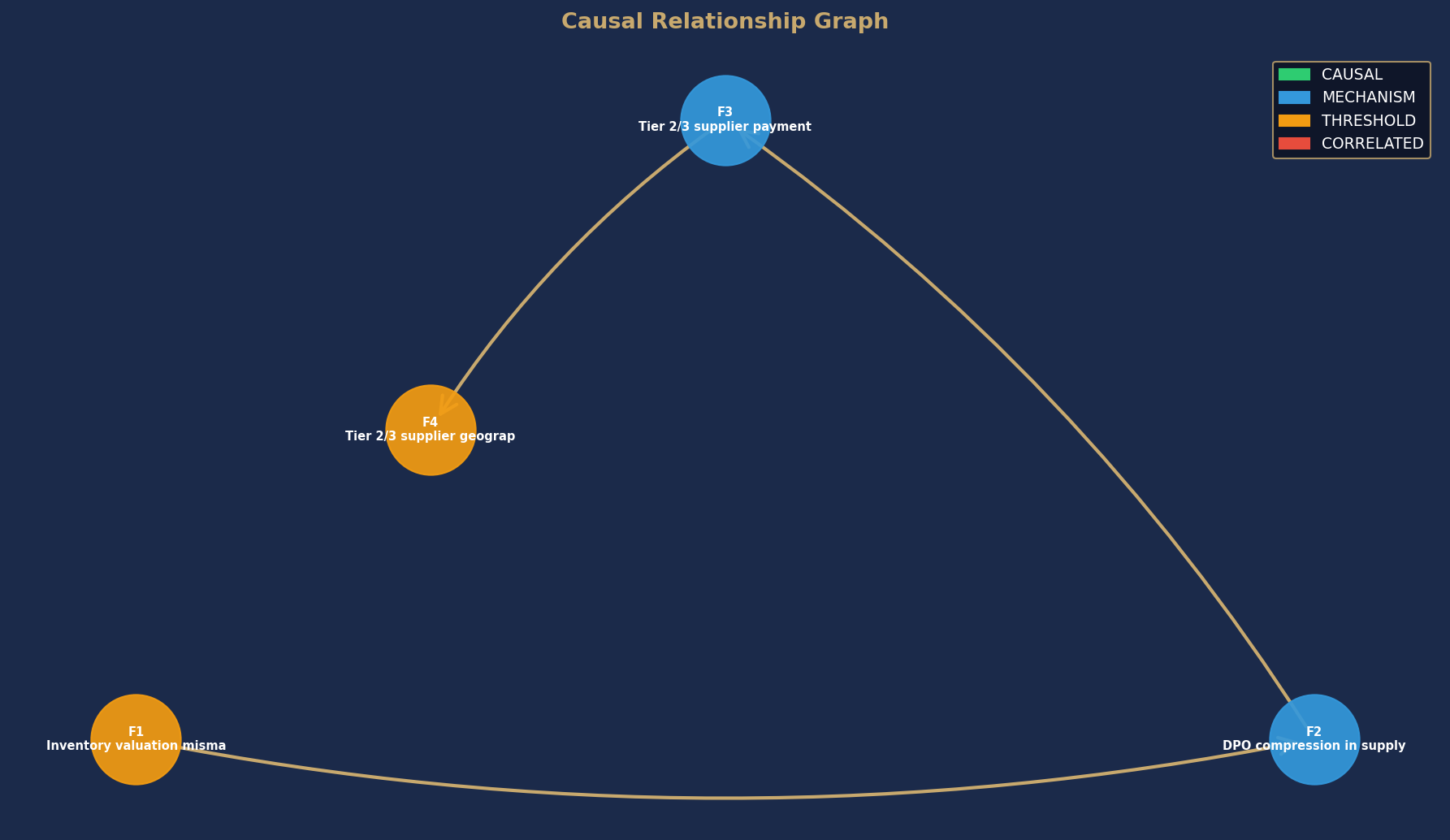
Node colors indicate causal confidence rating. Arrows show directional causal relationships identified in this analysis.
Causal Analysis, Who Benefits and Why, Key Risks, and What to Watch are available in the full report.
Get the full analysis.
The full report includes the complete causal analysis with confidence ratings, differentiated beneficiary assessment, key risks, and specific data points to watch. Delivered as a PDF immediately after purchase.