WARSH'S FEDERAL RESERVE: THE DECOUPLING PROBLEM, SHADOW TIGHTENING, AND SECOND-ORDER FINANCIAL CONDITIONS TRANSMISSION
IMPORTANT DISCLAIMER
This report is published by Novo Navis, LLC for general informational purposes only. It does not constitute financial advice, investment advice, legal advice, or any other professional advice. Nothing in this report should be construed as a recommendation to buy, sell, or hold any security, make any investment decision, or take any specific action.
The analysis contained in this report reflects information available as of May 2026. Market conditions, competitive dynamics, regulatory environments, and other factors can change rapidly. Novo Navis makes no representation that the information contained herein is accurate, complete, or current after the date of publication.
Always seek the advice of a qualified financial advisor, attorney, or other licensed professional before making decisions based on information in this report. Past performance of any market, company, or strategy referenced herein is not indicative of future results.
Novo Navis, LLC and its affiliates accept no liability for any loss or damage arising from reliance on this report.
WARSH'S FEDERAL RESERVE: THE DECOUPLING PROBLEM, SHADOW TIGHTENING, AND SECOND-ORDER FINANCIAL CONDITIONS TRANSMISSION
Executive Summary
Kevin Warsh was confirmed as the 17th Chair of the Federal Reserve on May 13, 2026, inheriting an institution whose policy signal has fractured in an unusual way. [1][4][6] The non-obvious finding of this report is not that Warsh must choose between cutting and hiking, though that tension is real. It is that the conventional framework for reading Fed tightness — headline policy rate as the primary signal — has materially lost explanatory power, and that most of the financial conditions consequences observers attribute to rate policy are actually driven by a separate, less-reported mechanism: balance sheet dynamics and the operating framework shift to ample reserves.
The critical finding, rated THRESHOLD under the causal framework applied here, is that the United States is currently experiencing a genuine paradox in financial conditions. Headline inflation is running above forecast, with CPI at 3.8% year-over-year and wholesale PPI at 6.0% annually. [25][28] The federal funds rate has remained unchanged at 3.5% to 3.75% since the most recent FOMC meeting. [49] Yet financial conditions, as measured by corporate credit spreads, remain near their loosest levels in two decades, with investment-grade option-adjusted spreads around 80 basis points and BBB spreads around 100 basis points. [65][68][70] Three plausible causal mechanisms have been identified for this paradox, but none is decisively supported by available evidence. This is an honest assessment of irreducible uncertainty, not an evasion of it.
One finding survives adversarial review at the MECHANISM level: the shadow-rate-versus-headline-rate decoupling. The Federal Reserve ended its quantitative tightening program on December 1, 2025. [18] That termination functioned as a de facto easing in the shadow rate — the metric that integrates balance sheet effects and term premium into a single monetary stance indicator — while the headline rate went unchanged. [11][15] The estimated gap between shadow rate and headline rate is on the order of 120 to 150 basis points. This is a directional finding, not a precise one, but the mechanism is empirically grounded in how QT duration drain affects term premium and how its removal reverses that pressure. The confound that prevents a CAUSAL rating is the inability to isolate shadow rate movements from simultaneous yield curve slope changes and forward guidance effects.
The second-order consequences for three major financial actor classes are concrete but not straightforwardly negative. For corporate refinancing, conditions are loose in a way that is structurally decoupled from the policy rate level, meaning Warsh rate hikes alone may not materially tighten refinancing costs unless accompanied by QT resumption. For pension funds, the picture has inverted from the standard concern: corporate plan funded ratios have reached roughly 108% on average, and the operative risk is now equity sensitivity and overfunding drift, not traditional duration-driven underfunding. [37][81] For banks, net interest margin compression is persisting under an ample reserves framework in a way that rate policy alone cannot repair, because the operative constraint is structural deposit repricing competition, not reserve availability.
Warsh's first FOMC meeting as chair is scheduled for June 16 to 17, 2026. [48] The decisions made in that meeting will either confirm or recouple the decoupling this report describes. Specifically, any signal on QT restart will matter more for financial conditions transmission than any headline rate move of comparable magnitude.
Situation and Context
Kevin Warsh, a former Federal Reserve governor who served from 2006 to 2011 and was a prominent critic of post-2008 quantitative easing, was confirmed by a 54 to 45 Senate vote on May 13, 2026, largely along party lines. [4][6][8] His confirmation was controversial on several grounds: concerns about his approach to Fed independence, questions about whether he would subordinate monetary policy to Treasury coordination, and uncertainty about the inflation versus growth trade-off he would navigate. [3][25] His first meeting as chair is June 16 to 17, 2026, and the market is watching that event as a potential inflection. [48]
The policy environment Warsh inherits is not cleanly characterized by headline rate data. The FOMC has held the federal funds rate target at 3.5% to 3.75% since its most recent meeting. [49] A December 2025 dot plot and subsequent guidance indicated a median expectation of one rate cut in 2026. [54] That rate path, as stated, looks modestly accommodative given the inflation data: headline CPI at 3.8% year-over-year is above forecast and above the Fed's 2% target, and wholesale PPI at 6.0% is well above both. [25] Oil prices above $100 per barrel add an inflationary layer that is difficult to dismiss as transitory. [29]
But the headline rate is an incomplete description of monetary stance. The Federal Reserve officially concluded its quantitative tightening program on December 1, 2025, ending a process that had reduced the balance sheet from a post-COVID peak of roughly $8.9 trillion to a lower level through passive maturity runoff. [18][20] The termination of QT is a material policy event because the balance sheet level affects term premium in long-duration assets, which in turn affects financial conditions independently of the overnight rate. When the Fed shrinks its balance sheet, it removes duration from the system, which tends to raise term premium on longer-dated instruments. When it stops shrinking, that pressure reverses. The QT program ran from mid-2022 through November 2025 — a period during which the Fed was simultaneously raising and then holding headline rates.
The Federal Reserve simultaneously transitioned to or reinforced its ample reserves operating framework during this period. [60][63] Under this framework, the Fed maintains enough reserves in the banking system that short-term rates are controlled primarily through administered rates — the interest on reserve balances (IORB) and the overnight reverse repurchase rate (ON RRP) — rather than through active reserve quantity management. This is a structurally significant change from the pre-2008 era of scarce reserves, where the Fed steered rates by rationing reserve supply. [20] The ample reserves framework means that balance sheet changes within the ample zone do not affect short-term rate control, but they do affect term premium through duration supply effects on longer-dated markets.
The net result is a policy environment where headline rates signal one thing, balance sheet posture signals another, and the operating framework mediates the transmission in ways that are not well-communicated in most public commentary. Corporate credit markets have priced conditions as loose. [65][68] Pension funds have reached funding levels not seen in years. [37][81] Banks are dealing with net interest margin compression that is not resolving the way prior rate cycles predicted. [42][46] Warsh's arrival coincides with a moment when the standard interpretive tools for reading the Fed are partially broken, and the analytical value is in identifying which mechanisms are actually operative.
A note on the May 2026 political context: Warsh's confirmation came with explicit pressure from Trump administration allies warning against rate cuts, while simultaneous signals from within the administration suggested desire for lower rates to support fiscal spending capacity. [21] This tension between explicit political messaging and stated Fed independence is unresolved and creates additional uncertainty about the forward policy path. [3]
Causal Relationship Graph
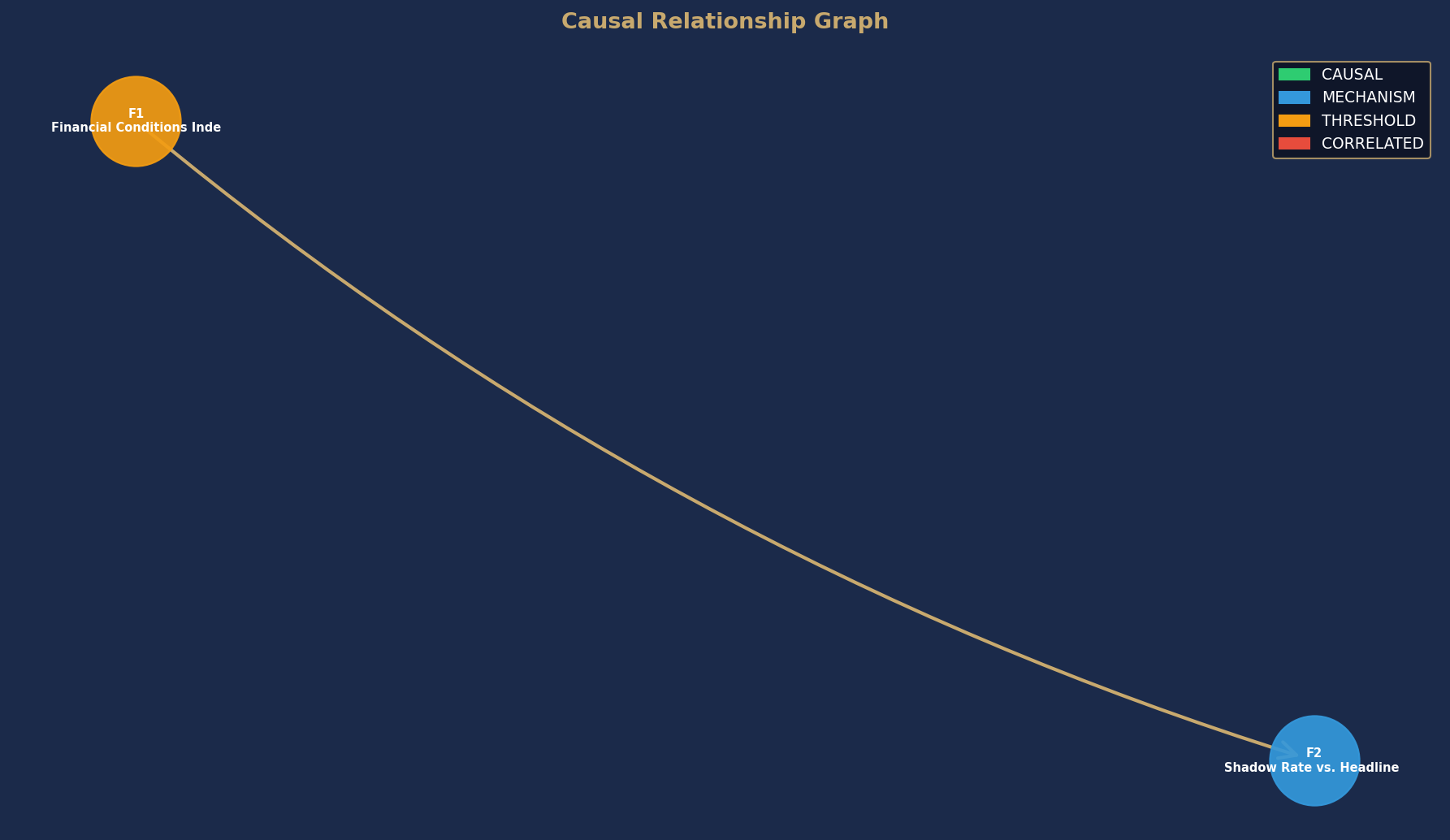
Node colors indicate causal confidence rating. Arrows show directional causal relationships identified in this analysis.
Causal Analysis, Who Benefits and Why, Key Risks, and What to Watch are available in the full report.
Get the full analysis.
The full report includes the complete causal analysis with confidence ratings, differentiated beneficiary assessment, key risks, and specific data points to watch. Delivered as a PDF immediately after purchase.