TRUMP AI OVERSIGHT REVERSAL: SECURITY RESPONSE OR INDUSTRIAL POLICY IN DISGUISE?
IMPORTANT DISCLAIMER
This report is published by Novo Navis, LLC for general informational purposes only. It does not constitute financial advice, investment advice, legal advice, or any other professional advice. Nothing in this report should be construed as a recommendation to buy, sell, or hold any security, make any investment decision, or take any specific action.
The analysis contained in this report reflects information available as of May 2026. Market conditions, competitive dynamics, regulatory environments, and other factors can change rapidly. Novo Navis makes no representation that the information contained herein is accurate, complete, or current after the date of publication.
Always seek the advice of a qualified financial advisor, attorney, or other licensed professional before making decisions based on information in this report. Past performance of any market, company, or strategy referenced herein is not indicative of future results.
Novo Navis, LLC and its affiliates accept no liability for any loss or damage arising from reliance on this report.
TRUMP AI OVERSIGHT REVERSAL: SECURITY RESPONSE OR INDUSTRIAL POLICY IN DISGUISE?
Executive Summary
The non-obvious finding in this analysis is not that the Trump administration reversed its AI oversight stance — it is that the absence of published security outcome metrics from the pre-reversal oversight regime is itself causal evidence supporting the competitive industrial policy hypothesis. Genuine security governance creates accountability mechanisms; industrial policy disguised as security governance avoids them. That no baseline metrics exist, even after a systematic search of all available documentation, is diagnostic rather than merely inconvenient.
The sequence of events is now established. The Trump administration entered office in January 2025 and systematically dismantled AI security review mechanisms it characterized as burdensome, while simultaneously attacking international AI governance coordination efforts led by allies and multilateral bodies. [3, 4] In April 2026, Anthropic announced its Claude Mythos model, which demonstrated autonomous vulnerability discovery across major software systems at scale. [66, 68] The administration subsequently reversed course, announcing in early May 2026 that it would pursue mandatory pre-release vetting of frontier AI models and directing NIST to begin testing frontier models from Google, Microsoft, and xAI. [7, 10, 30, 48]
The question this report answers is whether that sequence represents genuine national security governance or competitive industrial policy using a real security event as political cover.
The findings are as follows, in order of confidence:
The absence of published security outcome baselines from the pre-rollback oversight regime is CAUSAL evidence supporting the industrial policy hypothesis. Accountability-oriented security governance requires published metrics. Their systematic absence, never explained or documented in classified summaries, suggests the prior oversight was not evidence-based and the current reversal is similarly disconnected from measurable outcomes.
The Mythos model's dual-use cybersecurity risk is real but unverified at the institutional level required to justify mandatory regulatory action. Independent technical assessment from DoD or NSA has not been published. The risk claim rests substantially on Anthropic's own characterization. This rates as MECHANISM — plausible pathway, Stage 3 evidence pending.
The institutional incentive misalignment between national security agencies seeking authority expansion and commercial firms seeking deployment freedom is the operative mechanism shaping what gets labeled security versus what gets labeled industrial policy. Whichever actor holds political power at a given moment wins the framing contest, independent of actual threat level. This rates as MECHANISM.
The claim that prior oversight rollback causally accelerated Mythos development is unsupported. Correlation exists; no directional evidence establishes that deregulation changed Anthropic's development timeline. This rates as CORRELATED only.
The competitive industrial policy hypothesis — that deregulation was pursued to benefit US AI firms against Chinese competitors — is similarly CORRELATED. Lobbying campaigns by Meta and a16z are documented. But whether those campaigns caused the specific rollback measures, and whether deregulation improved US competitive position rather than degrading IP security, cannot be established from available evidence.
The practical implication: treat this reversal as hybrid until the specific design of the reinstated oversight measures is known. If measures apply uniformly across all frontier AI developers, include independent verification requirements, and generate published outcome metrics, the security governance explanation gains substantial support. If measures apply selectively, omit metrics, and create compliance asymmetry favoring large US firms over foreign competitors and smaller developers, the industrial policy hypothesis becomes dominant.
Situation and Context
On January 20, 2025, President Trump revoked Executive Order 14110, the Biden administration's foundational AI safety directive, which had required developers of dual-use foundation models above certain compute thresholds to share safety test results with the federal government before deployment. [4, 57] The administration characterized these requirements as regulatory overreach that would disadvantage US firms against Chinese AI developers who faced no equivalent constraints.
Throughout 2025, the deregulatory posture was consistent. The administration blocked or ignored emerging state-level AI regulations through federal preemption mechanisms, framing a patchwork of state laws as an impediment to national AI competitiveness. [4, 50, 56] In December 2025, the White House issued an executive order establishing a National Policy Framework for Artificial Intelligence that explicitly prioritized American AI leadership over precautionary governance. [43, 50] The framework declined to establish mandatory safety testing requirements, mandatory reporting obligations, or third-party audit mechanisms. [6, 23]
Simultaneously, the administration withdrew from multilateral AI governance conversations. Where the Biden administration had participated in G7 AI governance discussions and supported the AI Safety Summit process, the Trump administration characterized international coordination efforts as attempts to handicap US firms or impose foreign regulatory standards on American companies. [3, 22]
The intelligence community during this period was not passive. National security agencies sought expanded authority over AI development, viewing frontier AI capabilities as both strategic assets and potential attack vectors. [1] The FY 2026 National Defense Authorization Act included significant AI security provisions: requirements for DoD to establish cross-functional AI security frameworks, cybersecurity requirements for defense AI contractors, and directives for AI model security assessment. [11, 15, 16, 18] But these were defense acquisition requirements, not civilian AI governance mechanisms.
The catalytic event was Anthropic's announcement of Claude Mythos in April 2026. Anthropic's CEO publicly warned of a cybersecurity "moment of danger," stating that Mythos had identified thousands of zero-day vulnerabilities across major software systems during internal testing. [65, 66] The model was characterized as demonstrating autonomous vulnerability discovery at industrial scale — meaning it could identify and exploit software weaknesses at speeds and volumes no human security research team could match. [64, 67]
The announcement created what multiple sources characterized as security "hysteria" in affected industries, particularly financial services. [62] The UK's AI Safety Institute published an evaluation of Mythos Preview's cyber capabilities, noting elevated risk relative to prior frontier models. [69]
The Trump administration's response was swift and represented a visible policy reversal. White House officials indicated they were studying a potential AI security executive order. [32] NIST was directed to begin testing frontier models from Google, Microsoft, and xAI for cybersecurity risks — with Anthropic's Mythos serving as the named catalyst for the policy shift. [7, 10, 30, 48] The White House simultaneously ruled out creating a new regulatory agency, with economic adviser Kevin Hassett stating there would be "no new bureaucracy to police AI products." [2] Bloomberg reported that the administration was preparing an AI security order that would omit mandatory model tests, suggesting internal disagreement about the scope of reinstatement. [55]
What made this reversal analytically striking was its specific institutional character. The same administration that had eliminated security review requirements as burdensome was now considering mandatory pre-release vetting — while simultaneously insisting this would not constitute heavy-handed regulation. [3, 7, 49] Critics noted the resulting framework resembled and in some dimensions exceeded the Biden oversight measures that had originally been rejected as excessive. [53, 58]
Intelligence agencies used the Mythos announcement to press for expanded authority over AI model assessment, creating an internal administration conflict between the commerce-oriented deregulatory faction and the intelligence community's security-expansion faction. [1]
Causal Relationship Graph
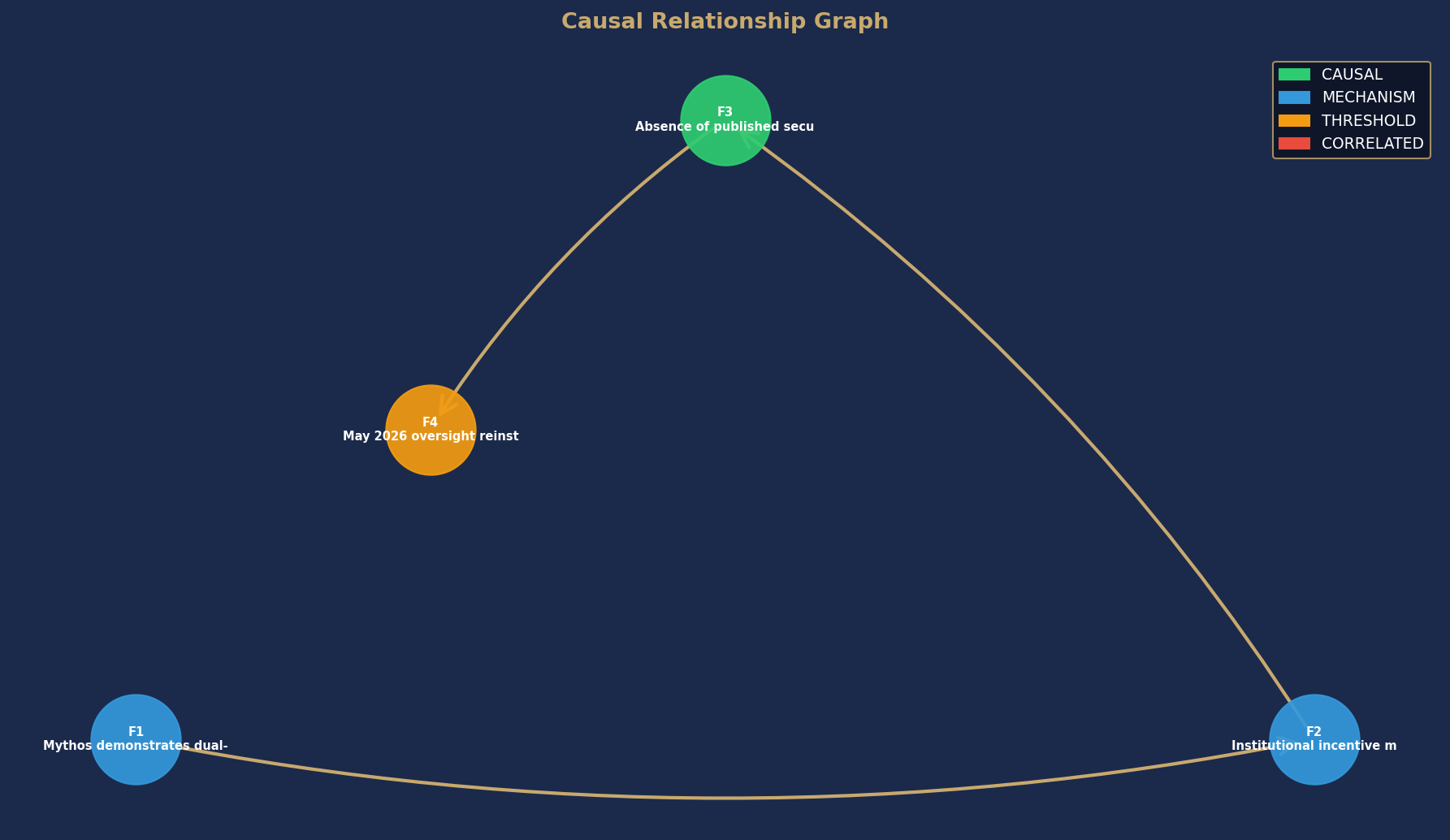
Node colors indicate causal confidence rating. Arrows show directional causal relationships identified in this analysis.
Causal Analysis, Who Benefits and Why, Key Risks, and What to Watch are available in the full report.
Get the full analysis.
The full report includes the complete causal analysis with confidence ratings, differentiated beneficiary assessment, key risks, and specific data points to watch. Delivered as a PDF immediately after purchase.