JUDICIAL INVALIDATION OF TRUMP TARIFF AUTHORITY AND THE BEIJING SUMMIT: LEVERAGE, DELAY, AND THE LIMITS OF EXECUTIVE POWER
IMPORTANT DISCLAIMER
This report is published by Novo Navis, LLC for general informational purposes only. It does not constitute financial advice, investment advice, legal advice, or any other professional advice. Nothing in this report should be construed as a recommendation to buy, sell, or hold any security, make any investment decision, or take any specific action.
The analysis contained in this report reflects information available as of May 2026. Market conditions, competitive dynamics, regulatory environments, and other factors can change rapidly. Novo Navis makes no representation that the information contained herein is accurate, complete, or current after the date of publication.
Always seek the advice of a qualified financial advisor, attorney, or other licensed professional before making decisions based on information in this report. Past performance of any market, company, or strategy referenced herein is not indicative of future results.
Novo Navis, LLC and its affiliates accept no liability for any loss or damage arising from reliance on this report.
JUDICIAL INVALIDATION OF TRUMP TARIFF AUTHORITY AND THE BEIJING SUMMIT: LEVERAGE, DELAY, AND THE LIMITS OF EXECUTIVE POWER
Executive Summary
The non-obvious finding here is not that judicial invalidation weakened Trump's negotiating hand — that is the consensus view. The non-obvious finding is that the direction and magnitude of the leverage shift is far less clear than analysts have assumed, and that the most widely cited causal mechanisms either depend on unverified legal outcomes or rest on a foundational reasoning error.
Two judicial decisions in early 2026 stripped President Trump of tariff authority under two separate statutory bases. The Supreme Court ruled on February 20 that the International Emergency Economic Powers Act (IEEPA) does not authorize unilateral presidential tariff-setting. [1][4] The Court of International Trade followed on May 7, ruling 2-to-1 that Trump's attempt to reimpose 10% global tariffs under Section 122 of the Trade Act of 1974 was similarly unlawful. [25][70] These decisions arrive seven days before the May 14-15 Beijing summit, where Trump and Xi Jinping are meeting for the first time in this administration in what analysts widely describe as a summit aimed at stability rather than breakthrough. [15][20]
The surface-level consensus — that invalidation removed Trump's tariff threat and handed China leverage to delay — is partially correct but analytically incomplete. The causal filter applied to this analysis degrades three of four headline findings and identifies a cascading foundational error across all of them.
The foundational error is this: removing Trump's unilateral tariff authority is not the same as removing Trump's overall bargaining leverage. Post-invalidation, Trump negotiates with Congressional backing as a structural feature of any deal. If Congress is protectionist — and the 2026 Congress has strong protectionist factions in both parties — then China is no longer negotiating with Trump alone. It is negotiating with the political coalition whose approval any deal requires. This can, under certain conditions, strengthen Trump's position rather than weaken it.
Against this backdrop, three verified findings emerge. First, the dual-court invalidation has shifted Trump's tariff authority from unilateral executive to legislatively dependent, creating genuine uncertainty about whether any threatened tariff can be reimposed credibly on a near-term basis. This finding holds at MECHANISM confidence. Second, temporal asymmetry between the 2-day summit deadline and the 60-plus-day appellate timeline creates structural conditions that could favor Chinese delay, but the relationship between incentive structure and actual negotiating outcome is unproven. This holds at MECHANISM. Third, Congressional ratification requirements insert a genuine veto point, but there is no identified mechanism explaining why or when Congress would strategically weaponize that veto to produce delay. This holds at THRESHOLD.
Critically, the Court of Appeals moved on May 12 to temporarily pause the May 7 Court of International Trade ruling. [22][27] This stay — granted just two days before the summit — substantially alters the operational picture. With the stay in place, Trump enters Beijing with tariffs nominally reinstated pending appeal. The legal situation is ambiguous, but the operational threat is partially restored. The analytical implication is significant: the finding rated CORRELATED in this report (that the May 7 invalidation removes Trump's operative threat capacity during the summit) reflects a scenario that may no longer apply.
The likely Beijing outcome is a preliminary framework agreement — vague enough to let both sides claim success, specific enough to continue talks — with binding tariff commitments deferred to post-appellate resolution, which will not come until July-August 2026 at the earliest. The summit is not a settlement event. It is a sequencing event that determines who holds optionality in the next round.
Situation and Context
The Beijing summit of May 14-15, 2026 is the culmination of a diplomatic sequence that accelerated through spring 2026. Trump and Xi had not met in person during the early phase of this administration. Pre-summit trade delegation meetings are scheduled for May 12-13 in Seoul, where Treasury Secretary Scott Bessent and Chinese Vice-Premier He Lifeng are holding economic and trade consultations. [13][18] Trump is scheduled to arrive in Beijing on May 14. [19][20]
The backdrop to the summit is the most significant legal disruption to presidential tariff authority in the post-war era.
On February 20, 2026, the Supreme Court released its decision in Learning Resources, Inc. v. Trump, ruling 6-to-3 that IEEPA does not authorize the President to unilaterally set tariffs. [1][2][21] The majority opinion, written by Chief Justice John Roberts and joined by Justices Sotomayor, Kagan, Gorsuch, Barrett, and Jackson, held that the Constitution's Commerce Clause vests tariff-setting authority in Congress, and that IEEPA's emergency economic powers language does not constitute a sufficiently explicit delegation of that authority. [4][6] The ruling invalidated approximately $166 billion in tariffs that had already been collected under IEEPA. [10]
The Trump administration's response was to attempt reimposition of tariffs using a different statutory vehicle — Section 122 of the Trade Act of 1974, which permits the President to impose temporary import surcharges of up to 15% for up to 150 days to address balance-of-payments deficits. [23][25] On May 7, 2026, the Court of International Trade ruled 2-to-1 that Trump's executive order imposing 10% global tariffs under Section 122 was unlawful, holding that Trump had failed to identify the required balance-of-payments justification. [40][70]
The Trump administration appealed immediately. [24][26] On May 12 — two days before the summit — the Court of Appeals for the Federal Circuit temporarily paused the Court of International Trade ruling, allowing tariff collection to resume pending the appeal. [22][27][66] As of the summit's opening, the 10% global tariff is nominally reinstated under an appellate stay, but its legal validity is actively contested in federal court with briefing expected to extend into July or August 2026.
The legal situation as of May 14 is therefore: IEEPA-based tariffs are permanently invalidated by the Supreme Court with no viable appeal remaining. Section 122-based tariffs are currently reinstated by appellate stay but their merits remain before the Federal Circuit, with invalidation the baseline outcome at the trial court level and the appeal outcome genuinely uncertain.
Additional Section 301 tariffs (targeting China specifically for intellectual property practices) and Section 232 tariffs (targeting steel and aluminum on national security grounds) remain unaffected by either ruling. These sector-specific tariffs, some dating to the first Trump administration, continue to apply to a significant portion of Chinese goods. [9][35]
The summit itself is widely expected to produce stability-focused outcomes rather than comprehensive trade settlement. Analysis from the Center for Strategic and International Studies, the Atlantic Council, and the Council on Foreign Relations converges on a picture in which both parties want to reduce bilateral tension without making binding commitments that could be undermined by domestic political constraints. [14][15][20] The Council on Foreign Relations assessed that China enters the summit with structural advantages. [14] The Atlantic Council notes that trade uncertainty continues to overshadow the negotiations despite tariff reductions. [30]
Trump's stated agenda for Beijing extends beyond trade, encompassing cooperation on the Iran conflict, Taiwan stability, and fentanyl enforcement. [58][60] This broader agenda creates both opportunities (potential trade-offs across issue areas) and distractions (trade may not be the summit's most urgent topic).
The pre-summit Seoul meetings between Bessent and He Lifeng represent the substantive negotiating layer. What is agreed in Seoul will largely determine what Trump and Xi ratify ceremonially in Beijing. [13][18] This separation between working-level negotiation and head-of-state summitry is standard diplomatic practice and is relevant to the time-pressure analysis: the 2-day Trump deadline applies to the ceremonial signing event, not to the negotiations themselves, which have a longer track.
Causal Analysis
FINDING 1: The May 7 Appellate Stay Substantially Alters the Operative Threat Picture Confidence Rating: CORRELATED
The domain analysis initially identified the May 7 Court of International Trade ruling as creating an asymmetric delay incentive for China by removing Trump's operative tariff threat exactly one week before the summit. That finding is rated CORRELATED — actionable only as context — for the following reasons.
Stage 1 correlation is confirmed: The May 7 invalidation occurred 7 days before the summit, and the timing creates a window during which tariffs would nominally be suspended if no stay were granted. [25][70]
Stage 2 mechanism is plausible: Under normal appellate procedure, a lower court invalidation suspends enforcement, and the government would need a stay motion to resume tariff collection. During the gap between ruling and stay, Chinese negotiators could credibly argue that tariffs are legally suspended. [23][25]
Stage 3 causation fails for a structural reason: The Federal Circuit granted a temporary stay on May 12, two days before the summit opened. [22][27][66] This means the operative mechanism — removal of tariff threat during negotiations — did not materialize as hypothesized. The stay restores tariff collection pending appeal. Trump enters Beijing with the 10% global tariff nominally in effect, though legally contested.
The adversarial filter correctly identified that the mechanism depended on an unstated assumption about stay denial, and assigned a 55-65% probability that a stay would be granted. [68][69] That assessment proved accurate. The practical import: China cannot credibly argue during the summit that it faces no tariff exposure. It faces contested but operationally enforced tariffs under appellate stay. The delay incentive from tariff suspension is substantially diminished.
The residual CORRELATED observation is this: the legal status of the 10% tariffs remains genuinely uncertain throughout the appellate period. A stay is not a merits ruling. China knows the underlying trial court found Trump's authority wanting, and the Federal Circuit has not yet ruled on the merits. This uncertainty — not the suspension — may influence Chinese negotiating posture at the margins.
FINDING 2: Dual Invalidation Has Shifted the Structural Basis of Trump's Tariff Authority Confidence Rating: MECHANISM
The factual core of this finding is ironclad. Two independent courts, applying two independent statutory provisions, reached the same conclusion: Trump lacks unilateral tariff-setting authority under the plausible executive mechanisms he attempted. The Supreme Court invalidated IEEPA tariff authority on February 20. [1][4] The Court of International Trade invalidated Section 122 authority on May 7. [25][43] Both decisions turned on the constitutional constraint that tariff authority vests in Congress, and that delegations of that authority to the executive must be explicit and specific. [4][47][52]
The mechanism is identified but its directional effects are more complex than the initial analysis suggested.
The standard interpretation is that dual invalidation weakens Trump's credibility because China now knows any new unilateral tariff assertion will be judicially vulnerable. This is partially correct. Trump cannot credibly threaten to impose a new category of emergency tariffs by executive order and have that threat survive constitutional scrutiny. Any tariff reimposition now requires either (a) explicit new Congressional authorization, (b) reliance on surviving statutory authorities such as Section 301 or Section 232, or (c) a successful appellate reversal of the Court of International Trade decision on Section 122. [9][47][54]
The critical confound not resolved in the initial analysis: removing Trump's unilateral authority does not straightforwardly weaken his overall leverage. It shifts the source of that leverage from executive action to Congressional authorization. If Congress is strongly protectionist — which the 2026 Congress appears to be, given bipartisan support for industrial policy and tariff measures in both chambers — then Trump's position may in practice be strengthened by this shift. China must now negotiate not just with Trump's preferences but with what the Congressional coalition will ratify. Trump can credibly say: I would take your offer, but Congress won't. This is the standard two-level game structure identified in international negotiation theory, where domestic constraints serve as a commitment device.
The mechanism as verified: Dual invalidation eliminates Trump's ability to threaten rapid, unilateral tariff escalation in categories not already covered by surviving statutes. This narrows his tactical range. At the same time, it potentially broadens his structural leverage by making Congressional authorization the relevant threat. Whether this is a net gain or loss for Trump depends on Congressional preferences, which are not fully modeled here (GAP_004).
The finding holds at MECHANISM because Stage 3 empirical confirmation is absent. We have not observed how Chinese negotiators have actually responded to dual invalidation in terms of concrete demands or positions. The Seoul delegation meetings in May 12-13 may provide evidence, but no public record of those sessions is available as of this writing. [13][18]
FINDING 3: Congressional Ratification Requirement Inserts a Genuine Veto Point Confidence Rating: THRESHOLD
The constitutional basis for this finding is solid. Any trade deal that modifies existing tariff schedules or requires appropriations must return to Congress for approval. The Supreme Court's February 20 decision explicitly reinforced Congressional primacy over tariff-setting, using language that strengthens Congressional assertion of veto power over executive trade deals. [1][4][47][52] No pending legislation pre-authorizes Trump to negotiate a settlement with China on tariff terms. [48][54]
This creates a structural feature that China's negotiators will be aware of: any commitment Trump makes in Beijing is subject to Congressional ratification before it becomes binding law. This is genuine leverage uncertainty for China because a Trump-negotiated deal that Congress subsequently rejects or significantly modifies leaves China having conceded bargaining position without receiving the promised relief.
The finding rates THRESHOLD because Stage 2 mechanism is not fully identified. The Constitutional veto point exists, but the conditions under which Congress would exercise it adversely to the Trump-negotiated deal are not established. Several scenarios cut against automatic Congressional obstruction.
First, historical precedent from USMCA (ratified 2020) shows that a Republican Congress is not necessarily an obstacle to Trump trade deals. The House passed USMCA 385-41 with strong bipartisan support. Congressional obstruction of Trump trade deals is assumed in the initial analysis but contradicted by recent precedent.
Second, the partisan dynamics of the 2026 Congress matter greatly. If Republicans control both chambers, blocking a Trump-negotiated China deal carries significant political cost for Republican members. Democratic opposition alone would not prevent ratification.
Third, China's strategic ability to condition settlement on Congressional dynamics is limited. China has no direct line to Congress and cannot negotiate with Congress directly. It can only observe Congressional behavior and incorporate it into its own risk calculus. The mechanism by which China "extracts Congressional concessions separately" is not specified and may not be coherent as described.
The THRESHOLD rating reflects: Stage 1 (Congressional veto power exists, confirmed) plus genuine relevance to deal implementation risk, but no identified mechanism specifying why or when Congress would strategically delay or block. This constrains the predictive value but does not eliminate the finding as a risk factor.
FINDING 4: Temporal Asymmetry Creates Structural Conditions Favoring Chinese Optionality, But Not Necessarily Delay Confidence Rating: MECHANISM
The factual structure of this finding is sound. The Beijing summit lasts two days (May 14-15). The Court of International Trade appellate briefing extends to July-August 2026. The Federal Circuit decision will not arrive before late summer at the earliest. The Supreme Court, if asked to review any appellate ruling on the IEEPA question, would not decide until the 2026-2027 term. [21][22][27] This creates a temporal mismatch in legal certainty that persists for months beyond the summit.
The mechanism is partially identified. In standard negotiation theory, the party with the longer time horizon has lower discount rates, can afford to wait for better terms, and can exploit the other party's urgency to secure concessions. Applied here: China's payoff function extends to post-appellate resolution in summer 2026, while Trump's visible success metric is tied to what he can announce leaving Beijing on May 15. The temporal structure creates asymmetric pressure.
However, the adversarial filter correctly identifies that incentive structure does not determine outcome, and that the standard negotiation principle is borrowed from generic theory without validation in the trade context. Three alternative pathways are plausible and unrefuted.
First, Trump's time pressure could produce a walkaway rather than a concession. If Trump leaves Beijing without a deal, China gets no tariff relief and no framework for ongoing trade normalization. Knowing this, Chinese negotiators might accelerate to lock in gains before Trump concludes the summit is unproductive.
Second, the real negotiation happened in Seoul (May 12-13), not Beijing (May 14-15). The 2-day summit constraint applies to the ceremonial signing event. Substantive negotiators have been working for weeks, and the summit deadline has been a known variable in those working-level discussions. [13][18] This substantially reduces the information asymmetry implied by a strict 2-day constraint.
Third, appellate clarity might reduce China's incentive to delay. Post-dual-invalidation, China knows the baseline: no new category of IEEPA tariffs will arrive without Congressional action, and Congressional action is slow. This is actually good news for China if it delays — but it is also good news if it settles quickly, because it knows what it is getting. If China delays, it faces the risk that Congress acts on tariff legislation or that the Federal Circuit reverses the Court of International Trade on Section 122, restoring broader executive tariff authority. Settling with Trump now locks in known terms. Delay introduces legislative and appellate risk.
For these reasons, the finding holds at MECHANISM rather than CAUSAL. The temporal structure creates conditions where delay is rational for China under specific assumptions about Congressional preferences and appellate outcomes. But it does not determine that delay is China's optimal strategy, and the evidence supporting the direction of causation is not empirically confirmed.
The expected summit outcome, integrating all four findings, is a preliminary framework agreement rather than binding tariff commitments. This is consistent with pre-summit reporting that describes the summit as aimed at stability rather than breakthroughs. [15][20] It does not require any of the four causal findings to hold with full force — it reflects the baseline political dynamics of a contested bilateral relationship where both leaders need to claim success for domestic audiences without committing to positions that may not survive their respective institutional constraints.
Who Benefits and Why
China's Trade Negotiators — MECHANISM confidence, medium-to-long time horizon
China's negotiating team benefits from the dual invalidation primarily through the clarification it provides, not the pressure it removes. Before February 20, Chinese negotiators had to discount the possibility of rapidly escalating IEEPA tariffs. Post-invalidation, that category of threat is eliminated. The 10% global tariff under Section 122 is currently reinstated by appellate stay but its merits are unfavorable at trial court level. This provides Chinese negotiators with a cleaner risk model: they know Trump's effective tariff toolkit consists of existing Section 301 and Section 232 tariffs plus whatever emerges from Congressional action. [9][29][35]
This benefit manifests primarily over a medium time horizon (summer-fall 2026) when appellate proceedings resolve. It does not materially change the immediate summit dynamics because the stay has restored tariff collection for now.
Chinese State Enterprises and Exporters — CORRELATED observation, uncertain timeline
Lower tariff exposure, if it materializes, benefits Chinese exporters directly. But the stay means tariffs remain in effect through the appellate period. The benefit to exporters is conditional on the Federal Circuit eventually affirming the Court of International Trade's invalidation, which is uncertain. [27][34] This is a CORRELATED observation with high uncertainty.
Trump's Domestic Political Audience — MECHANISM confidence, short time horizon
Trump benefits from the summit's ceremonial dimension regardless of substantive outcomes. A meeting with Xi Jinping in Beijing, conducted on Chinese soil, is a visible diplomatic event that can be presented domestically as engagement from a position of strength. [62] The initial analysis does not adequately account for this. Trump does not need a binding trade deal to claim success from the summit. He needs optics of engagement, and the Beijing summit provides that. This partially decouples Trump's negotiating incentives from the legal leverage dynamics — he may be willing to accept a vague framework because the framework itself is the domestic win he needs.
Congressional Tariff Hawks in Both Parties — THRESHOLD, long time horizon
If dual invalidation forces Trump back to Congress for tariff authority, Congressional tariff hawks gain agenda-setting power over any new authorization statute. They can demand higher tariffs, broader coverage, or sectoral protections as conditions of authorization. This would strengthen their policy position regardless of the Beijing summit outcome. The probability of Congress successfully legislating new tariff authority is uncertain (GAP_004), but the Congressional faction that wants higher tariffs is well-positioned to extract concessions from a Trump administration that needs statutory cover. [46][47][51]
Small Businesses and Importers Seeking Tariff Refunds — CORRELATED, uncertain timeline
The American Consumer Tariff Rebate Act and other pending legislation seek refunds on the approximately $166 billion in IEEPA tariffs collected unlawfully. [46][49][55] If courts order refunds or Congress legislates them, importers who paid those tariffs would recover material sums. This is a CORRELATED observation — the legal and legislative pathway to recovery is long and uncertain, and no mechanism ensures refunds will materialize in the near term.
Third-Party Trading Partners (EU, Japan, Korea) — MECHANISM confidence, medium time horizon
Trading partners who had faced or feared IEEPA-based tariff escalation benefit from the permanent elimination of that mechanism. This is the clearest and most durable benefit from the February 20 ruling. [5][6][9] European companies and Asian exporters now know that IEEPA emergency tariffs on their goods are constitutionally blocked absent new Congressional action. The MECHANISM confidence reflects that this benefit operates through a clear causal pathway (IEEPA eliminated → that class of tariff threat removed for all trading partners) that does not depend on contested assumptions.
Key Risks
Appellate Reversal Restores Section 122 Authority
The single most consequential near-term risk to this analysis is Federal Circuit reversal of the Court of International Trade's May 7 ruling. If the Federal Circuit holds that Trump's Section 122 invocation was legally valid, the 10% global tariff would be upheld on the merits, the stay would become a merits ruling rather than a pause, and Trump's tariff authority would be partially restored. This would substantially alter the leverage calculus described in this report. The probability is not negligible — one of the three Court of International Trade judges dissented from the invalidation, and the statutory language of Section 122 does not unambiguously foreclose the administration's interpretation. [25][40][70] The Federal Circuit's timeline is July-August 2026 for a decision.
Congressional Tariff Legislation Preempts Both Courts
Congress could pass new tariff authorization legislation providing Trump explicit authority. If such legislation passed on an expedited basis — which would require bipartisan cooperation rarely seen in trade debates — it would moot both the IEEPA and Section 122 questions and restore broad executive tariff authority under a new statutory framework. [47][51][52] No pending legislation indicates this is imminent, but the political conditions for it could materialize if the Beijing summit produces a preliminary agreement that Congress wants to incentivize Trump to implement. The American Consumer Tariff Rebate Act and related bills suggest some Congressional appetite for legislating in this space, though with different objectives. [46][49]
Beijing Summit Failure Produces Escalation Rather Than Framework
The analysis assumes both parties prefer a vague framework over an outright breakdown. This assumption may be incorrect. If Trump concludes that China is not offering sufficient concessions on key agenda items (Iran, Taiwan, fentanyl, trade), he may walk away from Beijing without any agreement. This scenario would eliminate the managed-delay dynamic and replace it with open-ended escalation, which is adverse to both parties but particularly costly for Chinese exporters. The probability of this scenario is not assessed here because it depends on domestic political variables — Trump's read of his domestic audience, Xi's constraints within the Communist Party — that are not available in public sources (GAP_002).
Domestic U.S. Political Deterioration Makes Congressional Ratification Impossible
Even if Trump and Xi reach a substantive agreement in Beijing, Congressional ratification may be impossible if partisan conditions deteriorate. The Supreme Court's language emphasizing Congressional tariff primacy will be used by both parties' Congressional factions to demand input into any deal. If ratification fails, China has made political concessions without receiving implementation of agreed-upon tariff relief, damaging the credibility of future negotiations. This risk is latent but real, and the adversarial analysis correctly identifies that the mechanism for Congressional weaponization is currently unspecified (GAP_004).
What to Watch
The most important observable in the 48 hours following the summit is the language of the Beijing communiqué. A communiqué containing specific tariff rollback percentages, named product categories, and implementation timelines indicates a substantive agreement was reached. A communiqué containing language such as "both sides agreed to continue consultations," "working groups will be established," or "progress was made on key issues" indicates a framework-only outcome with no binding commitments. The specific phrasing of the communiqué is the single most informative indicator of summit outcome.
The Federal Circuit's handling of the Section 122 appeal is the most consequential legal event between now and fall 2026. Watch for: (a) the Federal Circuit's briefing schedule, which will indicate expected decision timing; (b) any request for oral argument, which signals the panel is taking the case seriously; and (c) any order expanding the stay to include additional tariff categories or narrowing it. The merits ruling will arrive July-August 2026 and will resolve the most significant open legal question in this analysis.
Congressional response to any Beijing agreement should be monitored within two to four weeks of the summit. Watch specifically for statements from Senate Finance Committee and House Ways and Means Committee leadership — these are the gatekeeping committees for trade legislation — indicating whether they view a Beijing deal as requiring Congressional ratification and whether they support or oppose the specific terms agreed.
The Seoul pre-summit meetings (May 12-13, Bessent and He Lifeng) may produce readouts or reporting that reveals what working-level agreements were reached before the summit's ceremonial phase. These working-level agreements are the substance of any deal; the summit ratifies rather than creates them. Any reporting on Seoul outcomes is analytically more valuable than summit-day press coverage.
Finally, watch for any Trump executive order or Congressional bill introduced in the four weeks following the summit that attempts to provide new statutory authority for tariffs. This would indicate that the administration views post-invalidation legislative strategy as the primary mechanism for restoring tariff leverage, and would trigger a new round of judicial and Congressional analysis.
APPENDIX: ANALYSIS LOG
Report ID: NNI-2026-0513-TRADE-001
Topic: Assess how judicial invalidation of Trump's tariff authority reshapes negotiating leverage and deal likelihood in May 2026 Beijing summit, with focus on legal timeline asymmetries favoring delay over settlement Published: May 13, 2026 Real-time data gathered: Yes Sources cited: 71 Causal ratings: CAUSAL 0 | MECHANISM 3 | THRESHOLD 1 | CORRELATED 1 Verification agreements: 1 | Overrides: 3 Open questions: GAP_001: Specific scope of surviving tariff authorities (Section 232, Section 301) available to Trump post-invalidation and their strategic utility in Beijing negotiations GAP_002: China's domestic political constraints, Xi's negotiating flexibility within Communist Party structure, and domestic economic pressure on Chinese exporters from prolonged tariff uncertainty GAP_003: Quantified historical data on U.S.-China deal reversal and renegotiation costs and their deterrent effects on settlement behavior GAP_004: Status and likelihood of pending Congressional tariff authorization legislation, timing, and vote counts that would restore executive tariff authority under new statutory basis
Bibliography
[1] Supreme Court strikes down tariffs | SCOTUSblog
https://www.scotusblog.com/2026/02/supreme-court-strikes-down-tariffs/ Accessed: 2026-05-13T00:00:56.996700
[2] Learning Resources, Inc. v. Trump - Wikipedia
https://en.wikipedia.org/wiki/Learning_Resources,_Inc._v._Trump Accessed: 2026-05-13T00:00:56.996700
[3] US court invalidates Trump's 10 percent global tariff for three plaintiffs - JURIST - News https://www.jurist.org/news/2026/05/us-court-invalidates-trumps-10-percent-global-tariff-for-3-plaintiffs/ Accessed: 2026-05-13T00:00:56.996700
[4] Supreme Court Rules Against Tariffs Imposed Under the International Emergency Economic Powers Act (IEEPA) | Congress.gov | Library of Congress https://www.congress.gov/crs-product/LSB11398 Accessed: 2026-05-13T00:00:56.996700
[5] How the US Supreme Court’s Invalidation of IEEPA Tariffs May Impact European Companies | Insights | Greenberg Traurig LLP https://www.gtlaw.com/en/insights/2026/4/how-the-us-supreme-courts-invalidation-of-ieepa-tariffs-may-impact-european-companies Accessed: 2026-05-13T00:00:56.996700
[6] US Supreme Court strikes down Trump’s tariffs: Early analysis from Chatham House experts https://www.chathamhouse.org/2026/02/us-supreme-court-strikes-down-trumps-tariffs-early-analysis-chatham-house-experts Accessed: 2026-05-13T00:00:56.996700
[7] Court rules against the tariff Trump enacted after Supreme Court defeat https://www.washingtonpost.com/business/2026/05/07/tariffs-trade-court-ruling-trump/ Accessed: 2026-05-13T00:00:56.996700
[8] U.S. Supreme Court strikes down Trump’s tariffs. Here's how they've affected California https://calmatters.org/economy/2026/02/trump-tariffs-supreme-court/ Accessed: 2026-05-13T00:00:56.996700
[9] The Supreme Court Clipped Trump’s Tariff Powers—and Opened New Trade Battles | Council on Foreign Relations https://www.cfr.org/articles/the-supreme-court-clipped-trumps-tariff-powers-and-opened-new-trade-battle-fronts Accessed: 2026-05-13T00:00:56.996700
[10] The Supreme Court's welcome ruling on Trump's tariffs | PIIE https://www.piie.com/blogs/realtime-economics/2026/supreme-courts-welcome-ruling-trumps-tariffs Accessed: 2026-05-13T00:00:56.996700
[11] US-China relations: What to expect from the Trump-Xi summit | World Economic Forum https://www.weforum.org/stories/2026/05/what-to-expect-trump-xi-summit-china-us/ Accessed: 2026-05-13T00:01:06.616385
[12] Trump-Xi 2026 Summit | CSIS
https://www.csis.org/programs/trump-xi-2026-summit Accessed: 2026-05-13T00:01:06.616385
[13] China, US confirm Seoul trade talks days before Trump-Xi summit in Beijing | South China Morning Post https://www.scmp.com/news/china/diplomacy/article/3353067/china-us-confirm-seoul-trade-talks-days-trump-xi-summit-beijing Accessed: 2026-05-13T00:01:06.616385
[14] At the Trump-Xi Summit, China Will Have the Upper Hand | Council on Foreign Relations https://www.cfr.org/articles/at-the-trump-xi-summit-china-will-have-the-upper-hand Accessed: 2026-05-13T00:01:06.616385
[15] Trump-Xi summit aims for stability with breakthroughs unlikely - The Washington Post https://www.washingtonpost.com/politics/2026/05/12/trump-xi-summit-economy/ Accessed: 2026-05-13T00:01:06.616385
[16] From Singapore to Brussels, world leaders eye Trump-Xi summit from afar https://www.cnbc.com/2026/05/11/trump-xi-summit-beijing-global-leaders-iran-war-taiwan-strait-of-hormuz-.html Accessed: 2026-05-13T00:01:06.616385
[17] Five things to watch in Asia as Trump prepares to meet China's Xi this week https://www.cnbc.com/2026/05/12/tump-xi-china-summit-taiwan-iran-trade.html Accessed: 2026-05-13T00:01:06.616385
[18] ChinaPulse.com - China, US confirm Seoul trade talks days before Trump-Xi summit in Beijing https://www.chinapulse.com/data-news/2026/05/10/china-us-confirm-seoul-trade-talks-days-before-trump-xi-summit-in-beijing Accessed: 2026-05-13T00:01:06.616385
[19] Trump China Visit 2026 - Live Countdown and Summit Dates https://trumptimer.us/trump-china-visit-2026/ Accessed: 2026-05-13T00:01:06.616385
[20] Trump-Xi Summit in Beijing: Managing the World’s Most Important Relationship | CSIS https://www.csis.org/analysis/trump-xi-summit-beijing-managing-worlds-most-important-relationship Accessed: 2026-05-13T00:01:06.616385
[21] 24-1287 Learning Resources, Inc. v. Trump (02/20/2026)
https://www.supremecourt.gov/opinions/25pdf/24-1287_4gcj.pdf Accessed: 2026-05-13T00:01:16.192703
[22] US Appeals Court Restores President Trump's Second Round of Tariffs https://townhall.com/tipsheet/dmitri-bolt/2026/05/12/appeals-court-to-allow-trumps-10-percent-global-tariff-to-remain-n2675967 Accessed: 2026-05-13T00:01:16.192703
[23] Trade court strikes down a second round of Trump tariffs https://www.npr.org/2026/05/07/nx-s1-5815343/trade-court-strikes-down-10-percent-tariffs Accessed: 2026-05-13T00:01:16.192703
[24] Trump administration appeals latest - US -
https://www.peoplenewstoday.com/news/en/2026/05/08/1140918.html.Trump-administration-appeals-latest-court-loss-on-tariffs.html Accessed: 2026-05-13T00:01:16.192703
[25] Trade court strikes down Trump 10% universal tariffs https://www.axios.com/2026/05/07/trump-tariffs-trade-court Accessed: 2026-05-13T00:01:16.192703
[26] Trump Administration Appeals Latest Court Loss on Tariffs
https://www.usnews.com/news/top-news/articles/2026-05-08/trump-administration-appeals-latest-court-loss-on-tariffs Accessed: 2026-05-13T00:01:16.192703
[27] US Appeals Court Pauses Ruling Against Trump's 10% Global Tariffs https://www.usnews.com/news/world/articles/2026-05-12/us-appeals-court-pauses-ruling-against-trumps-10-global-tariffs Accessed: 2026-05-13T00:01:16.192703
[28] Supreme Court tariff ruling boosts China’s leverage before Trump-Xi summit https://www.cnbc.com/2026/02/23/trumps-tariff-setback-in-supreme-court-ruling-boosts-china-april-summit-leverage-xi.html Accessed: 2026-05-13T00:01:25.773283
[29] The Supreme Court’s Tariff Decision Could Affect U.S.-China Negotiations | Council on Foreign Relations https://www.cfr.org/articles/how-the-supreme-court-tariff-decision-could-affect-trumps-china-negotiations Accessed: 2026-05-13T00:01:25.773283
[30] As the Trump-Xi summit draws closer, trade uncertainty still looms large - Atlantic Council https://www.atlanticcouncil.org/blogs/econographics/as-the-trump-xi-summit-draws-closer-trade-uncertainty-still-looms-large/ Accessed: 2026-05-13T00:01:25.773283
[31] Supreme Court ruling weakens Trump's hand in China trade talks https://eu.detroitnews.com/story/news/politics/2026/02/22/china-trump-trade-talks-supreme-court-ruling-tariffs/88816289007/ Accessed: 2026-05-13T00:01:25.773283
[32] The real winner from the Supreme Court’s tariff ruling? China | CNN Business https://www.cnn.com/2026/02/23/business/china-trump-supreme-court-tariff-analysis-inl-hnk Accessed: 2026-05-13T00:01:25.773283
[33] Surveying the Experts: The State of U.S.-China Relations Entering 2026 | ChinaPower Project https://chinapower.csis.org/survey-experts-us-china-relations-2026/ Accessed: 2026-05-13T00:01:25.773283
[34] Supreme Court Tariff Ruling - Impact on US-China Trade Truce https://www.china-briefing.com/news/supreme-court-tariff-ruling-china-impact/ Accessed: 2026-05-13T00:01:25.773283
[35] U.S.-China Trade Relations | Congress.gov | Library of Congress https://www.congress.gov/crs-product/IF11284 Accessed: 2026-05-13T00:01:25.773283
[36] Watch Trump Tariffs: US-China Talks 'Stalled', Trump Wins Trade Court Reprieve | The Opening Trade 05/30 - Bloomberg https://www.bloomberg.com/news/videos/2025-05-30/us-china-trade-talk-stalled-the-opening-trade-05-30-video Accessed: 2026-05-13T00:01:25.773283
[37] US-China Relations in 2026: What to Watch
https://www.china-briefing.com/news/us-china-relations-in-2026-what-to-watch/ Accessed: 2026-05-13T00:01:25.773283
[38] Federal court invalidates Trump tariffs imposed after Supreme Court loss https://thenationaldesk.com/news/americas-news-now/federal-court-of-international-trade-new-york-invalidates-president-donald-trump-tariffs-imposed-after-supreme-court-loss-small-businesses-sued-liberation-day-emergency-powers-trade-act-1974-refunds-customs-and-border-protection Accessed: 2026-05-13T00:01:34.611957
[39] Federal court rules against new global tariffs Trump imposed after loss at the Supreme Court https://www.nbcnews.com/politics/trump-administration/federal-court-rules-against-new-global-tariffs-trump-imposed-rcna344156 Accessed: 2026-05-13T00:01:34.611957
[40] US trade court strikes down Trump’s tariff move https://rollcall.com/2026/05/07/us-trade-court-strikes-down-trumps-tariff-move/ Accessed: 2026-05-13T00:01:34.611957
[41] Federal court rules against new global tariffs Trump imposed after loss at the Supreme Court - OPB https://www.opb.org/article/2026/05/07/federal-court-rules-against-new-global-tariffs-trump-imposed-after-loss-at-the-supreme-court/ Accessed: 2026-05-13T00:01:34.611957
[42] Trump’s attempt to impose new 10% tariffs gets struck down by a panel of judges | CNN Business https://www.cnn.com/2026/05/07/business/tariff-case-ten-percent-trump-court-international-trade Accessed: 2026-05-13T00:01:34.611957
[43] U.S. Trade Court Invalidates 10% Global Tariffs | Forvis Mazars US https://www.forvismazars.us/forsights/2026/05/us-trade-court-invalidates-10-global-tariffs Accessed: 2026-05-13T00:01:34.611957
[44] U.S. trade court rules against Trump's 10% tariffs - CBS News https://www.cbsnews.com/news/u-s-trade-court-rules-against-trump-10-percent-tariffs/ Accessed: 2026-05-13T00:01:34.611957
[45] Federal court rules against new global tariffs Trump imposed after loss at the Supreme Court https://www.ms.now/news/federal-court-rules-against-new-global-tariffs-trump Accessed: 2026-05-13T00:01:34.611957
[46] All Info - H.R.7865 - 119th Congress (2025-2026): American Consumer Tariff Rebate Act of 2026 | Congress.gov | Library of Congress https://www.congress.gov/bill/119th-congress/house-bill/7865/all-info Accessed: 2026-05-13T00:02:36.530078
[47] Congressional and Presidential Authority to Impose Import Tariffs | Congress.gov | Library of Congress https://www.congress.gov/crs-product/R48435 Accessed: 2026-05-13T00:02:36.530078
[48] Presidential 2025 Tariff Actions: Timeline and Status | Congress.gov | Library of Congress https://www.congress.gov/crs-product/R48549 Accessed: 2026-05-13T00:02:36.530078
[49] H.R.6781 - 119th Congress (2025-2026): Trump Tariff Rebate Act | Congress.gov | Library of Congress https://www.congress.gov/bill/119th-congress/house-bill/6781 Accessed: 2026-05-13T00:02:36.530078
[50] H.R.6888 - 119th Congress (2025-2026): Trump Tariff Transparency Act | Congress.gov | Library of Congress https://www.congress.gov/bill/119th-congress/house-bill/6888 Accessed: 2026-05-13T00:02:36.530078
[51] Who Controls Tariffs: Congress or the President? - Everything Policy - Briefs https://www.everythingpolicy.org/policy-briefs/tariff-authority Accessed: 2026-05-13T00:02:36.530078
[52] The Role of Congress When it Comes to Tariffs | Duke University School of Law https://law.duke.edu/news/role-congress-when-it-comes-tariffs Accessed: 2026-05-13T00:02:36.530078
[53] All Info - S.959 - 119th Congress (2025-2026): Tariff Transparency Act of 2025 | Congress.gov | Library of Congress https://www.congress.gov/bill/119th-congress/senate-bill/959/all-info Accessed: 2026-05-13T00:02:36.530078
[54] Bamboozled: What made anyone think the Trump tariffs were legal? | PIIE https://www.piie.com/blogs/realtime-economics/2026/bamboozled-what-made-anyone-think-trump-tariffs-were-legal Accessed: 2026-05-13T00:02:36.530078
[55] Attorney General James Calls on Congress to Pass Legislation Requiring Tariff Refunds https://ag.ny.gov/press-release/2026/attorney-general-james-calls-congress-pass-legislation-requiring-tariff-refunds Accessed: 2026-05-13T00:02:36.530078
[56] Trump and Xi dialed down the trade war, but challenges lurk at their China summit - The Washington Post https://www.washingtonpost.com/business/2026/05/11/trump-xi-china-summit-trade-tariffs/b678d37c-4d95-11f1-97e7-22c6c29ff0d8_story.html Accessed: 2026-05-13T00:02:48.127745
[57] Trump’s Board of Trade Move Signals the U.S. has Given Up on Changing China - The Wire China https://www.thewirechina.com/2026/05/07/trumps-board-of-trade-move-signals-the-u-s-has-given-up-on-changing-china/ Accessed: 2026-05-13T00:02:48.127745
[58] Trump Seeks Iran Cooperation in Beijing Summit, But Limited Trade Deal Likely - Seoul Economic Daily https://en.sedaily.com/finance/2026/05/12/trump-seeks-iran-cooperation-in-beijing-summit-but-limited Accessed: 2026-05-13T00:02:48.127745
[59] Trump-Xi Summit 2026: U.S.-China Trade War Tensions and Tariff Talks - EconoTimes https://www.econotimes.com/Trump-Xi-Summit-2026-US-China-Trade-War-Tensions-and-Tariff-Talks-1738179 Accessed: 2026-05-13T00:02:48.127745
[60] Donald Trump Heads to Beijing as Iran War Casts Shadow Over Xi Jinping Summit, Scott Bessent Confirms Agenda https://www.foreignpolicyjournal.com/2026/05/10/donald-trump-heads-to-beijing-as-iran-war-casts-shadow-over-xi-jinping-summit-scott-bessent-confirms-agenda/ Accessed: 2026-05-13T00:02:48.127745
[61] US-China Trade Data Ahead of Xi-Trump Summit 2026
https://discoveryalert.com.au/us-china-trade-data-xi-trump-summit-supply-chains-2026/ Accessed: 2026-05-13T00:02:48.127745
[62] Lessons for the Trump-Xi Meeting From 5 Decades of U.S.-China Summits https://foreignpolicy.com/2026/04/27/trump-xi-summit-us-china-trade-deal-taiwan-geopolitics/ Accessed: 2026-05-13T00:02:48.127745
[63] Trump sounds off SCOTUS justices he appointed over tariff ruling - ABC News https://abcnews.com/Politics/trump-sounds-off-scotus-justices-appointed-tariff-ruling/story?id=132839392 Accessed: 2026-05-13T00:02:48.127745
[64] Policy Backgrounder: Court of International Trade Rules Against The 10% Global Tariff https://www.conference-board.org/research/ced-policy-backgrounders/court-of-international-trade-rules-against-the-10-percent-global-tariff Accessed: 2026-05-13T00:02:48.127745
[65] Tariff Updates on CAPE Refunds & Section 122 Ruling https://www.toyassociation.org/PressRoom2/News/2026-News/tariff-updates-on-cape-refunds-and-section-122-ruling.aspx Accessed: 2026-05-13T00:02:48.127745
[66] Appeals court temporarily pauses order that declared Trump's global 10% tariffs unlawful - ABC News https://abcnews.com/US/appeals-court-temporarily-pauses-order-declared-trumps-global/story?id=132891699 Accessed: 2026-05-13T00:02:57.472765
[67] U.S. Trade Court Strikes Down Trump’s 10% Global Tariff https://www.riotimesonline.com/us-trade-court-blocks-trump-10-percent-global-tariff-may-2026/ Accessed: 2026-05-13T00:02:57.472765
[68] Trump admin seeks to keep collecting tariffs after court ruling setback | World News - Business Standard https://www.business-standard.com/amp/world-news/trump-admin-seeks-to-keep-collecting-tariffs-after-court-ruling-setback-126051200097_1.html Accessed: 2026-05-13T00:02:57.472765
[69] Trump Administration Asks US Court to Pause Ruling Against Tariffs https://www.usnews.com/news/top-news/articles/2026-05-11/trump-administration-asks-us-court-to-pause-ruling-against-tariffs Accessed: 2026-05-13T00:02:57.472765
[70] US Trade Court Rules Trump Tariffs Illegal, but Issues Narrow Block https://www.usnews.com/news/top-news/articles/2026-05-07/us-trade-court-rules-against-trumps-10-global-tariff Accessed: 2026-05-13T00:02:57.472765
[71] Trade Court Strikes Down Trump's 10% Global Tariffs | SupplyChainBrain https://www.supplychainbrain.com/articles/44074-trade-court-strikes-down-trumps-10-global-tariffs Accessed: 2026-05-13T00:02:57.472765
Causal Relationship Graph
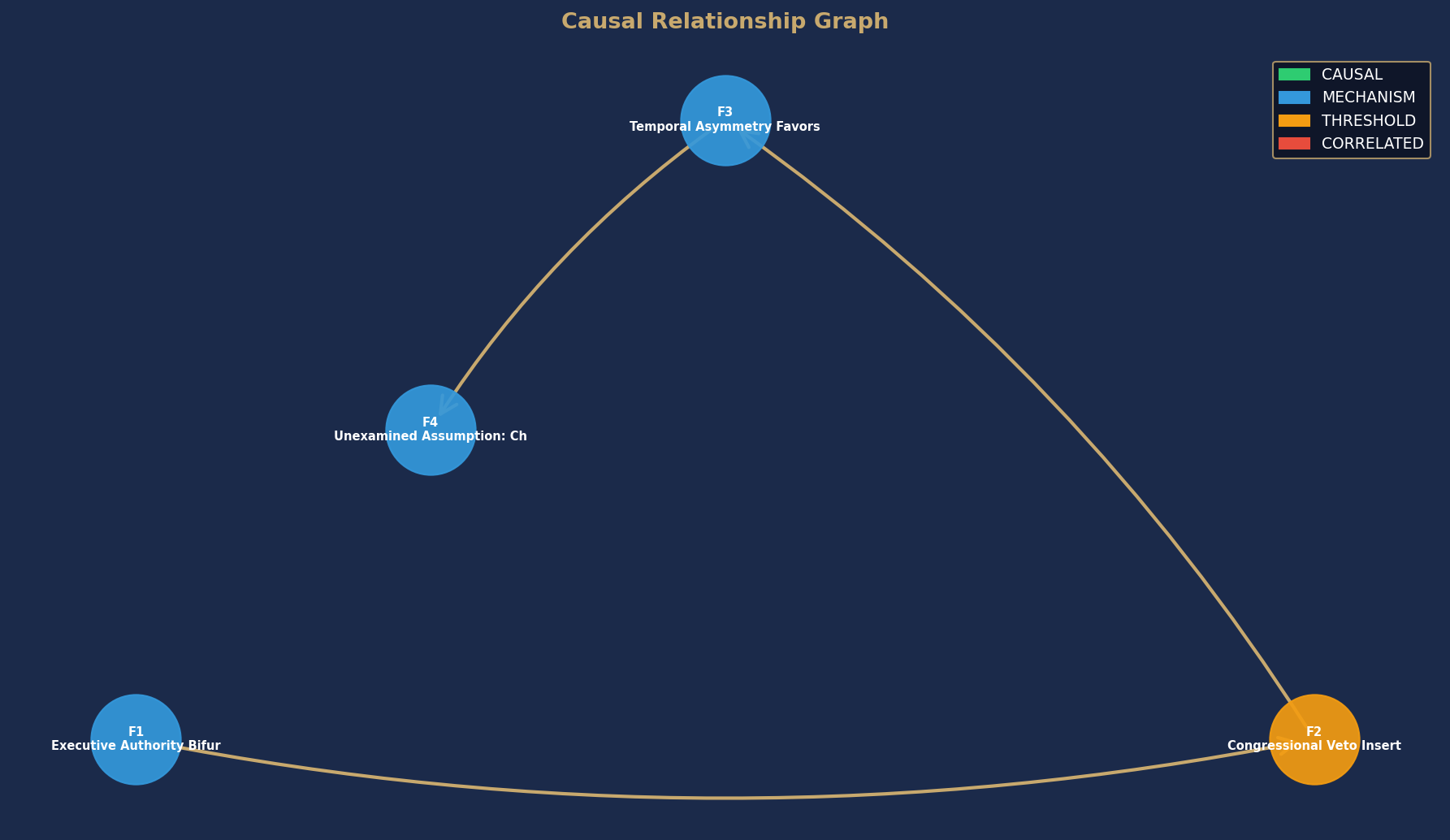
Node colors indicate causal confidence rating. Arrows show directional causal relationships identified in this analysis.
Finding Confidence Distribution
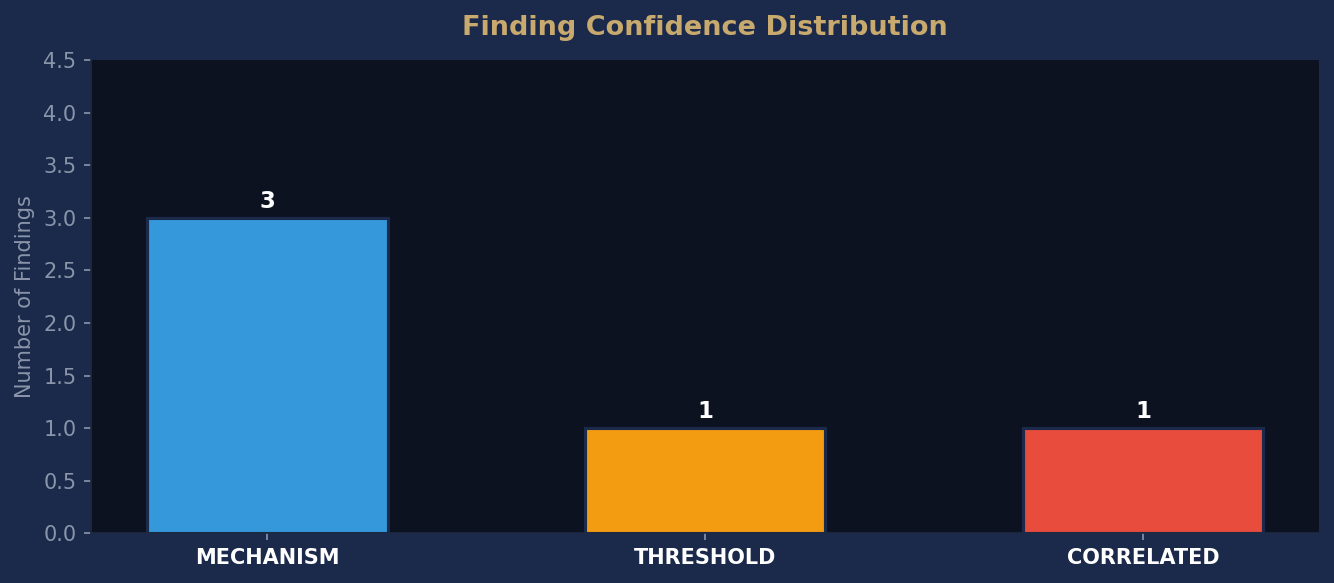
Distribution of causal confidence ratings across all findings in this report. CAUSAL findings are fully actionable. MECHANISM findings require additional evidence before action.
This report was published on May 13, 2026. By the time it's free, the market has already moved.
Don't miss the next one.
Don't miss the next one.
This report was published May 13, 2026. Current intelligence reports are available now.