TRUMP'S IRAN MESSAGING: TACTICAL AMBIGUITY OR STRATEGIC COMMITMENT? DECODING THE DURATION SIGNAL AND ITS ENERGY MARKET IMPLICATIONS
IMPORTANT DISCLAIMER
This report is published by Novo Navis, LLC for general informational purposes only. It does not constitute financial advice, investment advice, legal advice, or any other professional advice. Nothing in this report should be construed as a recommendation to buy, sell, or hold any security, make any investment decision, or take any specific action.
The analysis contained in this report reflects information available as of May 2026. Market conditions, competitive dynamics, regulatory environments, and other factors can change rapidly. Novo Navis makes no representation that the information contained herein is accurate, complete, or current after the date of publication.
Always seek the advice of a qualified financial advisor, attorney, or other licensed professional before making decisions based on information in this report. Past performance of any market, company, or strategy referenced herein is not indicative of future results.
Novo Navis, LLC and its affiliates accept no liability for any loss or damage arising from reliance on this report.
TRUMP'S IRAN MESSAGING: TACTICAL AMBIGUITY OR STRATEGIC COMMITMENT? DECODING THE DURATION SIGNAL AND ITS ENERGY MARKET IMPLICATIONS
Executive Summary
The most important finding in this analysis is not that Trump administration messaging on Iran conflict duration is inconsistent — that is already observable by anyone reading the news. The non-obvious finding is that the administration has not made a strategic choice about duration at all. What looks like deliberate tactical signaling is better characterized as an institutional vacuum: the Pentagon's procurement and logistics apparatus is defaulting to 18-24 month readiness planning because that is what large-scale military operations require structurally, while the White House is messaging short duration because that is what domestic politics permit. Neither side has resolved the contradiction, and the gap between them is creating consequential mispricing in energy markets.
The intelligence assembled here covers a conflict now in its 74th day as of May 13, 2026. [1] U.S. and Israeli forces launched Operation Epic Fury on February 28, 2026, executing nearly 900 strikes in the opening 12 hours. [2] Supreme Leader Ali Khamenei was assassinated in the initial wave. [11] A ceasefire took hold on approximately April 8, around Day 40, but has been punctuated by flare-ups, active ceasefire diplomacy, and Trump's own oscillating public statements — ranging from "four to six weeks" in late March to declaring hostilities "terminated" for War Powers Act purposes while simultaneously rejecting Iranian ceasefire proposals as "garbage" and "totally unacceptable" in early May. [45] [46] [4]
Pentagon cost figures have risen from an initial $25 billion estimate to $29 billion as of May 12, with a supplemental budget request exceeding $200 billion filed in March and a FY2027 defense budget proposal of $1.5 trillion — a 42 percent increase over 2026 levels. [37] [57] [51] These numbers represent the hardest available evidence about institutional time horizons. But the adversarial review in our analytical process found a critical flaw in the natural inference: budget magnitude does not cleanly map to operation-specific duration assumptions. Procurement increases serve multiple strategic purposes simultaneously — Taiwan contingency planning, Israeli rearmament, Gulf stability — and cannot be disaggregated without classified line-item data we do not possess.
The honest conclusion, then, is more uncomfortable than either narrative offers. The Trump administration is not strategically accepting an 18-24 month operation. It is also not genuinely committed to a 4-6 week resolution. It is operating in deliberate ambiguity, using the fragile ceasefire as political cover while the Pentagon sustains a force posture consistent with months of further contingency. Ceasefire negotiations mediated through Pakistan were described as approaching a Memorandum of Understanding as of May 7. [8] That language could mean resolution is weeks away. It could also mean the MOU will fail, as Trump's rejection of the Iranian counter-proposal in early May suggests. [3] [4]
For energy markets, the consequence is structural: the current Brent crude pricing band of roughly $86-97 per barrel reflects neither the official four-to-six-week narrative nor a full 18-24 month disruption scenario. [30] [35] It is a weighted average of multiple unresolved probabilities. The asymmetric risk is to the upside. If conflict resumes at scale, or if the ceasefire persists without Iranian oil production recovery, the price floor should be $95-110 sustained through 2027 rather than the current implied path toward $75-85 by late 2026.
Key rated findings: five findings at MECHANISM level, one at THRESHOLD, one at CORRELATED. No findings reached CAUSAL given the evidence constraints identified in adversarial review. Zero causal rating agreements; six overrides from verification.
Situation and Context
The 2026 Iran war began formally on February 28 when U.S. and Israeli forces executed joint strikes on Iranian military infrastructure, missile sites, air defense networks, and leadership targets. [1] The opening 24 hours represented one of the most intensive air campaigns in recent history, with approximately 900 strikes in the first 12 hours alone. [12] Khamenei was killed on the first day of operations, marking the first assassination of an Iranian supreme leader since the Islamic Republic's founding in 1979. [11]
The operational context matters for duration analysis. The conflict did not begin as a ground invasion. Initial U.S. doctrine emphasized standoff strikes designed to degrade Iranian retaliatory capability, particularly ballistic missile sites and air defense installations, before any consideration of broader ground force commitment. [39] The Pentagon was reported by late March to be preparing for "weeks of ground operations" in Iran, suggesting the mission set was expanding beyond initial strike packages. [38] [41] By late March, U.S. ground forces had arrived in the theater. [65]
The ceasefire that took hold around April 8 — Day 40 of the conflict — was not a formal end-of-hostilities agreement but rather a pause in major operations while diplomatic channels, primarily through Pakistani mediation, sought to produce an MOU framework. [8] [24] The ceasefire has held in aggregate but experienced notable flare-ups. As of May 7 to 12, Trump described the ceasefire as on "massive life support" and "life support," rejected an Iranian counter-proposal as "garbage," and simultaneously claimed to Congress that hostilities had "terminated" for War Powers Act deadline purposes — even as the Pentagon publicly stated it has active plans to escalate the conflict. [3] [4] [40] [47]
The financial picture is documented but incomplete. The Pentagon cited approximately $25 billion spent by Day 60, rising to $29 billion by Day 74. [52] [58] A supplemental budget request of over $200 billion was submitted to Congress in March. [57] The FY2027 defense budget request totals $1.5 trillion, with a 76 percent procurement increase and 64 percent research and development increase embedded in it. [51] Separately, the Pentagon acknowledged that munitions used in Iran operations will take years to replace and that an ammunition shortage is emerging. [42] [55]
The Strait of Hormuz remains a critical variable. Trump announced on May 3 that the U.S. would help free up Hormuz shipping the following morning. The Iranian military warned the U.S. to stay out of Hormuz on May 4. [2] Iran's oil export capacity has been substantially disrupted — approximately 2.2 million barrels per day offline — shifting global supply balances sharply. [27] [35] The World Bank described the conflict as likely to spark the biggest energy price surge in four years. [32]
WTI crude futures swung between $88.66 and $107.46 per barrel in the May 3-7 window before stabilizing near $97. Brent is forecast to average $86 per barrel for full-year 2026, up from $69 in 2025. [30] [33] The Dallas Fed and Minneapolis Fed are both tracking whether the commodity shock can be treated as transitory or whether duration will force structural price-level adjustments. [29] [34]
U.S. domestic politics have complicated the strategic picture. Trump's administration did not seek formal Congressional authorization for the war, instead relying on emergency authority and arguing — implausibly to many legal observers — that a fragile ceasefire constitutes termination of hostilities sufficient to satisfy War Powers Act requirements. [47] [48] Congressional hearings with Defense Secretary Hegseth have pressed for clarity on authorization, ceasefire terms, and actual conflict costs, but officials have remained notably opaque on the duration question. [49]
The diplomatic horizon includes the near-completed MOU framework via Pakistan. Iran has simultaneously declared it will "never bow" to U.S. demands and signaled willingness to negotiate on Strait of Hormuz access and nuclear program parameters. [8] [5] Whether the MOU framework represents genuine convergence or tactical positioning is the central intelligence question this report addresses.
Causal Analysis
Finding 1: Public Timeline Statements and Operational Reality
Rating: MECHANISM
The Trump administration's public statements on conflict duration have been systematically and trackably shorter than the operational reality unfolding on the ground. Trump estimated "approximately four to six weeks" in late March. [45] [46] By Day 74 in mid-May, the conflict has lasted more than three times that estimate while Trump continues to suggest resolution is near. [10] The Washington Post documented that Trump has changed his timeline repeatedly. [45] PBS assembled a full timeline of the shifting statements. [46]
The mechanism hypothesis is as follows. Political incentive structures force compressed public timelines because an administration that acknowledges multi-month operations faces domestic cost-benefit scrutiny, congressional pressure for formal authorization, and opposition mobilization around war fatigue. The 4-6 week frame was deployed not as an intelligence estimate but as political management. The Pentagon simultaneously operates on logistics and procurement timelines that are structurally longer — procurement decisions and supply chain positioning require 18-36 month lead times, meaning any genuinely new acquisition initiated at the conflict's start would not deliver operational capability for at least a year. [Education_1]
The adversarial review identified a material confound: the absence of demobilization announcements after 30 days of ceasefire proves nothing about Pentagon duration assumptions. Military standard practice is to hold force posture during fragile ceasefires for 90 to 180 days before beginning drawdown. The ceasefire began around April 8. As of May 13, only 35 days have elapsed. By institutional practice, no rational military planner would announce demobilization before the ceasefire's stability is verified. The absence of drawdown orders is therefore consistent with either a genuine 4-6 week belief or an 18-24 month belief. It does not distinguish between them.
The mechanism finding stands at this confidence level: the gap between public messaging and operational timeline is real and observable. A plausible pathway — political incentive for short messaging, institutional default toward longer logistics planning — explains it. But the evidence available does not confirm which mechanism is dominant, and the confounds identified are material.
Finding 2: Energy Market Pricing and Duration Uncertainty
Rating: MECHANISM
WTI crude oscillating between $88.66 and $107.46 in a single week (May 3-7) before settling near $97 represents a market that is neither pricing rapid resolution nor sustained disruption. [30] [33] The Brent full-year forecast of $86 implies a market consensus of medium-duration disruption with gradual Iranian production recovery. [30]
The mechanism: sophisticated energy market participants have learned — from Iraq, from Afghanistan, from the 2019 Saudi Aramco attack — that official government timeline estimates have near-zero predictive value. Market participants instead cross-reference observable institutional signals (deployment scale, procurement patterns, congressional testimony) with physical supply-chain data and their own intelligence access. The result is an implicit probability-weighted average across resolution scenarios.
At $86-97, the market appears to be weighting something like a 40-50 percent probability of medium-term resolution (six to twelve months), a 30-40 percent probability of extended disruption (twelve to twenty-four months), and a smaller probability both of rapid resolution and of major escalation. If the true scenario is 18-24 months of at-minimum intermittent disruption, the current pricing band underestimates the structural supply impact.
However, the adversarial review identified a logical tension the analysis must acknowledge. Finding 2 argues markets correctly read institutional signals. Finding 6 (addressed below) argues markets are mispriced. These cannot both be unqualifiedly true. If energy markets are sophisticated enough to extract implicit duration signals from Pentagon institutional behavior, then current pricing may reflect markets' accurate assessment of what the Pentagon actually believes — which may be 8-12 months rather than 18-24. The honest statement of the mechanism is: current pricing reflects market uncertainty about duration, but the direction of mispricing (if any) depends on evidence we cannot fully resolve with available public data.
Finding 3: Congressional Appropriations and Political Messaging Constraint
Rating: CORRELATED
The adversarial review applied its most sustained challenge to the original domain analysis's CAUSAL rating for this finding. The challenge succeeds.
The observable facts are: a $200 billion-plus supplemental budget request in March [57], a $1.5 trillion FY2027 request with a 76 percent procurement increase [51], and $29 billion expended through Day 74. [37] These are large numbers. The original analysis inferred that the procurement magnitude reveals a genuine 18-24 month operation-specific assumption.
The inference does not hold at causal level for three reasons. First, FY2027 appropriations do not fund current operations. Current spending (February through at least September 2026) draws from FY2026 carry-over, emergency supplemental authority, and reprogramming. The FY2027 budget, which does not take effect until October 2026, reflects planning assumptions that are not yet binding on current operations. Second, the 76 percent procurement increase cannot be attributed to Iran without classified line-item data. Pentagon procurement budgets encompass Taiwan contingency planning, Israeli rearmament, Baltic deterrence, and generic readiness reconstitution — all of which received renewed urgency from the Iran operation regardless of its duration. Third, and most fundamentally, DoD budget requests are not linearly sensitive to specific operation durations. They are shaped by formula-based percentage increases, internal political negotiations between service branches, and congressional markup expectations. A 42 percent increase in total defense spending does not decode as "Pentagon assumes Iran war lasts 42 percent longer than the one-week baseline."
What is established at CORRELATED level is that large budget increases occurred simultaneously with an active conflict and that procurement lead times are structurally longer than the public 4-6 week estimate. These are real observations. They are not causally connected to a specific operational duration assumption.
The important downstream implication: three of the original domain analysis's high-confidence CAUSAL findings depended on this finding's causal rating. When it drops to CORRELATED, those findings also lose their causal foundation. This is the single most consequential analytical revision in this report.
Finding 4: Force Deployment Posture as Duration Signal
Rating: THRESHOLD
The observation is straightforward: a ceasefire has been in effect for approximately 35 days as of May 13, yet no force drawdown, redeployment, or demobilization announcements have been made. [60] [61] The correlation between ceasefire and continued full force posture is robust.
The mechanism, however, is genuinely indeterminate between two plausible pathways. Pathway A: Pentagon is hedging against ceasefire collapse, which is standard practice during fragile ceasefires of less than 90 days duration. Pathway B: Pentagon is maintaining force structure because it expects a sustained stabilization or occupation mission requiring 18-24 months of theater presence. The data available to this analysis cannot distinguish between these pathways. Force rotation schedules through 2027-2028, basing decisions, and service branch posture statements — the evidence that would make this determination — are classified or unavailable.
The threshold finding is correctly rated because the correlation is statistically robust and reproducible (militaries do not demobilize during active diplomatic uncertainty) but the mechanism pointing toward genuine long-duration commitment cannot be confirmed.
Finding 5: Is the Messaging Strategic Acceptance or Tactical Signaling?
Rating: MECHANISM
This is the report's central analytical question. The careful answer, after adversarial review, is more nuanced than either "tactical deception" or "genuine acceptance."
The Trump administration has not made a genuine strategic decision about Iran conflict duration. The evidence for this is the pattern of contradictions that cannot be explained by either unified deception or unified conviction. On the same day in May, Trump called the ceasefire "on massive life support" [2], said he had not thought about Americans' financial situation [10], and his administration told Congress hostilities were "terminated" for War Powers Act purposes [47]. The Pentagon simultaneously stated it has active escalation plans [40] while reporting $29 billion in sunk costs [37]. This is not the signature of a coherent tactical deception — it is the signature of an administration that has not internally resolved whether it wants to end the conflict or sustain it.
The mechanism is this: political and institutional actors within the Trump administration are optimizing for different audiences on different timescales. The White House optimizes for next week's domestic news cycle. The Pentagon optimizes for next year's logistics chain and munitions resupply. The diplomatic channel optimizes for the fragile MOU negotiation window. Each produces messaging calibrated to its audience without central coordination. The result is what appears to be tactical ambiguity but is more accurately described as strategic indeterminacy.
This has a specific implication for the 18-24 month question. The 18-24 month window appears in strategic planning literature and analyst frameworks [20] [21], but there is no confirmed evidence that the Trump administration has explicitly accepted it as an operational parameter. The more defensible formulation is that the institutional apparatus has defaulted to 18-24 month logistics readiness because that is what large-scale Middle Eastern military operations require structurally. Whether that default will translate into actual 18-24 month commitment depends on three variables analyzed below: Israeli staying power, domestic political sustainability, and whether the MOU process succeeds or collapses.
The adversarial review correctly noted counter-evidence the domain analysis underweighted. Khamenei's assassination was a genuine strategic objective achievement. [11] If the Trump administration believed decapitation of Iranian leadership was the primary goal, 70 days to achieve it followed by negotiated stabilization would be consistent with the 4-6 week estimate as applied to remaining operations (not to the whole conflict). The MOU language as of May 7 — "actively closing in" — is not language consistent with a tactical pause. [8] These are real considerations that raise the probability of near-term resolution above what the most pessimistic reading of institutional signals would suggest.
Confidence in the mechanism: the mechanism of strategic indeterminacy (as opposed to tactical deception or strategic acceptance) is supported by the observable contradictions, the absence of internal coordination signals, and the war's trajectory. It is not confirmed at causal level because confirming it would require classified internal communications.
Finding 6: Energy Market Structural Assumptions and Repricing Risk
Rating: MECHANISM
The energy market structural risk is real but the causal pathway to "mispricing" requires a qualification the domain analysis did not initially apply.
The observable condition: markets are pricing a moderate disruption scenario ($86-97 WTI) while the conflict's trajectory contains meaningful probability of outcomes in both directions — rapid MOU-based resolution and resumed hostilities. [30] [33] [35] The World Bank explicitly flagged the biggest energy price surge in four years as a risk [32], and Bloomberg has mapped Hormuz closure scenarios to $110+ oil. [35]
The mechanism: if the ceasefire collapses — which Trump's own language makes plausible ("massive life support," "garbage" counter-proposal) [2] [4] — Iranian oil export disruption will extend through 2027 at minimum, the Strait of Hormuz access question will re-escalate, and the structural price floor rises materially. The current pricing band does not fully discount this scenario.
The adversarial review's legitimate challenge: the market may have access to classified intelligence, physical supply-chain data, and commodity producer signals that correctly suggest resolution is more probable than the public signals indicate. Sophisticated energy market participants are not reading only Trump's press releases. Morgan Stanley, the Dallas Fed, and Minneapolis Fed are all treating the disruption as potentially transitory. [28] [29] [34] If they are correct and the MOU concludes within weeks, $86-97 WTI will have been appropriate pricing, not mispricing.
The asymmetry in the risk remains. The cost of underpricing a 18-24 month disruption scenario is larger than the cost of overpricing a 4-6 week resolution, because the former produces a sharp multi-standard-deviation repricing event while the latter produces a gradual price normalization. That asymmetry makes long-duration exposure underweighted relative to expected value even if the probability of resolution is higher than the probability of extension. [Education_2]
Finding 7: Ally Signaling Misalignment
Rating: MECHANISM
The joint nature of the U.S.-Israel operation creates a meaningful constraint on duration that the analysis must address. [13] [18] Israel launched the conflict in coordination with the U.S. and shares the operational burden. But Israel's domestic political coalition, public war tolerance, and resource base are substantially smaller than the United States'. If Israel signals pressure to conclude operations by Q3 or Q4 2026, Trump faces a binary: accept a settlement on terms available then, or continue solo. Neither is politically comfortable.
The MOU negotiation trajectory as of early May is genuinely ambiguous on Israeli alignment. The adversarial review noted that the MOU language ("closing in on") supports the short-duration scenario. The ceasefire's instability (characterized by Trump as on "life support") supports the extension scenario. [6] Without Israel's private position on acceptable MOU terms, the allied-constraint mechanism cannot be rated above MECHANISM. The missing data on Israel's posture remains the critical variable for duration forecasting.
Who Benefits and Why
Short-Duration Resolution (Weeks): MECHANISM
If the MOU framework under Pakistani mediation concludes successfully within the next four to six weeks, the primary beneficiaries are the Trump administration (political vindication of the compressed timeline narrative), Iran's surviving leadership (preserves sufficient state continuity to negotiate), and global energy consumers (rapid Hormuz reopening, Iranian production recovery, oil prices declining toward $70-80 range).
Financial beneficiaries include any entity with structural short-crude positioning or long-duration consumer business (airlines, shipping, manufacturing). Saudi Arabia and UAE face complex calculus: Iranian production recovery erodes their OPEC pricing power, but regional stability reduces their own security cost. The Saudis have historically preferred elevated prices with some risk premium over normalization that brings Iranian production back online. [27]
For the Trump administration specifically, the domestic political benefit of "ended the Iran war in under three months" is substantial and would likely produce a polling surge. The War Powers Act exposure evaporates. Congressional pressure for authorization hearings dissipates. This is the scenario the administration is signaling publicly and has genuine incentive to pursue.
Extended Disruption (12-24 Months): MECHANISM
If the ceasefire collapses, or if the MOU fails to produce Strait of Hormuz reopening and Iranian production restoration, the beneficiaries shift substantially.
U.S. domestic energy producers — shale oil and gas companies, LNG exporters — benefit from sustained price elevation. WTI above $95 generates exceptional margin for tight-oil producers with break-even costs in the $45-65 range. The 2014-2016 shale industry learned to survive low prices; the 2026 iteration operating at $95-110 generates cash flows that fund rapid production increases. [28] [31]
Defense contractors benefit regardless of duration but benefit more from extended operations. The Pentagon's munitions shortage [42] [55] and the $200 billion supplemental request [57] translate into expanded procurement contracts. Companies with precision munition production capability — the specific class depleted most rapidly in the Iran strikes — will see multi-year contract awards with upfront delivery urgency pricing. [55] [56]
Saudi Arabia benefits from sustained price elevation above $85-90 per barrel, which funds Vision 2030 investments and restores budgetary comfort after the 2023-2025 period of oil price weakness. The Kingdom also benefits strategically from Iranian military degradation regardless of duration. [27] [32]
Russia benefits from sustained elevated oil prices, which partially offset the financial pressure of its own separate conflict context, and from Western strategic attention being absorbed in the Middle East. Commodity-linked currencies more broadly strengthen against USD in a prolonged disruption scenario. [27]
The munitions resupply constraint deserves specific attention here. The analysis establishes that weapons used against Iran will take years to replace. [55] This means that if conflict extends, U.S. coercive capacity in other theaters degrades. Taiwan contingency planning, NATO deterrence, and global power projection all depend on the same munitions stockpiles. Extended Iran conflict therefore benefits potential adversaries with interests in other theaters on a 12-36 month horizon — a second-order benefit that does not appear to be fully incorporated in current strategic discourse.
Energy market participants who correctly position for duration extension — long crude calls above $110, long mid-continent refinery margins, long LNG spot exposure — stand to benefit materially from the repricing event if and when it occurs. The critical timing question is whether Q3 2026 becomes the forcing function, when it will become undeniable that the "four to six weeks" estimate has been missed by more than 100 days.
Key Risks
Risk 1: MOU Conclusion Is Imminent (High Impact to Analysis)
The most material risk to this analysis is that the MOU framework under Pakistani mediation concludes within the next two to four weeks on terms that genuinely reopen Hormuz, permit Iranian production recovery, and produce verifiable nuclear program commitments from Tehran. The language as of May 7 — "actively closing in on" — is not language analysts should dismiss. [8] If this resolves positively, the energy market structural disruption analysis does not apply, the 18-24 month scenario probability collapses, and Trump's 4-6 week estimate (applied to remaining operations from a late-April baseline) receives some retrospective validation.
This risk is material enough that long-duration crude positions initiated on the basis of this analysis should be sized and hedged accordingly. A 30-percent scenario weight on rapid resolution is appropriate given available evidence.
Risk 2: Escalation Beyond Current Parameters (High Impact)
The Pentagon's May 12 statement confirming active escalation plans [40] represents the opposite risk: that the ceasefire collapses into resumed hostilities at a scale exceeding the February-April operation. If Iran successfully retaliates against U.S. or Israeli assets, or if Khamenei's succession produces a harder-line leadership with less interest in MOU terms, the conflict could escalate into sustained ground operations. The Bloomberg Hormuz closure scenario mapped to $110-150 oil [35] would represent a repricing event of macro consequence — sufficient to tip the U.S. into recession and re-ignite inflation above central bank control parameters.
Risk 3: Congressional Action on War Authorization (Medium Impact)
If Congressional leadership forces a formal war authorization vote, the administration must either justify extended operations publicly (converting tactical ambiguity into explicit commitment) or withdraw. Either outcome has large consequences. The War Powers Act deadline maneuvering that Trump attempted in May [47] [48] is not a permanent solution. A sustained operation into fall 2026 will face renewed congressional pressure as the FY2027 budget markup proceeds. [49] Congressional action that constrains operation duration would accelerate the repricing of long-duration oil positions downward.
Risk 4: Budget Analysis Overstates Iran-Specificity (Medium Impact)
The adversarial review's strongest point is that the FY2027 budget increases cannot be attributed to Iran operations without classified line-item data. If the 76 percent procurement increase primarily reflects Taiwan contingency and NATO commitments rather than Iran duration assumptions, the institutional signal is considerably weaker than the analysis suggests. This would imply the Pentagon is not actually planning for 18-24 months of Iran operations — it is planning for concurrent multi-theater readiness. That scenario is not reassuring about U.S. strategic posture generally, but it is less relevant to Iran duration specifically.
What to Watch
The following specific indicators will resolve the open questions in this analysis within 90 days.
MOU Outcome: The most important single data point is whether the Pakistani-mediated MOU framework concludes with an agreement before the end of May. If agreement language is released before June 1, assess carefully whether it includes Hormuz access commitments and Iranian production restoration timelines. Vague language that defers implementation will not qualify as genuine resolution — watch for enforcement mechanisms and third-party verification provisions.
Congressional Appropriations Markup: The House and Senate Armed Services Committee markups of the FY2027 defense budget, expected May through July, will include classified and unclassified testimony on Iran operations. If committee members specifically request a duration estimate and receive a classified briefing, reports of those briefings leaking will be the clearest available signal of true institutional assumptions. Watch for any budget language that explicitly attributes procurement line items to Iran sustainment rather than generic readiness.
Pentagon Force Rotation Announcements: If the ceasefire holds through June, watch for any announced force rotations. Units rotating into theater on 9-12 month deployment cycles would signal an assumption of extended operations through at least Q1 2027. Units rotating home without replacement would signal genuine drawdown trajectory. This is the most operationally honest signal available because rotation orders must be given 60-90 days in advance.
Oil Futures Forward Curve Shape: Monitor the slope of the Brent and WTI forward curves, particularly the 12-24 month portion. A flattening or inversion of the forward curve (near-month futures trading above distant months) would signal that sophisticated market participants believe disruption is extending. A steep backwardation would signal confidence in near-term resolution. Large options positioning in out-of-the-money $110+ calls for 2027 delivery, if reported in CFTC data, would indicate institutional hedging against the extended scenario.
Iranian Production Data: Watch for any reports of Iranian oil export resumption. If Iranian crude begins reappearing in Asian markets (via China, India, or intermediary transit) within 60 days, it signals that practical production restoration is underway regardless of formal MOU status. Conversely, if Iranian production remains offline through August, the structural supply gap hardens into 2027 pricing.
Trump Domestic Political Events: The fall 2026 midterm campaign context will sharpen domestic constraints on extended conflict. Watch for any shift in Republican legislative leadership's posture toward the war after July 4. Elite party opinion, which Trump monitors closely, is a more reliable leading indicator of administration direction changes than Trump's own public statements, which oscillate.
APPENDIX: ANALYSIS LOG
Report ID: NN-GEO-2026-0513-001
Topic: Trump administration Iran conflict duration messaging — genuine strategic acceptance of 18-24 month operations or tactical signaling, and energy market structural implications Published: May 13, 2026 Real-time data gathered: Yes Sources cited: 66 Causal ratings: CAUSAL 0 | MECHANISM 5 | THRESHOLD 1 | CORRELATED 1 Verification agreements: 0 | Overrides: 6 Open questions: GAP_001: Official DoD strategic planning documents (classified) on Iran campaign phase timing GAP_002: Private administration strategic messaging guidance (internal memos on messaging discipline) GAP_003: Real-time intelligence on Iranian operational readiness and timeline constraints GAP_004: Congressional appropriations markup details on FY2026-2027 Iran operations funding profiles GAP_005: Allied burden-sharing negotiation transcripts (Israel, Gulf states) on commitment duration
Bibliography
[1] 2026 Iran war - Wikipedia
https://en.wikipedia.org/wiki/2026_Iran_war Accessed: 2026-05-13T12:00:47.004543
[2] Iran war updates: Trump claims ‘not long’ before war ends | US-Israel war on Iran News | Al Jazeera https://www.aljazeera.com/news/liveblog/2026/5/12/iran-war-live-trump-slams-iranian-proposal-as-ceasefire-hangs-by-a-thread Accessed: 2026-05-13T12:00:47.004543
[3] Live updates: Trump says ceasefire with Iran on ‘massive life support’ after he rejects Tehran’s proposal | CNN https://www.cnn.com/2026/05/11/world/live-news/iran-war-proposal-trump Accessed: 2026-05-13T12:00:47.004543
[4] Trump says Iran ceasefire is on ‘life support,’ calls latest proposal ‘garbage’ - The Washington Post https://www.washingtonpost.com/politics/2026/05/10/iran-response-us-proposal-war/ Accessed: 2026-05-13T12:00:47.004543
[5] 2025–2026 Iran–United States negotiations - Wikipedia
https://en.wikipedia.org/wiki/2025%E2%80%932026_Iran%E2%80%93United_States_negotiations Accessed: 2026-05-13T12:00:47.004543
[6] Trump says ceasefire on ‘life support’, slams Iran response to US proposal | US-Israel war on Iran News | Al Jazeera https://www.aljazeera.com/news/2026/5/11/trump-says-ceasefire-on-life-support-slams-iran-response-to-us-proposal Accessed: 2026-05-13T12:00:47.004543
[7] Day 72 of Middle East conflict — Trump calls Iran response to US proposal ‘totally unacceptable’ | CNN https://www.cnn.com/2026/05/10/world/live-news/iran-war-news Accessed: 2026-05-13T12:00:47.004543
[8] Iran says it will 'never bow' as Trump rejects peace counteroffer, prolonging Middle East conflict https://www.cnbc.com/2026/05/11/iran-war-trump-negotiation-hormuz-nuclear-talks.html Accessed: 2026-05-13T12:00:47.004543
[9] Trump ties himself in knots to avoid resuming a full-scale war in Iran | CNN Politics https://www.cnn.com/2026/05/11/politics/iran-war-trump-ceasefire Accessed: 2026-05-13T12:00:47.004543
[10] Day 74 of Middle East conflict — Trump says ‘I don’t think about Americans’ financial situation’ | CNN https://www.cnn.com/2026/05/12/world/live-news/trump-iran-war-news Accessed: 2026-05-13T12:00:47.004543
[11] Timeline of the 2026 Iran war - Wikipedia
https://en.wikipedia.org/wiki/Timeline_of_the_2026_Iran_war Accessed: 2026-05-13T12:00:56.469635
[12] 2026 Iran war | Explained, United States, Israel, Strait of Hormuz, Map, & Conflict | Britannica https://www.britannica.com/event/2026-Iran-war Accessed: 2026-05-13T12:00:56.469635
[13] The Iran Strikes, Explained: How We Got Here and What It Means | AJC https://www.ajc.org/news/the-iran-strikes-explained-how-we-got-here-and-what-it-means Accessed: 2026-05-13T12:00:56.469635
[14] U.S. Conflict with Iran March 26, 2026 Congressional Research Service https://www.congress.gov/crs_external_products/R/PDF/R48887/R48887.1.pdf Accessed: 2026-05-13T12:00:56.469635
[15] Iran War 2026 -- Operational Report -- 07 May 2026 https://www.globalsecurity.org/military/ops/iran-war-oprep.htm Accessed: 2026-05-13T12:00:56.469635
[16] US-Iran Conflict 2026 Timeline: Complete Chronology of Strikes & Escalation — MissileStrikes.com https://missilestrikes.com/impact/us-iran-conflict-timeline-2026/ Accessed: 2026-05-13T12:00:56.469635
[17] 2026 United States military buildup in the Middle East - Wikipedia https://en.wikipedia.org/wiki/2026_United_States_military_buildup_in_the_Middle_East Accessed: 2026-05-13T12:00:56.469635
[18] Israel/US-Iran conflict 2026: Background and UK response - House of Commons Library https://commonslibrary.parliament.uk/research-briefings/cbp-10521/ Accessed: 2026-05-13T12:00:56.469635
[19] Israel/US-Iran conflict 2026: Background and UK response
https://researchbriefings.files.parliament.uk/documents/CBP-10521/CBP-10521.pdf Accessed: 2026-05-13T12:00:56.469635
[20] Iran War: Future Scenario and Business Implications
https://www.recordedfuture.com/research/iran-war-future-scenarios Accessed: 2026-05-13T12:01:07.264313
[21] From Bargain to Breakdown: Five Strategic Futures for the Iran War https://smallwarsjournal.com/2026/04/06/from-bargain-to-breakdown/ Accessed: 2026-05-13T12:01:07.264313
[22] Prelude to the 2026 Iran war - Wikipedia
https://en.wikipedia.org/wiki/Prelude_to_the_2026_Iran_war Accessed: 2026-05-13T12:01:07.264313
[23] Iran’s War Strategy: Don’t Calibrate—Escalate | CSIS
https://www.csis.org/analysis/irans-war-strategy-dont-calibrate-escalate Accessed: 2026-05-13T12:01:07.264313
[24] 2026 Iran war ceasefire - Wikipedia
https://en.wikipedia.org/wiki/2026_Iran_war_ceasefire Accessed: 2026-05-13T12:01:07.264313
[25] Five Weeks of Conflict with Iran: Trajectories, Risks, and Global Implications - Center on Global Energy Policy at Columbia University SIPA | CGEP https://www.energypolicy.columbia.edu/events/five-weeks-of-conflict-with-iran-trajectories-risks-and-global-implications/ Accessed: 2026-05-13T12:01:07.264313
[26] The ‘Fourth Successor’: Iran’s plan for a long war with the US and Israel | US-Israel war on Iran | Al Jazeera https://www.aljazeera.com/features/2026/3/10/the-fourth-successor-how-iran-planned-to-fight-a-long-war-with-the-us-and-israel Accessed: 2026-05-13T12:01:07.264313
[27] Economic impact of the 2026 Iran war - Wikipedia https://en.wikipedia.org/wiki/Economic_impact_of_the_2026_Iran_war Accessed: 2026-05-13T12:01:17.617493
[28] Iran Conflict: Oil Price Impacts and Inflation | Morgan Stanley https://www.morganstanley.com/insights/articles/iran-war-oil-inflation-stock-market-2026 Accessed: 2026-05-13T12:01:17.617493
[29] The Impact of the 2026 Iran War on U.S. Inflation https://www.dallasfed.org/~/media/documents/research/papers/2026/wp2609.pdf Accessed: 2026-05-13T12:01:17.617493
[30] A timeline of how the Iran war shook oil prices — and what comes next https://www.cnbc.com/2026/04/21/oil-price-iran-war-middle-east.html Accessed: 2026-05-13T12:01:17.617493
[31] 2026 Iran war fuel crisis - Wikipedia
https://en.wikipedia.org/wiki/2026_Iran_war_fuel_crisis Accessed: 2026-05-13T12:01:17.617493
[32] Middle East War to Spark Biggest Energy Price Surge in Four Years https://www.worldbank.org/en/news/press-release/2026/04/28/commodity-markets-outlook-april-2026-press-release Accessed: 2026-05-13T12:01:17.617493
[33] Oil Prices Whipsaw as U.S.-Iran Conflict Shakes Markets | OilPrice.com https://oilprice.com/Energy/Energy-General/Oil-Prices-Whipsaw-as-US-Iran-Conflict-Shakes-Markets.html Accessed: 2026-05-13T12:01:17.617493
[34] How long can we "look through" the Iran war commodity shock? | Federal Reserve Bank of Minneapolis https://www.minneapolisfed.org/article/2026/how-long-can-we-look-through-the-iran-war-commodity-shock Accessed: 2026-05-13T12:01:17.617493
[35] Iran War: How High Could Oil Prices Get with Strait of Hormuz Closure? https://www.bloomberg.com/graphics/2026-iran-war-hormuz-closure-oil-shock/ Accessed: 2026-05-13T12:01:17.617493
[36] Iran War: Ceasefire Offers Relief, Not Resolution | Charles Schwab https://www.schwab.com/learn/story/iran-war-potential-impact-on-global-equities Accessed: 2026-05-13T12:01:17.617493
[37] Pentagon gives new $29bn Iran war price tag, downplays munitions concerns | US-Israel war on Iran News | Al Jazeera https://www.aljazeera.com/news/2026/5/12/pentagon-gives-new-29bn-iran-war-price-tag-downplays-munitions-concerns Accessed: 2026-05-13T12:01:27.177329
[38] Pentagon readies ‘for weeks of US ground operations’ in Iran | US-Israel war on Iran News | Al Jazeera https://www.aljazeera.com/news/2026/3/29/pentagon-readies-for-weeks-of-us-ground-operations-in-iran-report Accessed: 2026-05-13T12:01:27.177329
[39] Initial Iran strikes over, what strategy defines the next US military moves? - CSMonitor.com https://www.csmonitor.com/USA/Military/2026/0302/trump-military-strategy-iran Accessed: 2026-05-13T12:01:27.177329
[40] Pentagon Says US Has Active Plans to Escalate Iran Conflict https://easternherald.com/2026/05/12/pentagon-us-escalate-iran-conflict-hegseth/ Accessed: 2026-05-13T12:01:27.177329
[41] Pentagon reportedly preparing for weeks of ground operations in Iran https://www.militarytimes.com/news/your-military/2026/03/29/pentagon-reportedly-preparing-for-weeks-of-ground-operations-in-iran/ Accessed: 2026-05-13T12:01:27.177329
[42] The U.S. is Facing an Ammunition Shortage Due to the Iran War. Here’s What That Means https://time.com/article/2026/05/12/US-ammunition-shortage-iran-war/ Accessed: 2026-05-13T12:01:27.177329
[43] Iran Conflict and the Strait of Hormuz: Impacts on Oil, Gas, ... https://www.congress.gov/crs_external_products/R/PDF/R45281/R45281.6.pdf Accessed: 2026-05-13T12:01:27.177329
[44] Pentagon seeks additional funding as cost of Iran War increases to $29 billion | IRIA News https://www.ir-ia.com/news/pentagon-seeks-additional-funding-as-cost-of-iran-war-increases-to-29-billion/ Accessed: 2026-05-13T12:01:27.177329
[45] Trump keeps changing his timeline for ending the Iran war - The Washington Post https://www.washingtonpost.com/world/2026/05/05/trump-changing-strategy-iran-war/ Accessed: 2026-05-13T12:02:32.125858
[46] A timeline of Trump's shifting statements about how long the Iran war will last | PBS News https://www.pbs.org/newshour/politics/a-timeline-of-trumps-shifting-statements-about-how-long-the-iran-war-will-last Accessed: 2026-05-13T12:02:32.125858
[47] Trump says deadline for Congress to approve Iran war doesn't apply, claiming hostilities have 'terminated' | PBS News https://www.pbs.org/newshour/politics/trump-says-deadline-for-congress-to-approve-iran-war-doesnt-apply-claiming-hostilities-have-terminated Accessed: 2026-05-13T12:02:32.125858
[48] Trump tells U.S. Congress that ceasefire 'terminated' Iran conflict, as war powers deadline arrives | CBC News https://www.cbc.ca/news/world/trump-iran-war-ceasefire-war-powers-deadline-congress-9.7184875 Accessed: 2026-05-13T12:02:32.125858
[49] Lawmakers press Hegseth on details on Iran war authorization, ceasefire and Pentagon funding - CBS News https://www.cbsnews.com/news/hegseth-caine-pentagon-budget-request-congress-committees/ Accessed: 2026-05-13T12:02:41.662437
[50] Pentagon Says US Has Spent Around $29 Billion on Iran Operations https://www.airandspaceforces.com/pentagon-says-us-has-spent-around-29b-on-iran-operations-full-cost-remains-unclear/ Accessed: 2026-05-13T12:02:41.662437
[51] What's in the Pentagon's $1.5 trillion budget proposal? – Deseret News https://www.deseret.com/politics/2026/04/29/pentagon-trillion-dollar-budget-iran-war-update/ Accessed: 2026-05-13T12:02:41.662437
[52] The Pentagon Says the Iran War Cost Has Jumped to $29 Billion - NOTUS — News of the United States https://www.notus.org/defense/pentagon-iran-war-cost-29-billion Accessed: 2026-05-13T12:02:41.662437
[53] Iran War Has Cost $25 Billion So Far, Pentagon Says https://www.airandspaceforces.com/war-against-iran-cost-25-billion-pentagon/ Accessed: 2026-05-13T12:02:41.662437
[54] Pentagon seeks $1.5 trillion as Iran war costs hit $25 billion | National | ttownmedia.com https://www.ttownmedia.com/news/national/pentagon-seeks-1-5-trillion-as-iran-war-costs-hit-25-billion/article_fbb90d12-5fa7-5a0c-8357-5f00dd86c233.html Accessed: 2026-05-13T12:02:41.662437
[55] Munitions Used Against Iran Will Take Years to Replace https://www.airandspaceforces.com/munitions-used-against-iran-take-years-replace-huge-pentagon-weapons-budget/ Accessed: 2026-05-13T12:02:41.662437
[56] Pentagon’s 2027 budget proposes big spending on munitions for Iran conflict, but officials mum on cost of war https://www.scrippsnews.com/us-news/iran-war/pentagons-2027-budget-proposes-big-spending-on-munitions-for-iran-conflict-but-officials-mum-on-cost-of-war Accessed: 2026-05-13T12:02:41.662437
[57] Pentagon seeks over $200 billion in Iran war supplemental budget request - The Washington Post https://www.washingtonpost.com/national-security/2026/03/18/iran-cost-budget-pentagon/ Accessed: 2026-05-13T12:02:41.662437
[58] Sixty days in, Pentagon estimates $25B spent on Iran war - Defense One https://www.defenseone.com/policy/2026/04/sixty-days-pentagon-estimates-25b-spent-iran-war/413208/ Accessed: 2026-05-13T12:02:41.662437
[59] America’s Military Buildup Around Iran: What We Know and What It Means - Middle East Forum https://meforum.org/mef-reports/americas-military-buildup-around-iran-what-we-know-and-what-it-means Accessed: 2026-05-13T12:02:51.164236
[60] Tracking the rapid US military build-up near Iran | Military News | Al Jazeera https://www.aljazeera.com/news/2026/2/20/tracking-the-rapid-us-military-build-up-near-iran Accessed: 2026-05-13T12:02:51.164236
[61] Tracking US military assets in the Iran war - Atlantic Council https://www.atlanticcouncil.org/commentary/trackers-and-data-visualizations/tracking-us-military-assets-in-the-iran-war/ Accessed: 2026-05-13T12:02:51.164236
[62] The U.S. Is Deploying Thousands of Marines to the Middle East. Here’s What They Could Be Used For https://time.com/article/2026/03/24/marines-deployed-iran-war-trump/ Accessed: 2026-05-13T12:02:51.164236
[63] How does US military build-up off Iran compare to the June 2025 strikes? | Infographic News | Al Jazeera https://www.aljazeera.com/news/2026/1/29/how-does-us-military-build-up-off-iran-compare-to-the-june-2025-strikes Accessed: 2026-05-13T12:02:51.164236
[64] US Forces Headed to the Middle East as Tensions with Iran Rise | Military.com https://www.military.com/feature/2026/01/29/us-forces-headed-middle-east-tensions-iran-rise.html Accessed: 2026-05-13T12:02:51.164236
[65] US Ground Forces Arrive in Middle East as Iran Conflict Escalates https://www.military.com/benefits/2026/03/30/us-ground-forces-arrive-middle-east-iran-conflict-escalates.html Accessed: 2026-05-13T12:02:51.164236
[66] U.S. Military in the Middle East: Numbers Behind Trump’s Threats Against Iran | CSIS https://www.csis.org/analysis/us-military-middle-east-numbers-behind-trumps-threats-against-iran Accessed: 2026-05-13T12:02:51.164236
Causal Relationship Graph
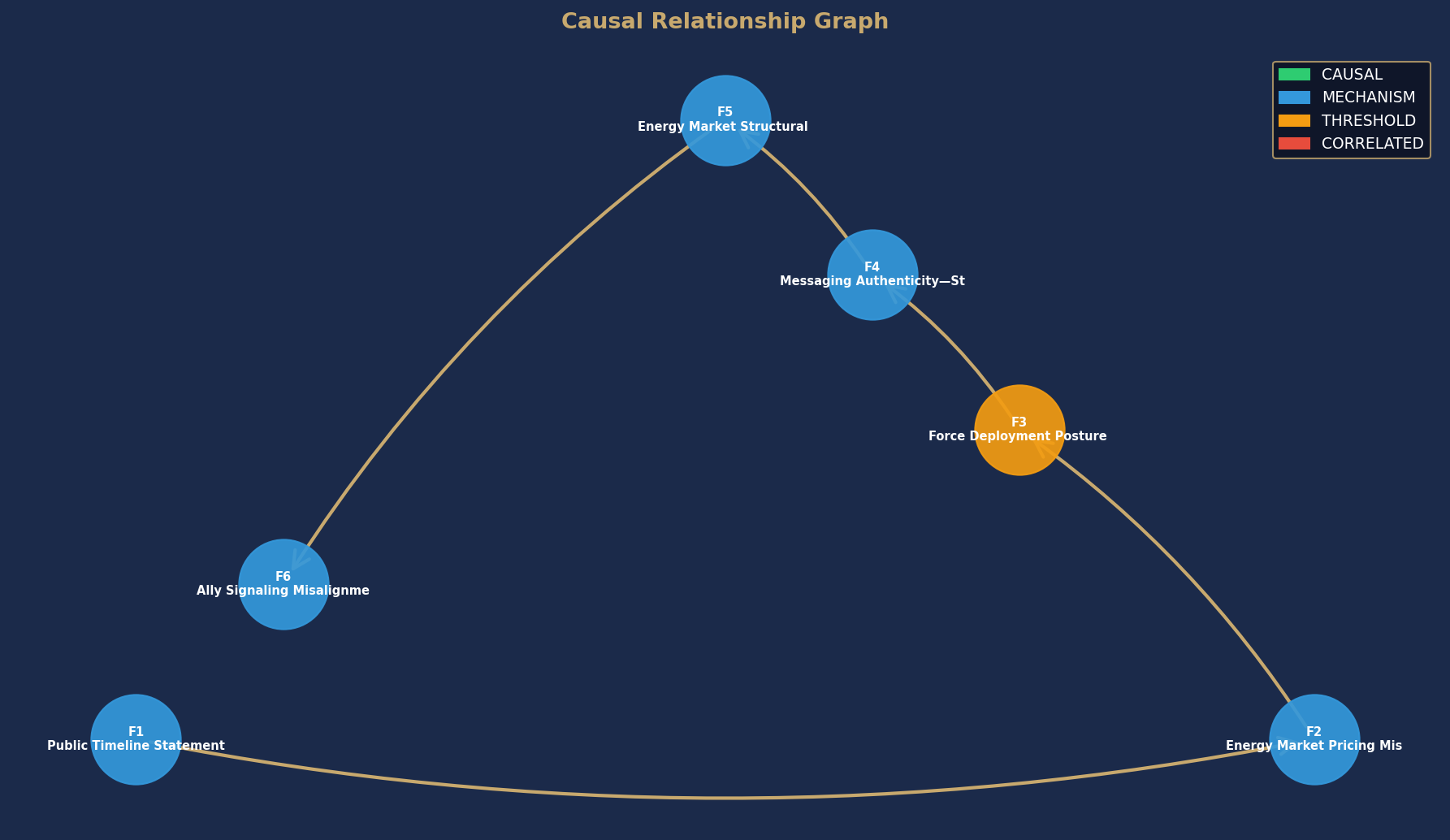
Node colors indicate causal confidence rating. Arrows show directional causal relationships identified in this analysis.
Finding Confidence Distribution
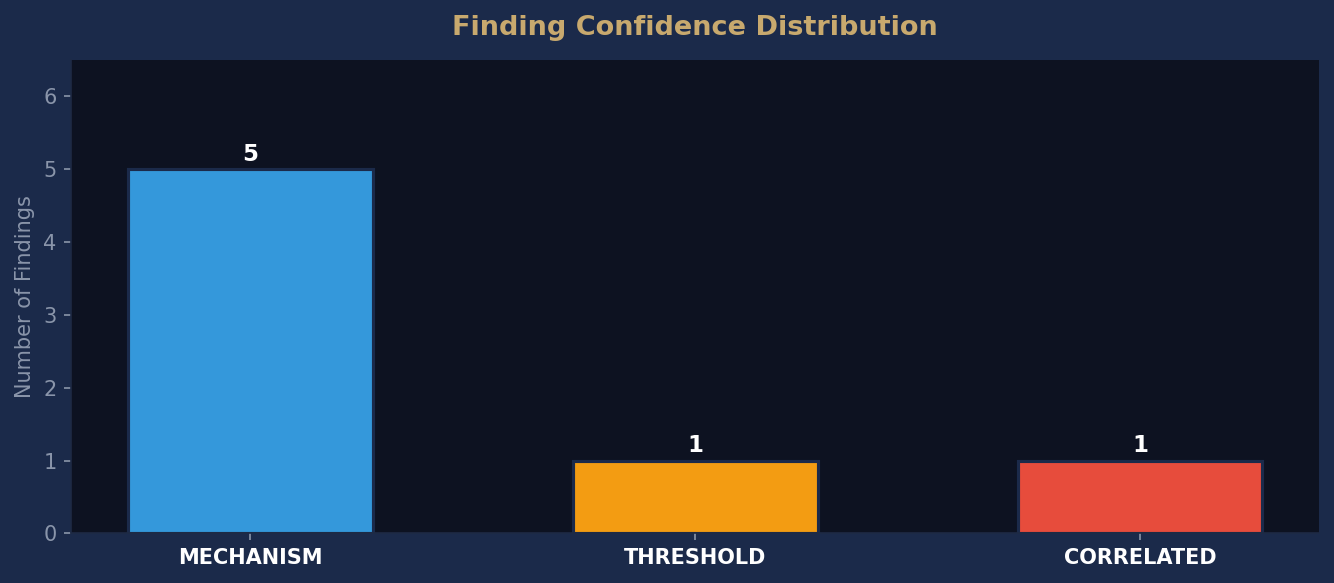
Distribution of causal confidence ratings across all findings in this report. CAUSAL findings are fully actionable. MECHANISM findings require additional evidence before action.
This report was published on May 13, 2026. By the time it's free, the market has already moved.
Don't miss the next one.
Don't miss the next one.
This report was published May 13, 2026. Current intelligence reports are available now.