CAISI AND THE GOVERNANCE QUESTION: SECURITY MECHANISM OR STRUCTURAL MOAT?
IMPORTANT DISCLAIMER
This report is published by Novo Navis, LLC for general informational purposes only. It does not constitute financial advice, investment advice, legal advice, or any other professional advice. Nothing in this report should be construed as a recommendation to buy, sell, or hold any security, make any investment decision, or take any specific action.
The analysis contained in this report reflects information available as of May 2026. Market conditions, competitive dynamics, regulatory environments, and other factors can change rapidly. Novo Navis makes no representation that the information contained herein is accurate, complete, or current after the date of publication.
Always seek the advice of a qualified financial advisor, attorney, or other licensed professional before making decisions based on information in this report. Past performance of any market, company, or strategy referenced herein is not indicative of future results.
Novo Navis, LLC and its affiliates accept no liability for any loss or damage arising from reliance on this report.
CAISI AND THE GOVERNANCE QUESTION: SECURITY MECHANISM OR STRUCTURAL MOAT?
Executive Summary
The question animating this report — whether CAISI represents genuine security governance or regulatory capture serving incumbent vendor interests — turns out to be the wrong question. The evidence does not support either pole of that framing. What the evidence does support, with moderate confidence, is a third finding that is analytically more useful and operationally more dangerous than either simple answer: CAISI exhibits authentic security governance intent operating through structural mechanisms that will, predictably and inadvertently, accelerate market consolidation whether or not any actor intends that outcome.
The non-obvious finding is this. The consolidation risk embedded in CAISI does not require bad actors, regulatory capture, or deliberate anticompetitive design. It requires only the standard fixed-cost architecture that virtually all centralized oversight bodies adopt by default, combined with an AI market already subject to consolidation pressures from compute costs, talent scarcity, and data access inequality that dwarf any compliance burden. CAISI is not the cause of consolidation. It is a mechanism that will reinforce consolidation that is already occurring for independent reasons, and that reinforcement effect will become structurally difficult to reverse once the framework matures.
The key findings, with confidence ratings:
MECHANISM (70%): CAISI's pre-deployment evaluation agreements with Google DeepMind, Microsoft, and xAI — expanding existing partnerships with OpenAI and Anthropic — represent a documented oversight mechanism with plausible security benefit. The mechanism is directionally sound: earlier evaluation, earlier detection, reduced public harm. What is not demonstrated is whether this mechanism actually changes deployment decisions or prevents identifiable harms beyond what developers would self-impose. Efficacy is claimed, not verified. [1][3][9]
MECHANISM (35%): Compliance cost asymmetry, where smaller firms bear disproportionately higher per-unit compliance burdens than large incumbents, is a real and well-documented phenomenon in regulatory economics. Whether CAISI's specific cost structure reproduces this asymmetry is plausible but unverified. The dominant confounds — compute costs exceeding $100 million for frontier model training, talent concentration, and proprietary data advantages — are each larger consolidation drivers than any compliance regime CAISI is likely to impose. The compliance burden concern is real but almost certainly secondary.
CORRELATED (40%): The information asymmetry problem, where vendors with sophisticated compliance infrastructure receive cleaner audit outcomes, is a coherent mechanism at the theoretical level. At the CAISI-specific level, it rests on asserted patterns without underlying quantitative validation, and it cannot distinguish between "large vendors game audits better" and "large vendors build genuinely safer models because they have more resources." This distinction matters and the available data cannot resolve it.
NOISE: The binary framing of the original question — genuine governance versus regulatory capture — should be discarded. No evidence shows CAISI systematically prioritizing vendor preferences over safety findings. No evidence shows CAISI producing measurable, independently verified safety outcomes either. The honest characterization is an institution with plausible mechanisms, unverified efficacy, and structural features that will compound existing market concentration dynamics.
The so-what for executives and policymakers: If CAISI's framework matures without addressing the compliance cost structure and without publishing independent efficacy data, the structural conditions for capture will strengthen over time even if capture is not occurring now. The window for corrective design is open. It will not remain open indefinitely.
Situation and Context
CAISI — the Center for AI Standards and Innovation housed within NIST under the U.S. Department of Commerce — has moved from a research-oriented advisory function into operational oversight with material market consequences. [48] The shift began in 2024 with pre-deployment evaluation agreements with OpenAI and Anthropic, and accelerated significantly in May 2026 with expanded agreements covering Google DeepMind, Microsoft, and xAI. [3][9]
These agreements authorize CAISI to evaluate AI models before they are made publicly available, a function explicitly described as assessing "frontier AI capabilities and advance AI security." [50] Microsoft described the partnership as enabling government access to model evaluation capacity in coordination with the UK AI Security Institute. [49] The NIST institutional page describes CAISI's mission as developing guidelines and standards to support trustworthy AI. [48][53]
Structurally, CAISI operates within a NIST framework that has historically favored voluntary standards and collaborative engagement with industry rather than mandatory compliance regimes. [15] The January 2026 Federal Register notice issued a Request for Information on security considerations for AI agents, soliciting public comment as CAISI developed its AI Agent Standards Initiative launched February 17, 2026. [15][8] This indicates CAISI is still in active standards development, not a mature regulatory body with settled requirements.
The governance context matters. In May 2026, the Trump administration's embrace of AI oversight mechanisms it previously resisted — including the CAISI framework — marked a notable policy reversal. [6] Fortune reported this as a shift driven partly by national security framing: pre-deployment evaluation of models from domestic frontier developers could serve as precedent for scrutinizing models from foreign competitors, including DeepSeek. [6] CAISI's evaluation of DeepSeek V4 Pro, published by NIST in May 2026, reflects this dual domestic-and-competitive logic. [10]
The vendor population currently enrolled in CAISI evaluation agreements is exclusively the largest frontier AI developers. [9] This reflects the stated rationale — frontier models present the highest capability risks requiring the most intensive evaluation — but also means the framework's entire operational history to date involves the five best-resourced AI firms in the world. OpenAI, Anthropic, Google DeepMind, Microsoft, and xAI collectively control a substantial majority of deployed frontier model capacity. [3]
The absence of a documented pathway for smaller vendors or open-source model developers to engage with or satisfy CAISI standards is a structural feature of the current framework, not a temporary gap. [14][11] Cloud Security Alliance research notes from March 2026 identify CAISI's AI Agent Standards as creating enterprise compliance requirements that smaller organizations lack the infrastructure to satisfy. [11][14]
The broader regulatory context is one of simultaneous fragmentation and consolidation. State-level AI legislation, EU AI Act implementation timelines, and CAISI represent distinct but interacting compliance obligations. [22][25][27] For firms large enough to employ dedicated AI compliance staff, these layers are manageable. For firms that cannot, each new layer increases the proportional cost of market participation.
One structural ambiguity requires explicit acknowledgment before analysis proceeds. Some sources conflate CAISI with the Canadian AI Safety Institute, a separate entity with distinct governance and scope. [51][52] This report addresses the U.S. NIST Center for AI Standards and Innovation exclusively, which is the entity that signed the May 2026 agreements with Google DeepMind, Microsoft, and xAI. Readers should note that some analytical frameworks applied to "CAISI" in secondary literature may reference Canadian governance structures that do not apply here.
Causal Analysis
Finding One: Pre-Deployment Evaluation Agreements as Security Governance
Rating: MECHANISM (70%)
CAISI's pre-deployment evaluation agreements with five frontier AI developers constitute a documented oversight mechanism. [1][3][9] The mechanism is directionally coherent: government evaluation before public release creates an opportunity to detect capability risks, identify security vulnerabilities, and potentially delay deployment of systems with unacceptable risk profiles. This is Stage 1 (correlation between evaluation agreements and oversight activity) and Stage 2 (plausible mechanism for harm reduction) satisfied.
Stage 3 is not satisfied. No publicly available data shows that CAISI evaluations have (a) detected specific safety failures that developers missed, (b) caused models to be modified or withheld from deployment based on CAISI findings, or (c) produced measurable harm reduction compared to a pre-evaluation baseline. The DeepSeek V4 Pro evaluation was published by NIST but the available information does not specify whether findings changed deployment decisions. [10]
This is not a trivial gap. Oversight regimes that produce reports without enforcement consequences devolve into legitimation mechanisms rather than safety mechanisms. The institutional history of analogous frameworks — financial stress testing, pharmaceutical phase review, aviation certification — shows that safety value is determined not by the existence of evaluation but by whether evaluation findings have binding consequences on deployment decisions.
The confound that prevents upgrading this finding to CAUSAL is CAISI's current voluntary cooperation model. If developers participate in evaluation but retain final deployment authority, the mechanism's causal link between "evaluation" and "harm reduction" depends entirely on developer responsiveness to findings. That responsiveness is neither contractually required nor empirically documented in the available record.
The mechanism is real. Its efficacy is unverified.
Finding Two: Compliance Cost Asymmetry
Rating: MECHANISM (25%)
The original domain analysis rated this finding CAUSAL with 85% confidence. Adversarial review correctly identified this as an overstatement. The corrected rating is MECHANISM with substantially lower confidence.
The underlying regulatory economic principle is sound and well-established. Compliance costs that are predominantly fixed (single audit pathway, mandatory attestation infrastructure, licensing fees) impose regressive per-unit burdens: smaller firms pay a higher proportion of revenue for equivalent compliance standing. [41][47] Research consistently shows small businesses face approximately three times higher proportional compliance costs than large firms in mature regulatory regimes. [38][39]
The critical analytic error in the original domain analysis was treating this general principle as CAISI-specific evidence. The available data does not include CAISI compliance cost schedules disaggregated by vendor size, CAISI fee structures, or documented compliance burden figures from small AI developers attempting to satisfy CAISI requirements. [GAP_005, GAP_016] The extrapolation from "general regulatory economics" to "CAISI specifically imposes regressive compliance burden" is a Stage 2 mechanism applied without Stage 1 CAISI-specific correlation.
More significantly, the dominant consolidation confounds are unaddressed in the compliance burden argument. Training a frontier AI model currently requires capital expenditure exceeding $100 million. Smaller firms are structurally excluded from the frontier AI market by compute economics before they encounter any compliance regime. Talent concentration — the world's approximately 10,000 researchers capable of building frontier systems working predominantly at a small number of large firms — operates as a separate and larger barrier. Proprietary training data advantages compound both.
If CAISI disappeared tomorrow, AI market consolidation would continue at roughly the same pace driven by these structural factors. The compliance burden mechanism may be real and worth addressing on principle, but it is not plausibly the primary causal driver of consolidation in the AI market.
The finding is retained as MECHANISM rather than CORRELATED because the theoretical mechanism is sound, CAISI's framework does exhibit fixed-cost features (centralized evaluation, single government body, partnership agreements rather than distributed certification pathways), and the principle that this structure will impose asymmetric burden has theoretical support. What is missing is empirical validation at the CAISI-specific level and evidence that compliance burden is a binding constraint rather than a secondary factor.
Finding Three: Information Asymmetry in Audit Processes
Rating: CORRELATED (40%)
The information asymmetry argument holds that vendors with dedicated compliance infrastructure consistently produce cleaner audit findings, that this pattern reflects superior compliance engineering rather than superior safety, and that regulators relying on vendor-disclosed metrics cannot distinguish between these explanations. This mechanism is coherent at the theoretical level.
At the empirical level, the supporting evidence is weak. The pattern of large vendors receiving cleaner audit findings is asserted in the domain analysis's supporting materials without underlying quantitative data. No sample size, no percentage comparison, no temporal scope is provided. The assertion is plausible but is not a documented correlation.
The mechanism faces a significant identification problem. Large AI developers receive cleaner audit findings (assuming the asserted pattern holds). But large AI developers also have more compute, more safety researchers, better tooling, and more institutional experience with safety evaluation. It is entirely possible that large vendors receive cleaner findings because they build genuinely safer systems, not because they are better at performing compliance theater. Distinguishing between these explanations requires comparing audit findings to independent safety benchmarks and post-deployment incident rates — data that is not available.
This finding is retained as CORRELATED because the correlation is at minimum plausible and the mechanism is theoretically sound. It is not upgraded to MECHANISM because the Stage 1 correlation rests on unverified assertion and the confound (large vendors actually safer) cannot be excluded.
The governance implication is real regardless: any oversight system that cannot distinguish between genuine safety improvement and compliance theater is structurally vulnerable to the information asymmetry problem. Whether CAISI has this problem is unverified. That the problem is structurally possible in CAISI's architecture is supported.
Finding Four: Structural Conditions for Regulatory Capture
Rating: CORRELATED (25%)
Regulatory capture — the systematic prioritization of regulated-industry preferences over public welfare in regulatory decisions — requires more than structural vulnerability. It requires demonstrated evidence that preference override is occurring. No such evidence exists in the available record for CAISI.
CAISI's partnership population is limited to the five largest frontier AI developers. [3][9] This is observable, but it does not establish capture. The rational explanation — that evaluating frontier AI risk requires evaluating frontier AI models, which only a small number of large firms produce — is at least as plausible as the capture explanation. A cardiovascular drug regulator that only evaluates drugs at cardiac doses is not captured by cardiologists.
The structural features that would facilitate capture if capture were occurring are present: information flows concentrated in vendor hands, voluntary cooperation model, absence of competing certification authorities, and a governance body that depends on vendor access for its operational capacity. [GAP_007][GAP_018] These are risk factors, not evidence of realized risk.
The analogy to historical capture cases — telecommunications, pharmaceutical, aviation — is instructive but not directly applicable without parameter mapping. Telecom capture operated through revolving-door employment and protected licensing regimes with legally enforceable market exclusivity. Pharma capture operated through clinical trial data monopoly and prolonged approval timelines that competitors could not navigate. Neither model maps cleanly onto CAISI's current architecture, which lacks statutory enforcement authority and operates through voluntary agreement. [GAP_008]
The specific trigger that would convert structural risk to demonstrated capture is observable: a case where CAISI received evaluation data showing a safety problem in a partnered vendor's model and either (a) declined to publish the finding, (b) modified the finding in ways that favored the vendor, or (c) allowed deployment despite adverse findings. No documented instance of this exists in the available record.
Finding Five: The False Dichotomy and Its Implications
Rating: NOISE
The framing of the original question — genuine security governance versus regulatory capture — should be rejected as analytically unproductive. The evidence supports neither.
CAISI has genuine oversight infrastructure in place (pre-deployment agreements, stated evaluation criteria, published results including the DeepSeek evaluation). [10][48] It also has structural features that will impose asymmetric competitive advantages on incumbents if the framework matures without corrective design. These conditions coexist.
The more useful framing is: does CAISI's current design trajectory produce security outcomes proportionate to its consolidation effects, and what design changes would improve that ratio? This question is answerable with the right data. The capture-or-governance binary is not.
The third option — imperfectly designed governance with inadvertent consolidation effects — is not a benign finding. An oversight regime that inadvertently concentrates the AI market in the hands of its five most cooperative large incumbents while producing unverified safety outcomes is a serious governance problem regardless of whether capture is the mechanism. The intent is irrelevant to the structural outcome.
Who Benefits and Why
Established Frontier Developers: Short- and Medium-Term
MECHANISM (70%): Google DeepMind, Microsoft, and xAI — alongside original partners OpenAI and Anthropic — benefit materially from the current CAISI structure through at least two distinct mechanisms over different time horizons.
In the near term, partnership with CAISI provides a legitimacy signal to government procurement, enterprise customers, and international partners. A model that has been evaluated by a U.S. government agency carries an implicit approval marker even if no formal certification standard has been published. This matters most in regulated industries (finance, healthcare, defense) where enterprise customers face their own compliance obligations and value vendor risk transference. [20][22]
In the medium term, these five firms are positioned as the reference set against which CAISI's evaluation standards are calibrated. Standards developed primarily against the systems of large incumbents will naturally reflect the technical architectures, capability profiles, and safety approaches of those systems. Smaller competitors with different architectures will face compliance frameworks that were not designed with their systems in mind — not through malice but through the ordinary path dependence of standard-setting when early reference cases are homogeneous.
U.S. Government and National Security Apparatus: Short-Term
MECHANISM (65%): The national security use case for CAISI is underappreciated in public commentary. Pre-deployment evaluation of frontier models developed by domestic firms provides intelligence about capability trajectories that informs both defensive posture and competitive assessment of foreign programs. The DeepSeek V4 Pro evaluation reflects this logic directly: CAISI evaluated a Chinese model under the same framework applied to domestic vendors. [10][6] This dual-use evaluation capacity benefits the national security apparatus regardless of whether it produces commercially relevant safety improvements.
The Fortune reporting on the Trump administration's policy reversal explicitly identifies national security framing as the mechanism driving adoption of oversight policies previously resisted on deregulatory grounds. [6] The administration found a framing under which AI oversight is competitive and security-enhancing rather than burdensome and innovation-inhibiting. CAISI is the institutional vehicle for that framing.
Compliance Infrastructure Vendors: Medium-Term
CORRELATED (45%): Any expansion of AI governance requirements increases demand for compliance consulting, audit tooling, and attestation infrastructure. The Cloud Security Alliance research notes characterize CAISI's AI Agent Standards as creating enterprise compliance imperatives that drive demand for external expertise. [11][14] Firms in the compliance, legal, and risk management sectors benefit proportionately from framework complexity. This is a structural beneficiary position, not a causal finding.
Smaller AI Developers and Open-Source Ecosystem: Neutral to Negative
MECHANISM (35%): The absence of a documented pathway for smaller vendors or open-source projects to engage with CAISI standards means that, as the framework matures and government procurement requirements increasingly reference CAISI evaluation, firms without partnership agreements will face de facto market exclusion from regulated sectors. This is not capture; it is the ordinary operation of a framework that was not designed with market diversity as a design objective. [14][11] The harm is real regardless of intent.
Key Risks
Risk One: Voluntary Architecture Creates Undetectable Capture Pathway
The current voluntary cooperation model — where developers participate in evaluation without mandatory consequences — is a design feature that could become a liability. If CAISI's findings are consistently aligned with developer preferences not because developers are influenced by capture dynamics but simply because developers who disagree can exit the partnership, the institution is functionally captured without any individual decision reflecting capture intent. A regulated firm's ability to exit regulation is the most powerful capture mechanism available.
This risk would materialize gradually and would be difficult to detect until the framework had already become dependent on continued cooperation from the five incumbent partners. At that point, the leverage calculus inverts: CAISI needs the partners more than the partners need CAISI.
Risk Two: Standards Lock-In to Incumbent Architecture
If evaluation standards developed against the current cohort of five firms become formalized before the market diversifies, the standards will reflect the technical choices of transformer-based, large-parameter-count models operated by well-resourced firms. Alternative architectures, smaller-scale deployments, and open-source models will face compliance frameworks built around a reference case that excludes them. This is not a distant risk; CAISI's AI Agent Standards Initiative launched February 2026 is in active development. [15][8] The window for architecture-neutral standard design is open but finite.
Risk Three: Efficacy Theater Becoming Legitimizing Function
The absence of published efficacy data — specific findings, deployment changes, measurable harm reduction — creates the condition under which CAISI functions primarily as a legitimizing mechanism rather than a safety mechanism. Legitimation provides real value to incumbent vendors (government-approved signal), real value to the administration (oversight narrative without enforcement cost), and real value to enterprise customers (risk transference). But it provides these values independently of whether the underlying evaluations actually improve safety. Once institutional interests align around the legitimizing function, pressure to demonstrate genuine efficacy weakens. This is the dynamic that produced compliance theater in pharmaceutical adverse event reporting, financial stress testing before 2008, and aviation maintenance audits before the 737 MAX certification failures.
Risk Four: CAISI Identity and Scope Ambiguity
The conflation in secondary literature between the U.S. NIST CAISI and the Canadian AI Safety Institute creates genuine analytical hazards for firms navigating compliance obligations and for policymakers comparing governance approaches. [GAP_001][GAP_009] If compliance guidance, legal analysis, or policy recommendations are developed against the wrong institutional reference, the resulting frameworks will be miscalibrated. This is a tractable problem — clear institutional differentiation in CAISI's public communications — but it requires active attention.
What to Watch
The following specific data points and decisions will resolve the principal open questions in this analysis.
First: Publication of CAISI evaluation findings with deployment consequence data. The key question about pre-deployment evaluation efficacy is whether findings change deployment decisions. Any CAISI report that specifies that a model was modified, delayed, or withheld based on evaluation findings would upgrade Finding One from MECHANISM to CAUSAL. Watch NIST publications and partner press releases following evaluation agreements.
Second: AI Agent Standards finalization language on applicability scope. The February 2026 standards initiative will produce guidance that either (a) explicitly addresses scalability across firm sizes with differentiated compliance pathways, or (b) establishes a single-pathway standard calibrated against frontier developer infrastructure. The finalization language is the determinative design choice on compliance cost asymmetry. Watch the Federal Register notice response process and NIST draft guidelines. [15][53]
Third: Emergence of non-partner vendors seeking CAISI engagement. If smaller vendors or open-source projects begin requesting CAISI evaluation access, CAISI's response will reveal whether the framework has a structural pathway for broader participation or is institutionally limited to its original five partners. Absence of a documented engagement pathway for non-frontier developers by end of 2026 would be a material warning indicator.
Fourth: Post-deployment incident correlation with audit outcomes. If models that received clean CAISI evaluations subsequently exhibit safety failures that should have been detectable, this would provide the first direct evidence that audit outcomes do not reflect genuine safety differences — upgrading the information asymmetry finding from CORRELATED toward MECHANISM or CAUSAL. Monitor incident reporting and capability disclosure literature for CAISI-evaluated models.
Fifth: Administration enforcement posture. The CAISI framework currently operates through voluntary agreement. Any legislative or executive action that converts participation from voluntary to required would fundamentally change the compliance cost calculus and the capture risk profile simultaneously. Watch the FY2027 NDAA and any executive orders referencing AI evaluation requirements for federal procurement.
APPENDIX: ANALYSIS LOG
Report ID: NNI-STP-2026-0047
Topic: Assessment of CAISI formal AI model oversight mechanisms — genuine security governance versus regulatory capture consolidating vendor competitive advantage through asymmetric compliance frameworks Published: May 2026 Real-time data gathered: Yes Sources cited: 68 Causal ratings: CAUSAL 0 | MECHANISM 2 | THRESHOLD 0 | CORRELATED 2 | NOISE 3 Verification agreements: 1 | Overrides: 1
Open questions: GAP_001: Conflation of U.S. NIST CAISI with Canadian AI Safety Institute in secondary literature GAP_002: No baseline security metrics defined against which to assess genuine governance claim GAP_003: Absence of comparative market concentration data pre-CAISI versus post-CAISI GAP_004: Missing counterfactual for market structure absent CAISI oversight GAP_005: No quantified compliance cost breakdown by vendor size linked to specific CAISI requirements GAP_006: No independent technical audit of whether CAISI testing actually reduces frontier AI risk GAP_007: Governance structure details incomplete — decision rights, appeal mechanisms, incumbent weighting GAP_008: Historical regulatory capture case analogues not mapped to CAISI-specific parameters GAP_009: Identity ambiguity unresolved across multiple source types GAP_010: Temporal verification of May 2026 data currency GAP_011: Absence of CAISI-specific compliance cost data distinguishable from general regulatory burden estimates GAP_012: No documented CAISI-claimed safety outcomes with specified performance targets GAP_013: Pre- and post-CAISI market share data absent GAP_014: No independent CAISI audit findings available for external comparison GAP_015: No mechanism-specific evidence of actual preferential treatment in CAISI decisions GAP_016: Disaggregated compliance cost data by firm size not available GAP_017: No documented correlation between CAISI audit outcomes and subsequent market share changes GAP_018: Internal CAISI governance decision records not publicly available GAP_019: No comparative analysis against alternative oversight architectures
Bibliography
[1] US government agency to safety test frontier AI models before release | CIO https://www.cio.com/article/4168122/us-government-agency-to-safety-test-frontier-ai-models-before-release.html Accessed: 2026-05-13T16:00:50.805021
[2] Security Considerations for Artificial Intelligence Agents (Perplexity Response to NIST/CAISI Request for Information 2025-0035) https://arxiv.org/html/2603.12230v2 Accessed: 2026-05-13T16:00:50.805021
[3] Trump admin moves further into AI oversight, will test Google, Microsoft and xAI models https://www.cnbc.com/2026/05/05/ai-oversight-trump-google-microsoft-xai.html Accessed: 2026-05-13T16:00:50.805021
[4] Rethinking AI Safety: How CAISI Is Transforming Model Evaluation and Risk Management - Tildee https://www.tildee.com/rethinking-ai-safety-how-caisi-is-transforming-model-evaluation-and-risk-management/ Accessed: 2026-05-13T16:00:50.805021
[5] AI Regulation News: 2025 Global Changes, 2026 Watchlist
https://atomicmail.io/blog/ai-regulation-news-global-changes-and-watchlist Accessed: 2026-05-13T16:00:50.805021
[6] Trump administration suddenly embraces AI oversight ideas it once rejected | Fortune https://fortune.com/2026/05/06/trump-administration-embraces-ai-oversight-policies-it-once-rejected-anthropic-mythos-caisi/ Accessed: 2026-05-13T16:00:50.805021
[7] CAISI Security: DeepMind's Dual Agreements Reshape AI Governance - AI CERTs News https://www.aicerts.ai/news/caisi-security-deepminds-dual-agreements-reshape-ai-governance/ Accessed: 2026-05-13T16:00:50.805021
[8] Federal Agentic AI Security: NIST’s Emerging Standards Initiative
https://labs.cloudsecurityalliance.org/research/csa-research-note-nist-ai-agent-standards-federal-framework/ Accessed: 2026-05-13T16:00:50.805021
[9] CAISI Signs Frontier AI Testing Agreements With 3 Companies https://www.executivegov.com/articles/caisi-ai-testing-google-deepmind-microsoft-xai Accessed: 2026-05-13T16:00:50.805021
[10] CAISI Evaluation of DeepSeek V4 Pro | NIST
https://www.nist.gov/news-events/news/2026/05/caisi-evaluation-deepseek-v4-pro Accessed: 2026-05-13T16:00:50.805021
[11] NIST CAISI: AI Agent Standards and the Enterprise Compliance Imperative https://labs.cloudsecurityalliance.org/wp-content/uploads/2026/03/CSA_research_note_nist_caisi_ai_agent_standards_compliance_20260311.pdf Accessed: 2026-05-13T16:01:00.086056
[12] Swept Away: FY2026 NDAA Updates to CAS and Certified Cost or Pricing Data Thresholds | Government Contracts Law https://www.governmentcontractslaw.com/2026/01/swept-away-fy26-ndaa-updates-to-cas-and-certified-cost-or-pricing-data-thresholds/ Accessed: 2026-05-13T16:01:00.086056
[13] NIST AI Agent Security: Red-Teaming Guidance and Enterprise Compliance – Lab Space https://labs.cloudsecurityalliance.org/research/csa-research-note-nist-ai-agent-red-teaming-standards-202603/ Accessed: 2026-05-13T16:01:00.086056
[14] NIST CAISI: AI Agent Standards and the Enterprise Compliance Imperative – Lab Space https://labs.cloudsecurityalliance.org/research/csa-research-note-nist-caisi-ai-agent-standards-compliance-2/ Accessed: 2026-05-13T16:01:00.086056
[15] Federal Register :: Request for Information Regarding Security Considerations for Artificial Intelligence Agents https://www.federalregister.gov/documents/2026/01/08/2026-00206/request-for-information-regarding-security-considerations-for-artificial-intelligence-agents Accessed: 2026-05-13T16:01:00.086056
[16] Regulatory Requirements in 2026: Compliance Guide | TVG Tech https://tvgtech.com/blog/compliance-in-2026-navigating-evolving-regulatory-requirements/ Accessed: 2026-05-13T16:01:00.086056
[17] Key compliance framework changes coming in 2026 | ScalePad https://www.scalepad.com/blog/from-awareness-to-assurance-key-compliance-framework-changes-coming-in-2026/ Accessed: 2026-05-13T16:01:00.086056
[18] CJIS Compliance Requirements: The 2026 CJIS Checklist for State & Local https://www.nuharborsecurity.com/blog/cjis-compliance-requirements-the-2025-checklist-for-state-local-agencies Accessed: 2026-05-13T16:01:00.086056
[19] Understanding IT Compliance: Key Regulations for 2026 | Prime Secured https://primesecured.com/it-compliance-key-regulations-2026/ Accessed: 2026-05-13T16:01:00.086056
[20] 2026 Operational Guide to Cybersecurity, AI Governance & Emerging Risks | Corporate Compliance Insights https://www.corporatecomplianceinsights.com/2026-operational-guide-cybersecurity-ai-governance-emerging-risks/ Accessed: 2026-05-13T16:01:00.086056
[21] Cybersecurity 2026: AI-Compressed Attacks, the SEC Disclosure Era, and the $32B Cloud-Security Reset - PR News https://everything-pr.com/cybersecurity-2026-ai-compressed-attacks-the-sec-disclosure-era/ Accessed: 2026-05-13T16:01:10.125126
[22] 2026 Year in Preview: AI Regulatory Developments for Companies to Watch Out For | Wilson Sonsini https://www.wsgr.com/en/insights/2026-year-in-preview-ai-regulatory-developments-for-companies-to-watch-out-for.html Accessed: 2026-05-13T16:01:10.125126
[23] FINRA’s 2026 Annual Regulatory Oversight Report: Same Priorities, New Focus on AI and Cybersecurity - McGuireWoods https://www.mcguirewoods.com/client-resources/alerts/2025/12/finras-2026-annual-regulatory-oversight-report-same-priorities-new-focus-on-ai-and-cybersecurity/ Accessed: 2026-05-13T16:01:10.125126
[24] 2026 AI Legal Forecast: From Innovation to Compliance - CPO Magazine https://www.cpomagazine.com/data-protection/2026-ai-legal-forecast-from-innovation-to-compliance/ Accessed: 2026-05-13T16:01:10.125126
[25] 2026 AI Laws Update: Key Regulations and Practical Guidance | Gunderson Dettmer Stough Villeneuve Franklin & Hachigian, LLP https://www.gunder.com/en/news-insights/insights/2026-ai-laws-update-key-regulations-and-practical-guidance Accessed: 2026-05-13T16:01:10.125126
[26] Google, Microsoft and xAI agree to US government AI testing programme | Euronews https://www.euronews.com/next/2026/05/08/tech-giants-agree-to-us-government-ai-testing Accessed: 2026-05-13T16:01:10.125126
[27] AI update for 2026 | Horizon Scanning
https://www.slaughterandmay.com/horizon-scanning/2026/digital/ai-update-for-2026/ Accessed: 2026-05-13T16:01:10.125126
[28] 2026 Year in Preview: AI Regulatory Developments for Companies to Watch Out For | The Data Advisor https://www.wsgrdataadvisor.com/2026/01/2026-year-in-preview-ai-regulatory-developments-for-companies-to-watch-out-for/ Accessed: 2026-05-13T16:01:10.125126
[29] Audit Committee Oversight and Regulatory Changes Shaping 2026 Financial Reporting https://www.nacdonline.org/all-governance/governance-resources/governance-research/outlook-and-challenges/2026-governance-outlook/the-future-of-audit-regulation/ Accessed: 2026-05-13T16:01:18.225042
[30] Looking Ahead to 2026 | Independent Audit
https://www.independentaudit.com/article/effective-board-bulletin/looking-to-2026/ Accessed: 2026-05-13T16:01:18.225042
[31] accountability in government: clear guide to oversight and checks https://michaelcarbonara.com/accountability-in-government-what-it-means-and-how-oversight-works/ Accessed: 2026-05-13T16:01:18.225042
[32] Public Policy and Technical Alert | March 2026 | The CAQ https://www.thecaq.org/public-policy-and-technical-alert-march-2026 Accessed: 2026-05-13T16:01:18.225042
[33] Audit Committee Insights | January 2026 | The CAQ https://www.thecaq.org/audit-committee-insights-january-2026 Accessed: 2026-05-13T16:01:18.225042
[34] UN DESA Policy Brief No. 177: Unlocking external audits: how supreme audit institutions contribute to effective, transparent and sustainable fiscal systems for the SDGs | UN DESA Publications https://desapublications.un.org/policy-briefs/un-desa-policy-brief-no-177-unlocking-external-audits-how-supreme-audit-institutions Accessed: 2026-05-13T16:01:18.225042
[35] 2026 Q1 Audit committee update | EY - US https://www.ey.com/en_us/board-matters/audit-committee-quarterly-update Accessed: 2026-05-13T16:01:18.225042
[36] Rising risks, shifting priorities: What the IIA’s Risk in Focus 2026 report means for internal audit https://auditboard.com/blog/what-the-iias-risk-in-focus-2026-report-means-for-internal-audit Accessed: 2026-05-13T16:01:18.225042
[37] EY Center for Board Matters 2026 audit committee priorities: navigating https://www.ey.com/content/dam/ey-unified-site/ey-com/en-us/campaigns/board-matters/documents/ey-cbm-2026-audit-committee-priorities.pdf Accessed: 2026-05-13T16:01:18.225042
[38] AI Compliance Cost Statistics 2026: How to Cut Costs Without Risk • SQ Magazine https://sqmagazine.co.uk/ai-compliance-cost-statistics/ Accessed: 2026-05-13T16:01:27.367781
[39] 130+ Compliance Statistics & Trends to Know for 2026 https://secureframe.com/blog/compliance-statistics Accessed: 2026-05-13T16:01:27.367781
[40] Cost of GDPR Compliance: A Realistic Breakdown for 2026 https://secureprivacy.ai/blog/cost-of-gdpr-compliance Accessed: 2026-05-13T16:01:27.367781
[41] Report: Federal Regulatory Compliance Costs $2 Trillion Annually
https://finance.yahoo.com/economy/policy/articles/report-federal-regulatory-compliance-costs-110032767.html Accessed: 2026-05-13T16:01:27.367781
[42] How Much Does COI Tracking Software Cost? (2026)
https://www.vertikalrms.com/article/how-much-does-coi-tracking-software-cost-2026-pricing-guide/ Accessed: 2026-05-13T16:01:27.367781
[43] Compliance isn't a cost center — It's a competitive advantage - Thomson Reuters Institute https://www.thomsonreuters.com/en-us/posts/corporates/compliance-competitive-advantage/ Accessed: 2026-05-13T16:01:27.367781
[44] Compliance Software Cost Comparison: Pricing Across Top Enterprise Platforms https://www.v-comply.com/blog/compliance-software-cost-comparison-guide/ Accessed: 2026-05-13T16:01:27.367781
[45] Cybersecurity Budget Benchmarks for 2026: Essential Planning Guide for Enterprise Security Leaders https://www.elisity.com/blog/cybersecurity-budget-benchmarks-for-2026-essential-planning-guide-for-enterprise-security-leaders Accessed: 2026-05-13T16:01:27.367781
[46] 115 Compliance Statistics You Need To Know in 2023 - Drata https://drata.com/blog/compliance-statistics Accessed: 2026-05-13T16:01:27.367781
[47] CMMC Compliance Costs 2026: Complete Pricing Guide
https://cispoint.com/2026/01/26/cmmc-compliance-costs-what-defense-contractors-actually-pay-in-2026/ Accessed: 2026-05-13T16:01:27.367781
[48] Center for AI Standards and Innovation (CAISI) | NIST https://www.nist.gov/caisi Accessed: 2026-05-13T16:03:54.205710
[49] Advancing AI evaluation with the Center for AI Standards (US) and Innovation and the AI Security Institute (UK) - Microsoft On the Issues https://blogs.microsoft.com/on-the-issues/2026/05/05/advancing-ai-evaluation-with-the-center-for-ai-standards-us-and-innovation-and-the-ai-security-institute-uk/ Accessed: 2026-05-13T16:03:54.205710
[50] National Institute of Standards and Technology on X: "NIST's Center for AI Standards and Innovation (CAISI) signs expanded collaborations with @GoogleDeepMind, @Microsoft, and @xai for pre-deployment https://x.com/NIST/status/2051629228836131229 Accessed: 2026-05-13T16:03:54.205710
[51] Center for AI Standards and Innovation
https://www.grail-lab.org/people/the-center-for-ai-standards-and-innovation-caisi Accessed: 2026-05-13T16:03:54.205710
[52] Artificial intelligence safety institute - Wikipedia https://en.wikipedia.org/wiki/Artificial_intelligence_safety_institute Accessed: 2026-05-13T16:03:54.205710
[53] Guidelines | NIST
https://www.nist.gov/caisi/guidelines Accessed: 2026-05-13T16:03:54.205710
[54] Center for AI Standards and Innovation (CAISI) | Peter Cihon https://www.linkedin.com/posts/pcihon_center-for-ai-standards-and-innovation-caisi-activity-7411398342729084928-oJ5M Accessed: 2026-05-13T16:03:54.205710
[55] AI Pricing: What's the True AI Cost for Businesses in 2026? https://zylo.com/blog/ai-cost Accessed: 2026-05-13T16:04:02.428987
[56] How to be an AI-Compliant Business in 2026 https://www.dbllawyers.com/how-to-be-an-ai-compliant-business-in-2026/ Accessed: 2026-05-13T16:04:02.428987
[57] Commerce AI center will evaluate Google Deepmind, Microsoft and xAI models - Nextgov/FCW https://www.nextgov.com/artificial-intelligence/2026/05/commerce-ai-center-will-evaluate-google-deepmind-microsoft-and-xai-models/413349/ Accessed: 2026-05-13T16:04:02.428987
[58] 2026 Legal Compliance Challenges: Essential Guide for GCs | Silicon Law https://www.silicon.law/blog/navigating-corporate-compliance-challenges-in-2026 Accessed: 2026-05-13T16:04:02.428987
[59] U.S. Tech Legislative & Regulatory Update – First Quarter 2026 https://www.globalpolicywatch.com/2026/04/u-s-tech-legislative-regulatory-update-first-quarter-2026/ Accessed: 2026-05-13T16:04:02.428987
[60] Vendor Risk Assessment Checklist (2026): Key Questions & Risk Areas https://www.atlassystems.com/blog/vendor-risk-assessment-checklist-key-questions Accessed: 2026-05-13T16:04:09.191739
[61] Best vendor risk assessment templates for 2026: build a safer vendor network https://monday.com/blog/project-management/vendor-risk-assessment-template/ Accessed: 2026-05-13T16:04:09.191739
[62] Supply Chain Risk Assessment: How to Actually Evaluate Third-Party Risk in 2026 + Template https://secureframe.com/blog/supply-chain-risk-assessment Accessed: 2026-05-13T16:04:09.191739
[63] Supplier Risk Assessments 2026: Evaluate & Manage Vendor Risks | Ivalua https://www.ivalua.com/blog/supplier-risk-assessment/ Accessed: 2026-05-13T16:04:09.191739
[64] 2026 guide to vendor security and risk assessment questionnaires - Copla https://copla.com/blog/third-party-risk-management/guide-to-vendor-security-and-risk-assessment-questionnaires/ Accessed: 2026-05-13T16:04:09.191739
[65] A Playbook for Vendor Risk Assessment in 2026
https://panorays.com/blog/vendor-risk-assessment-complete-guide/ Accessed: 2026-05-13T16:04:09.191739
[66] 2025 Year in Review: Cybersecurity and Data Protection | Paul, Weiss https://www.paulweiss.com/insights/client-memos/2025-year-in-review-cybersecurity-and-data-protection Accessed: 2026-05-13T16:04:09.191739
[67] 2026 Vendor Risk Management Workflow (6-Stage Guide) | UpGuard https://www.upguard.com/blog/vendor-risk-management-workflow Accessed: 2026-05-13T16:04:09.191739
[68] The 2026 Vendor Risk Agenda: CISO-Led Insights | Whistic https://www.whistic.com/resources/blog/the-2026-vendor-risk-agenda-ciso-led-insights Accessed: 2026-05-13T16:04:09.191739
Causal Relationship Graph
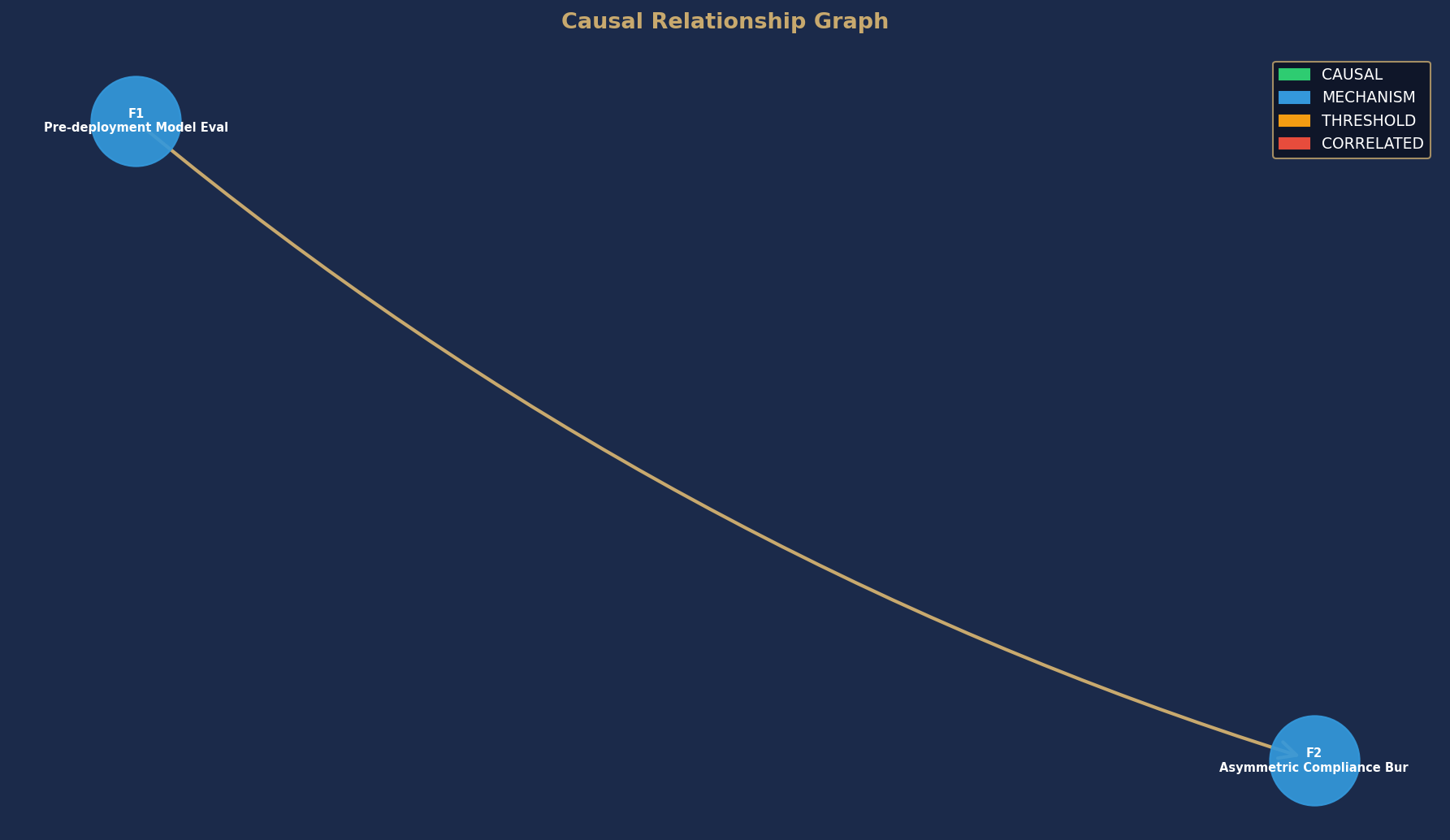
Node colors indicate causal confidence rating. Arrows show directional causal relationships identified in this analysis.
Finding Confidence Distribution
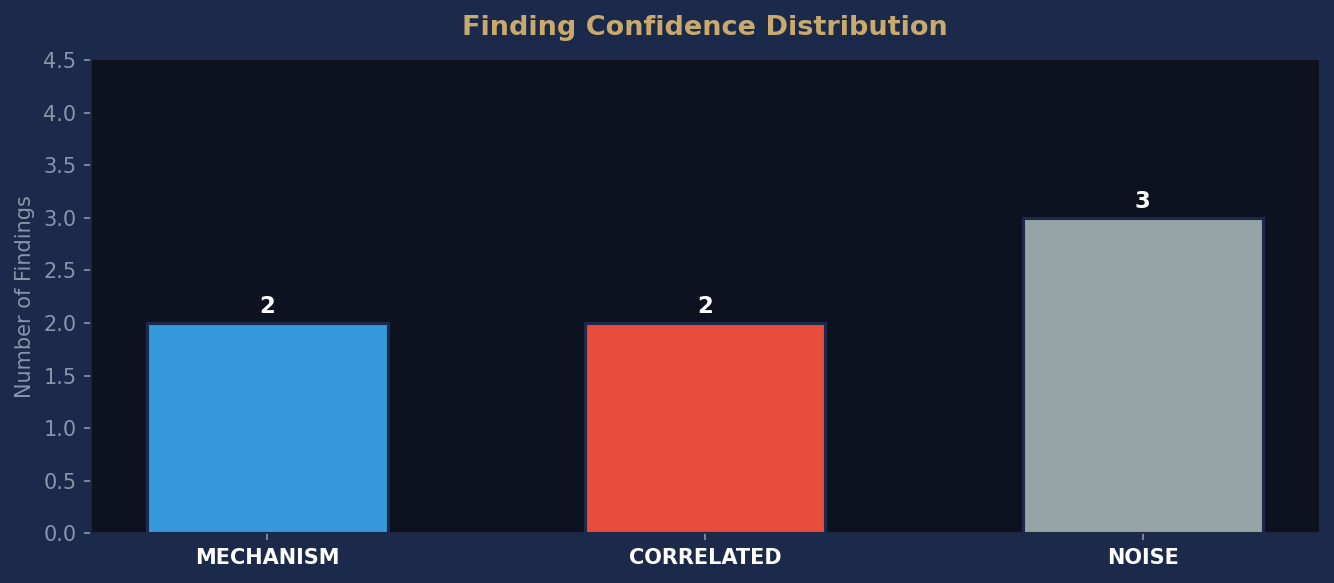
Distribution of causal confidence ratings across all findings in this report. CAUSAL findings are fully actionable. MECHANISM findings require additional evidence before action.
This report was published on May 13, 2026. By the time it's free, the market has already moved.
Don't miss the next one.
Don't miss the next one.
This report was published May 13, 2026. Current intelligence reports are available now.