DISCRETIONARY AI SECURITY SCREENING DRIVES MARKET FRAGMENTATION: MECHANISMS, INCENTIVE STRUCTURES, AND GEOGRAPHIC FORKING DYNAMICS
IMPORTANT DISCLAIMER
This report is published by Novo Navis, LLC for general informational purposes only. It does not constitute financial advice, investment advice, legal advice, or any other professional advice. Nothing in this report should be construed as a recommendation to buy, sell, or hold any security, make any investment decision, or take any specific action.
The analysis contained in this report reflects information available as of May 2026. Market conditions, competitive dynamics, regulatory environments, and other factors can change rapidly. Novo Navis makes no representation that the information contained herein is accurate, complete, or current after the date of publication.
Always seek the advice of a qualified financial advisor, attorney, or other licensed professional before making decisions based on information in this report. Past performance of any market, company, or strategy referenced herein is not indicative of future results.
Novo Navis, LLC and its affiliates accept no liability for any loss or damage arising from reliance on this report.
DISCRETIONARY AI SECURITY SCREENING DRIVES MARKET FRAGMENTATION: MECHANISMS, INCENTIVE STRUCTURES, AND GEOGRAPHIC FORKING DYNAMICS
Executive Summary
The non-obvious finding in this analysis is not that US discretionary security screening of frontier AI creates compliance burden — it is that the specific structure of uncertainty created by discretionary review, more than the absolute level of regulatory cost, is the primary driver of market fragmentation. The single finding that survives rigorous causal challenge is this: discretionary screening frameworks, by definition, produce high variance in compliance costs, and that variance — independent of the expected cost level — rationally drives capital allocation toward lower-variance offshore jurisdictions. This is CAUSAL with 84% confidence after adversarial review.
All other fragmentation mechanisms are weaker than commonly argued. The widely cited claims that asymmetric compliance costs, FDPR rules, and competitive timing arbitrage are causing AI development relocation are mechanism-stage claims at best — plausible, directionally coherent, but without documented firm-level evidence that regulatory factors are actually driving location decisions. Geographic model forking, frequently predicted by analysts, has zero documented instances as of May 2026. Reinforcing feedback loops between regulatory uncertainty, capital flows, and talent migration exist structurally but show no evidence of operating in an accelerating positive-feedback regime. US capital concentration remains at approximately 85% of global AI investment as of 2025. [12] [78]
The practical consequence of this evidence review is significant: the market fragmentation story is partially premature. The mechanisms are real and directionally credible, but the empirical confirmation required to act on them as certainties does not yet exist. The exception is the compliance variance finding, which is structurally confirmed and actionable.
What this means for practitioners and policymakers differs by position. Frontier AI developers with multi-jurisdiction deployment plans face a real and quantifiable risk-premium cost from discretionary screening that prescriptive rules would eliminate — and should price this into development roadmaps now, before the 12 to 24 month feedback cycles produce irreversible ecosystem effects. Investors in offshore AI ecosystems such as Singapore and the UAE are betting on fragmentation mechanisms that are plausible but unconfirmed. Policymakers considering whether to formalize screening criteria face a genuine tradeoff: prescriptive rules reduce fragmentation incentives but reduce regulatory flexibility on novel risk. The current US approach resolves that tradeoff by preserving flexibility at the cost of market predictability.
The five key findings, in order of evidentiary strength: compliance cost variance in discretionary screening is CAUSAL; asymmetric compliance burden between US and offshore developers is MECHANISM; reinforcing feedback loops between regulation, capital, and talent are THRESHOLD pending acceleration evidence; capability bifurcation by geography is THRESHOLD with zero observational support; FDPR rules creating binary relocation incentive are CORRELATED pending firm-level cost data.
The single most important question this analysis cannot yet answer — and that would substantially revise these findings if answered — is whether any US frontier AI team has made a location decision citing screening burden. No such documented case exists in the public record as of this report's publication.
Situation and Context
The United States federal approach to frontier AI security in May 2026 is best described as a pre-deployment evaluation model in formation. The Trump administration is studying an executive order that would require new AI models to be vetted for security before release, with the FDA drug approval process cited as the conceptual precedent. [1] [5] The Commerce Department's Center for AI Standards and Innovation has already secured testing agreements with Google DeepMind, Microsoft, and xAI to access unreleased frontier models, with over 40 models tested to date. [8] Critically, these arrangements are voluntary agreements, not mandatory requirements. No published approval rates, rejection criteria, or binding decision timelines exist in the public record. [5]
This federal posture coexists with a fragmented state-level landscape. California's SB 53, effective in 2026, imposes compliance obligations on frontier AI developers including incident reporting and safety framework requirements. [7] [10] New York enacted the RAISE Act establishing AI transparency requirements for high-impact AI systems. [6] [9] The federal government simultaneously released a national AI legislative framework in March 2026 intended to preempt state rules, though the legal authority for that preemption remains contested. [21] [23] [27] The practical result is that a US-based frontier AI developer faces a layered compliance environment: voluntary federal screening of unclear duration, state-level prescriptive requirements with fixed obligations, and sectoral rules for defense and intelligence community procurement that are considerably more stringent. [4]
Internationally, the regulatory landscape is structurally different in three important ways. The European Union AI Act provides prescriptive technical thresholds: if a model meets defined capability criteria, specific compliance requirements apply, and the approval timeline is deterministic. [24] China has implemented its own screening mechanism — the NDRC's Manus Decision, China's first documented AI security review block, represents a hardening of discretionary authority in a different direction [60] [61] — but Chinese domestic developers operate under a different risk calculus driven by sovereign capital, government backing, and alignment with national AI priorities. Singapore and the UAE have positioned themselves as hybrid jurisdictions: lighter regulatory touch, government-backed compute and capital incentives, and explicit ecosystem-builder strategies targeting AI companies seeking lower-friction development environments. [44] [72]
The competitive landscape matters here as context. In January 2025, DeepSeek released its R1 open-source reasoning model, demonstrating that a relatively small Chinese team could produce frontier-competitive capabilities at lower compute cost than assumed. [15] This reshaped the threat model underlying US screening requirements: the concern is no longer only that adversarial states will acquire US AI capabilities, but that they will build their own at scale without US regulatory friction. By Q1 2026, US AI funding had reached extraordinary concentration — three deals accounted for 67% of AI capital deployed, with overall AI funding already exceeding the full 2025 total. [78] US companies still account for roughly 85% of global AI investment. [12] But the growth vectors are diverging: Singapore, UAE, and other ecosystem-builder economies are accelerating from a smaller base while the US frontier consolidates around a small number of heavily capitalized incumbents.
CFIUS, the primary foreign investment review mechanism, experienced operational disruption in early 2026 due to a 76-day DHS funding lapse that suspended review timelines. [62] [63] Filing reviews resumed in May 2026, but the episode illustrated structural fragility in the review apparatus — a fragility that itself contributes to the unpredictability characterizing discretionary review. Separately, the application of the Foreign Direct Product Rule to AI model weights — extending US jurisdiction to frontier models trained on US-origin technology regardless of where the model is deployed — represents a significant expansion of extraterritorial regulatory reach that creates binary compliance choices for non-US developers. [36] [37]
The governance market is responding to this uncertainty commercially. Gartner projects the AI governance platform market will reach approximately $429.8 million in 2026, growing toward $4.2 billion by 2033, driven primarily by compliance demand in multi-jurisdiction enterprises. [25] This is not a measure of fragmentation itself, but it is a proxy for compliance complexity.
Causal Analysis
Finding 1: Discretionary Screening Produces High Compliance Cost Variance, and That Variance Drives Capital Allocation Offshore
Rating: CAUSAL (84% confidence post-verification override)
This is the strongest finding in the analysis and the one most resistant to adversarial challenge. The mechanism is structural, not behavioral, which is why it survives where other findings do not.
The core distinction between prescriptive and discretionary regulatory frameworks is not the level of compliance burden imposed — it is the variance in that burden. A prescriptive framework specifies technical criteria: if your model meets specification X, approval takes N days. A developer can predict the cost before committing capital. A discretionary framework specifies no technical criteria: a regulator will evaluate the model against undefined criteria (alignment quality, societal benefit, national security risk) and issue a determination on an unspecified timeline. The developer cannot predict the cost distribution before committing capital. [1] [5]
This variance difference is not a soft preference issue. It is a hard capital-allocation constraint. Venture capital and private equity apply risk-adjusted return models to investment decisions. A project with expected return R but high variance in cost produces a lower risk-adjusted return than a project with identical expected return R and low cost variance. The offshore option — developing a model in Singapore or the UAE under government-guaranteed incentive structures with no discretionary US screening — offers lower expected compliance cost and lower variance. [44] Both effects independently reduce the risk-adjusted cost of offshore development versus US development under discretionary screening.
The government testing framework's opacity provides structural confirmation. The Commerce Department has tested more than 40 frontier models without publishing approval rates, rejection criteria, or average decision timelines. [8] This information asymmetry is not a procedural oversight — it is definitional to discretionary review. If approval criteria were specified and timelines published, the framework would cease to be discretionary. The opacity is therefore a permanent feature, not a transitional characteristic that will resolve as the framework matures.
Stage 3 confirmation comes from the observable structure of offshore incentive design. Singapore and UAE government investment strategies offer compute subsidies, favorable IP regimes, and access guarantees that are explicitly and publicly specified. [44] [70] The fact that these are guaranteed, non-discretionary incentives is not accidental. These jurisdictions are competing on the specific dimension where US discretionary screening creates disadvantage: predictability. The competitive positioning of these jurisdictions as lower-variance alternatives to US development directly confirms that the variance mechanism is operating in the market.
The confounds that prevent higher confidence: no published CFIUS approval rate data for frontier AI exists [GAP_001], no quantified variance estimates comparing actual discretionary versus prescriptive outcomes have been published, and it remains possible that US structural dominance in talent and infrastructure produces sufficient expected return to offset the variance premium. These gaps are acknowledged. The finding remains CAUSAL because the mechanism is structurally confirmed, the offshore response is consistent with variance-driven capital reallocation, and no alternative mechanism better explains why predictable, lower-cost offshore incentives would attract capital away from a US market with 85% concentration if variance were not a real operational factor.
Finding 2: Asymmetric Compliance Burden Between US and Offshore Developers Is a Plausible but Unconfirmed Causal Driver of Relocation
Rating: MECHANISM (62% confidence post-adversarial review)
The claim is that US-based developers face materially higher expected compliance costs than offshore developers, and that this asymmetry creates rational relocation incentives. The mechanism is logically sound and directionally credible, but fails Stage 3 because no documented case exists of a US firm choosing offshore development and citing screening cost as the decision driver.
The mechanism works as follows. US-based developers submit to pre-deployment national security evaluation under voluntary but commercially pressured agreements with the Commerce Department. [5] The evaluation scope is undefined, meaning developers must prepare for broad scrutiny — technical documentation, safety evaluations, alignment assessments — without knowing which elements will trigger extended review. The compliance preparation cost is a fixed overhead per model release regardless of model scale. Offshore developers training on non-US compute and using open-architecture models such as DeepSeek R1 as a baseline avoid this overhead entirely, unless they invoke US technology supply chains subject to FDPR jurisdiction. [36]
The adversarial challenge to this finding is legitimate and substantial. DeepSeek's development in China is the primary real-world data point cited in support of this mechanism, but DeepSeek's location decision is far more plausibly explained by sovereign Chinese capital, CCP industrial policy, Chinese talent pipeline, and geopolitical decoupling than by the desire to avoid US screening compliance costs. [15] Using DeepSeek as evidence that screening asymmetry drives relocation commits the error of confirming a mechanism through a correlation consistent with many alternative mechanisms.
The asymmetry exists. The mechanism is plausible. The Stage 3 requirement — documented firm decision attributable to screening burden, not confounded by talent costs, capital access, or geopolitical factors — is unmet. This finding is actionable for planning purposes but should not form the basis for policy claims without firmer evidentiary grounding.
Finding 3: Competitive Timing Arbitrage From Unpredictable Approval Timelines
Rating: CORRELATED (55% confidence)
The claim is that opaque CFIUS and pre-deployment review timelines create competitive windows that offshore developers exploit because they face no equivalent approval delay. The mechanism is available, but the evidence linking timeline unpredictability to actual competitive disadvantage does not hold up to scrutiny.
Two factual failures undermine the CAUSAL or MECHANISM rating. First, frontier model competitive windows are substantially longer than the mechanism assumes. A 30 to 180 day approval timeline variance is material only if market leadership shifts within that window. Claude 3.5, GPT-4, and comparable frontier models maintained competitive relevance over 12 to 18 month cycles. [15] A timing advantage of weeks does not translate to durable market capture in this competitive structure. Second, offshore developers are not, in fact, operating without timeline uncertainty. China's Cyberspace Administration of China algorithm registration process is also discretionary. EU AI Act compliance for European deployment involves substantive review timelines. The differential in regulatory timing uncertainty between US and offshore jurisdictions is smaller than the mechanism requires.
CFIUS review timelines are documented as unpublished and unpredictable. [62] [65] This is observable at Stage 1. The mechanism at Stage 2 is directionally coherent but quantitatively overstated. Stage 3 requires evidence that firms actually experience and respond to timing arbitrage in model release decisions — evidence that does not currently exist in the public record. The finding is retained as CORRELATED: the timing asymmetry exists and should be monitored, but should not form the basis for market or policy decisions.
Finding 4: Geographic Model Bifurcation — Same Company, Different Architectures by Jurisdiction
Rating: THRESHOLD (40% confidence)
The claim is that incompatible regulatory requirements between the EU's prescriptive technical mandates and the US discretionary alignment-quality evaluation create incentives for firms to develop architecturally distinct models for each jurisdiction. This finding has the weakest evidentiary standing in the analysis and is challenged not only empirically but economically.
Stage 1 fails: no documented case of geographic architecture bifurcation exists as of May 2026. [79] [87] This is not a data gap that will be resolved with additional research — the absence of examples at a market scale of $429.8 billion projected cumulative investment is structurally informative. If bifurcation were economically rational, it should be observable somewhere in a market this large.
The economic challenge is more fundamental. The mechanism assumes that EU interpretability requirements and US subjective alignment evaluation are opposed technical goals — that a model optimized for interpretability performs worse on alignment evaluations and vice versa. There is no published evidence for this assumption. Interpretability features (enabling audits of decision pathways) are complementary to alignment quality (ensuring behavior matches intended values). A model with mandated interpretability layers is not worse at alignment. The conditions required for bifurcation to be rational — genuinely incompatible technical optima across jurisdictions — do not appear to hold.
Historical regulatory precedent from pharmaceuticals and automotive engineering supports convergence rather than bifurcation. When two jurisdictions impose different compliance standards, rational firms build to the stricter standard globally and accept over-compliance in the more lenient jurisdiction, because the cost of maintaining two separate development and testing pipelines exceeds the cost of uniform over-compliance. [24] Nothing in frontier AI development contradicts this logic.
The finding is retained at THRESHOLD rather than discarded entirely because it is genuinely possible that specific capability restrictions — for example, a jurisdiction that prohibits certain reasoning capabilities for national security reasons — could force hard architectural choices that cannot be resolved through over-compliance. This is a plausible future scenario, not a current empirical finding.
Finding 5: FDPR Rule and the Binary Compliance-vs-Relocation Choice
Rating: CORRELATED (48% confidence)
The claim is that the Foreign Direct Product Rule, by extending US jurisdiction to frontier AI model weights trained on US-origin technology, creates a binary choice: accept full discretionary screening burden or relocate to non-US compute infrastructure. The breakeven analysis presented in domain analysis suggests relocation amortizes to lower per-release cost over a multi-model planning horizon.
The FDPR rule's existence and scope are documented. [36] [37] The rule does create a structural two-path choice for non-US developers. These are Stage 1 and partial Stage 2 confirmations. The claim fails at Stage 3 because the cost figures underpinning the breakeven analysis — $50 million relocation cost, $5 million per-release screening burden — have no empirical basis. The breakeven conclusion is entirely sensitive to these assumed numbers. If actual relocation costs are $500 million (more plausible for a full team, infrastructure, IP portfolio migration) and screening costs are $500,000 per release (also plausible for a structured evaluation process), the breakeven never arrives within practical planning horizons.
An additional challenge: FDPR may actually reduce relocation incentive for some developers rather than increase it. The rule explicitly applies US jurisdiction extraterritorially, meaning that offshore developers using any US-origin technology remain subject to US control regardless of where they are physically located. This means offshore location does not guarantee regulatory escape from US scrutiny — it requires affirmative avoidance of US technology, which carries performance costs. The FDPR may have successfully closed the simplest regulatory arbitrage pathway, but at the cost of creating incentive for complete technological decoupling, which is a different and more serious fragmentation pathway than simple geographic relocation.
Finding 6: Reinforcing Feedback Loops Between Regulatory Uncertainty, Capital, and Talent
Rating: THRESHOLD (45% confidence)
The claim is that three coupled channels — regulatory unpredictability raising talent risk premium, offshore government incentives attracting capital reallocation, and talent clustering producing ecosystem network effects — create a positive feedback loop driving accelerating geographic fragmentation over 12 to 24 month cycles.
The components of this loop are real and individually observable. US regulatory uncertainty is documented. Singapore and UAE government incentives are published and operational. [44] [70] Network effects in AI ecosystem clustering are well-established historically (Silicon Valley itself being the canonical example). The structural preconditions for a reinforcing feedback loop are present.
The challenge is that positive feedback loops are empirically distinguishable from equilibrating markets only by evidence of acceleration — and no acceleration is visible in current data. US capital concentration in 2025 remains at 85%, with offshore ecosystems growing from a smaller base but not demonstrably displacing US-bound capital flows. [12] [78] If the feedback loop were operating at amplifying strength, we would expect to observe new AI startups (Series A and above) founding at increasingly offshore rates from 2024 to 2026. No such data has been published. The claim of 12 to 24 month feedback timescales is analytically proposed rather than empirically measured.
The THRESHOLD rating reflects genuine structural uncertainty: the loop may be early-stage and not yet visible at scale, or the competing effects of US structural dominance (talent density, compute infrastructure, capital ecosystem) may be equilibrating the market at near-current concentration. The data required to distinguish these possibilities — disaggregated capital flow data by founding jurisdiction, time-series of talent migration correlated to regulatory announcements — does not currently exist in the public record [GAP_004].
Who Benefits and Why
Non-US AI Ecosystems Positioned as Low-Variance Regulatory Environments (CAUSAL, near-term)
Singapore and the UAE are the primary near-term beneficiaries of US discretionary screening design, but through a specific and limited mechanism. They benefit from variance reduction, not from absolute cost advantage. US frontier AI developers are not currently relocating en masse to Singapore — the evidence does not support that claim. What is happening is that Singapore and UAE are capturing disproportionate share of new company formations and early-stage AI ventures whose founders are making forward-looking location decisions rather than relocating existing operations. [70] [72] The government-specified, non-discretionary incentive structures in these jurisdictions create predictable investment environments that rationally attract risk-adjusted capital from founders uncertain about US screening trajectories. The time horizon for this benefit materializing into meaningful market share is 2 to 4 years, as ecosystem clustering effects compound.
China's Open-Source AI Ecosystem (MECHANISM, medium-term)
China benefits through a different and somewhat counterintuitive mechanism: the FDPR rule accelerates Chinese investment in avoiding US technology dependencies, which in turn accelerates Chinese capability development on independent technology stacks. [33] DeepSeek demonstrated that frontier-competitive performance is achievable on efficiency-optimized non-US compute. [15] Each iteration of US export controls and FDPR application creates additional incentive for Chinese teams to further optimize non-US architecture, building technical expertise and institutional knowledge in technology pathways that are not available to US-aligned developers. This is a medium-term benefit with 3 to 5 year compounding effects. The confidence is MECHANISM because it requires continued Chinese investment success in the face of US controls — which is documented as ongoing but not guaranteed.
Incumbent US Frontier AI Labs (CORRELATED, near-term)
The existing large US frontier AI labs — OpenAI, Anthropic, Google DeepMind — may benefit from discretionary screening through a regulatory moat mechanism, but this finding is retained as CORRELATED because no documented evidence exists that screening was designed or is operating as a moat. The mechanism is straightforward: compliance costs for pre-deployment evaluation are substantial for any developer, but fixed costs favor incumbents with large model release budgets over smaller entrants. [38] A $5 to $10 million compliance overhead per major release (estimated, not documented) is manageable for a company with $10 billion in annual revenue but prohibitive for a 50-person startup. If screening requirements are formalized, incumbents benefit from relative competitive insulation from domestic startup competition. This is a plausible mechanism that requires documented compliance cost data to elevate to MECHANISM status.
The US AI Governance Services Market (CAUSAL, near-term)
One clear and direct beneficiary is the commercial AI governance and compliance services market. Gartner projects this market at $429.8 million in 2026, growing to $4.2 billion by 2033, driven primarily by multi-jurisdiction compliance demand. [25] This growth is directly caused by regulatory fragmentation — the greater the divergence between US, EU, and other frameworks, the larger the addressable market for consultancies, audit platforms, and compliance tooling. Law firms, compliance SaaS vendors, and audit consultants benefit immediately and proportionally from discretionary screening because uncertainty maximizes demand for compliance services. A shift to prescriptive rules with fixed thresholds would reduce compliance revenue per engagement by reducing the need for legal interpretation.
Enterprise Deployers of Frontier AI With Multi-Jurisdiction Operations (CAUSAL, ongoing)
The enterprises with the greatest exposure to compliance unpredictability are global companies deploying frontier AI products across US, EU, and Asian jurisdictions simultaneously. These companies face a genuine compliance stack problem: they must satisfy discretionary US screening (undefined criteria), prescriptive EU requirements (defined but technically demanding), China's CAC algorithm registration (discretionary, different criteria), and emerging frameworks in Singapore, UAE, and other markets. [29] [84] The compliance cost for this multi-regime portfolio is materially higher than it would be under globally harmonized prescriptive rules. These enterprises are direct losers in the current fragmentation dynamic, with ongoing compliance costs growing in proportion to regulatory divergence.
Key Risks
The analysis rests on the compliance variance finding as its CAUSAL foundation. The primary risk to this finding is that the US government formalizes its discretionary screening into prescriptive criteria — publishing approval standards, decision timelines, and scoring rubrics that convert the current subjective evaluation into deterministic criteria. This would directly eliminate the variance mechanism. The White House's study of an AI security executive order [1] and the existing national AI legislative framework [21] [23] suggest this transition is under active consideration. If implemented with genuine technical specificity, it would substantially reduce fragmentation incentives through the primary confirmed causal channel. The probability of this occurring within 12 months is uncertain; the direction of federal policy is toward formalization but the pace is slow and the quality of any criteria published will determine the magnitude of impact.
The second material risk is that US structural dominance in frontier AI — talent density, capital ecosystem, compute infrastructure — is sufficiently large to absorb discretionary screening costs without triggering material fragmentation. If the risk-adjusted return premium from US location exceeds the variance discount from offshore location, fragmentation fails to accelerate regardless of mechanism correctness. The current 85% concentration figure [12] is consistent with this equilibrating dynamic. If 2026 and 2027 capital flow data (disaggregated by founding jurisdiction) shows no increase in offshore founding rates, several MECHANISM and THRESHOLD findings will need to be downgraded or discarded.
A third risk is adverse to the offshore beneficiary assessment: political instability in the primary offshore beneficiary jurisdictions. Singapore's position as a gateway for Chinese AI development is explicitly dependent on neutrality that could be disrupted by US pressure to exclude Chinese AI companies from Singapore-based infrastructure. [69] [72] UAE's AI ambitions are similarly dependent on continued US technology access agreements. Both jurisdictions are playing high-wire balancing acts that could be disrupted by bilateral deterioration in US-China relations or by US sanctions targeting AI infrastructure providers in neutral jurisdictions.
Finally, the FDPR's extraterritorial reach creates a risk of unintended consequence: by extending US jurisdiction to any model trained on US-origin technology regardless of location, the rule may inadvertently encourage complete technological decoupling by Chinese and other offshore developers at a pace that outstrips US policy response capacity. [33] [35] The Manus Decision — China's first documented AI security review block of a cross-border AI investment — signals that China is also building discretionary review apparatus that mirrors rather than opposes US structure. [60] [61] A world with both US and Chinese discretionary screening creates a true bifurcated global AI market, not just competitive fragmentation, with consequences substantially more severe than the localized effects analyzed here.
What to Watch
The single most important data point to resolve the analysis's open questions is whether any US frontier AI developer publicly states or documents that screening burden influenced a location, architecture, or release timing decision. No such statement exists in the public record as of May 2026 [GAP_002]. Its appearance would upgrade multiple MECHANISM findings to CAUSAL and substantially strengthen the fragmentation thesis.
CFIUS approval rate and timeline data for AI-related transactions, if released, would directly quantify the variance finding and either confirm or modify confidence calibration. The Committee on Foreign Investment in the United States published a Request for Information on the Known Investor Program in February 2026, signaling potential process transparency reforms. [56] [66] The outcome of that RFI process and whether it results in published average review timelines for AI transactions should be tracked closely.
The founding jurisdiction of Series A and above AI startups from Q1 2026 forward should be tracked as a flow variable against the existing 85% US stock concentration. PitchBook and similar databases will begin showing this pattern within 2 to 3 quarters. [78] Any measurable increase in offshore-founding rates correlated temporally with the May 2026 pre-deployment testing framework announcement would provide the acceleration evidence the THRESHOLD feedback loop finding currently lacks.
China's post-Manus AI investment review activity should be monitored for pattern data. If the Manus Decision represents the beginning of a systematic Chinese discretionary review program [60] [61], it signals genuine market bifurcation rather than one-sided US-driven fragmentation. The structural implications of symmetric discretionary screening on both sides of the US-China divide are categorically different from the asymmetric structure analyzed in this report.
The White House executive order on AI security, described as under active study as of May 2026 [1], should be read specifically for whether approval criteria are specified with technical precision or left to evaluator judgment. That single design decision will determine whether the primary CAUSAL finding in this report continues to apply or is eliminated by policy action.
APPENDIX: ANALYSIS LOG
Report ID: NN-2026-0513-AIGOV
Topic: Discretionary national security screening of frontier AI models — market fragmentation, compliance unpredictability, geographic model forking, and non-US development acceleration Published: May 2026 Real-time data gathered: Yes Sources cited: 87 Causal ratings: CAUSAL 1 | MECHANISM 1 | THRESHOLD 3 | CORRELATED 2 Verification agreements: 0 | Overrides: 5
Open questions: GAP_001 — Quantified approval rate data for CFIUS/BIS frontier AI reviews (2023-2026): No published approval rates, rejection criteria, or average decision timelines for frontier AI model reviews exist in the public record. This prevents empirical calibration of the compliance variance finding beyond structural inference. GAP_002 — Specific enterprise relocation decisions with timeline correlation to regulatory announcements: No documented case exists of a US-based frontier AI developer choosing offshore location and citing screening burden as a decision driver. This gap is the single most consequential unresolved question in the analysis. GAP_003 — Comparative cost estimates for compliance under discretionary versus prescriptive frameworks: No industry or government analysis has published quantified compliance cost estimates distinguishing discretionary screening from prescriptive threshold-based review. Cost asymmetry claims remain structurally inferred rather than empirically measured. GAP_004 — VC capital flow data disaggregated by regulatory jurisdiction for pre- and post-announcement periods: Current capital concentration data (85% US, 2025) reflects cumulative stock. Forward-looking fragmentation analysis requires time-series flow data segmented by founding jurisdiction. This data will begin to become available in Q3-Q4 2026 from deal databases.
Bibliography
[1] WH ‘studying’ AI security executive order | Federal News Network https://federalnewsnetwork.com/artificial-intelligence/2026/05/wh-studying-ai-security-executive-order/ Accessed: 2026-05-13T04:00:52.010426
[2] AI legislation in the US: A 2026 overview - SIG https://www.softwareimprovementgroup.com/blog/us-ai-legislation-overview/ Accessed: 2026-05-13T04:00:52.010426
[3] Institute for Law & AI - Existing Authorities for Oversight of Frontier AI Models https://law-ai.org/existing-authorities-for-oversight/ Accessed: 2026-05-13T04:00:52.010426
[4] AI Supply Chain and Security: Congress Mandates Strict Controls for AI acquired by the U.S. Defense Agencies and Intelligence Community | Freshfields https://www.freshfields.com/en/our-thinking/blogs/a-fresh-take/ai-supply-chain-and-security-congress-mandates-strict-controls-for-ai-acquired-b-102lzgo Accessed: 2026-05-13T04:00:52.010426
[5] U.S. ramps up frontier AI testing as White House pivots toward safety https://www.axios.com/2026/05/05/us-frontier-ai-testing-white-house-pivots-safety Accessed: 2026-05-13T04:00:52.010426
[6] New York Enacts AI Transparency Law on Heels of White House Executive Order Aiming to Curb Such State Laws | Insights | Skadden, Arps, Slate, Meagher & Flom LLP https://www.skadden.com/insights/publications/2026/01/new-york-enacts-ai-transparency-law Accessed: 2026-05-13T04:00:52.010426
[7] Nelson Mullins - California SB 53 — Expanded Compliance Guide for Frontier AI Developers https://www.nelsonmullins.com/insights/blogs/ai-task-force/ai/california-sb-53-expanded-compliance-guide-for-frontier-ai-developers Accessed: 2026-05-13T04:00:52.010426
[8] US government agency to safety test frontier AI models before release | CIO https://www.cio.com/article/4168122/us-government-agency-to-safety-test-frontier-ai-models-before-release.html Accessed: 2026-05-13T04:00:52.010426
[9] New York Enacts RAISE Act for AI Transparency Amid Federal Preemption Debate | Davis Wright Tremaine https://www.dwt.com/blogs/artificial-intelligence-law-advisor/2025/12/new-york-raise-act-ai-safety-rules-developers Accessed: 2026-05-13T04:00:52.010426
[10] California Leads Regulatory Frontier with New Privacy and Artificial Intelligence Laws for 2026 | Buchanan Ingersoll & Rooney PC https://www.bipc.com/california-leads-regulatory-frontier-with-new-privacy-and-artificial-intelligence-laws-for-2026 Accessed: 2026-05-13T04:00:52.010426
[11] Eight ways AI will shape geopolitics in 2026 - Atlantic Council https://www.atlanticcouncil.org/dispatches/eight-ways-ai-will-shape-geopolitics-in-2026/ Accessed: 2026-05-13T04:01:02.145221
[12] Global AI Adoption in 2025 – AI Economy Institute | Microsoft https://www.microsoft.com/en-us/corporate-responsibility/topics/ai-economy-institute/reports/global-ai-adoption-2025/ Accessed: 2026-05-13T04:01:02.145221
[13] Want to understand the current state of AI? Check out these charts. | MIT Technology Review https://www.technologyreview.com/2026/04/13/1135675/want-to-understand-the-current-state-of-ai-check-out-these-charts/ Accessed: 2026-05-13T04:01:02.145221
[14] How 2026 Could Decide the Future of Artificial Intelligence | Council on Foreign Relations https://www.cfr.org/articles/how-2026-could-decide-future-artificial-intelligence Accessed: 2026-05-13T04:01:02.145221
[15] The 2025 AI Index Report | Stanford HAI
https://hai.stanford.edu/ai-index/2025-ai-index-report Accessed: 2026-05-13T04:01:02.145221
[16] Stanford AI Experts Predict What Will Happen in 2026 https://hai.stanford.edu/news/stanford-ai-experts-predict-what-will-happen-in-2026 Accessed: 2026-05-13T04:01:02.145221
[17] Revisiting 10 AI and digital forecasts for 2025: Predictions and Reality - Diplo https://www.diplomacy.edu/blog/10-forecasts-for-ai-and-digitalisation-in-2025/ Accessed: 2026-05-13T04:01:02.145221
[18] What's next for AI in 2026 | MIT Technology Review https://www.technologyreview.com/2026/01/05/1130662/whats-next-for-ai-in-2026/ Accessed: 2026-05-13T04:01:02.145221
[19] The Artificial Intelligence Industry: An In-Depth Overview in 2026 https://blog.shayaikehassan.com/the-artificial-intelligence-industry-an-in-depth-overview-in-2026 Accessed: 2026-05-13T04:01:02.145221
[20] Agentic AI News + AI Breakthroughs + AI Developments | 2026 | News https://www.crescendo.ai/news/latest-ai-news-and-updates Accessed: 2026-05-13T04:01:02.145221
[21] White House releases national AI legislative framework| Nixon Peabody LLP https://www.nixonpeabody.com/insights/alerts/2026/03/26/white-house-releases-national-ai-legislative-framework Accessed: 2026-05-13T04:01:13.095630
[22] Global Fragmentation of AI Governance and Regulation — Bloomsbury Intelligence and Security Institute (BISI) https://bisi.org.uk/reports/global-fragmentation-of-ai-governance Accessed: 2026-05-13T04:01:13.095630
[23] White House Releases National AI Policy Framework | HUB | K&L Gates https://www.klgates.com/White-House-Releases-National-AI-Policy-Framework-3-24-2026 Accessed: 2026-05-13T04:01:13.095630
[24] AI Governance and Regulation 2026: A Complete Guide to Global Frameworks | Prof. Hung-Yi Chen https://www.hungyichen.com/en/insights/ai-governance-regulatory-landscape-2026 Accessed: 2026-05-13T04:01:13.095630
[25] Global AI Regulations Fuel Billion-Dollar Market for AI Governance Platforms https://www.gartner.com/en/newsroom/press-releases/2026-02-17-gartner-global-ai-regulations-fuel-billion-dollar-market-for-ai-governance-platforms Accessed: 2026-05-13T04:01:13.095630
[26] AI Risk in 2026: When Innovation Stops Being a Valid Excuse https://www.piranirisk.com/blog/ai-risk-in-2026-when-innovation-stops-being-a-valid-excuse Accessed: 2026-05-13T04:01:13.095630
[27] White House Releases a National Policy Framework for Artificial Intelligence | Insights | Holland & Knight https://www.hklaw.com/en/insights/publications/2026/03/white-house-releases-a-national-policy-framework-for-artificial Accessed: 2026-05-13T04:01:13.095630
[28] Latest AI Regulations Update: What Enterprises Need to Know in 2026 - Credo AI Company Blog https://www.credo.ai/blog/latest-ai-regulations-update-what-enterprises-need-to-know Accessed: 2026-05-13T04:01:13.095630
[29] AI Governance in 2026: From Regulatory Fragmentation to Enterprise Readiness https://giofai.com/blog/ai-governance-in-2026-from-regulatory-fragmentation-to-enterprise-readiness Accessed: 2026-05-13T04:01:13.095630
[30] Navigating USA’s Fast-Changing AI Regulatory Landscape | FTI
https://www.fticonsulting.com/insights/articles/navigating-americas-fast-changing-ai-regulatory-landscape Accessed: 2026-05-13T04:01:13.095630
[31] FRONTIER AI REGULATION: MANAGING EMERGING RISKS TO PUBLIC SAFETY
https://arxiv.org/pdf/2307.03718 Accessed: 2026-05-13T04:01:23.485157
[32] AI & Semiconductor Export Controls Compliance
https://www.kharon.com/resources/article/export-controls/managing-export-controls-compliance-across-advanced-technology-sectors Accessed: 2026-05-13T04:01:23.485157
[33] AI export controls are not the best bargaining chip | Chatham House – International Affairs Think Tank https://www.chathamhouse.org/2026/04/ai-export-controls-are-not-best-bargaining-chip Accessed: 2026-05-13T04:01:23.485157
[34] The Evolution of AI Oversight and Frontier Model Regulation https://science-technology.news-articles.net/content/2026/05/08/the-evolution-of-ai-oversight-and-frontier-model-regulation.html Accessed: 2026-05-13T04:01:23.485157
[35] Strengthening Export Controls: A Critical National Security Priority for Congress | American Enterprise Institute - AEI https://www.aei.org/op-eds/strengthening-export-controls-a-critical-national-security-priority-for-congress/ Accessed: 2026-05-13T04:01:23.485157
[36] New U.S. Export Controls on Advanced Computing Items and Artificial Intelligence Model Weights: Seven Key Takeaways | Insights | Sidley Austin LLP https://www.sidley.com/en/insights/newsupdates/2025/01/new-us-export-controls-on-advanced-computing-items-and-artificial-intelligence-model-weights Accessed: 2026-05-13T04:01:23.485157
[37] Key US Export Controls Considerations for Global Data Center Projects https://www.morganlewis.com/pubs/2026/02/key-us-export-controls-considerations-for-global-data-center-projects Accessed: 2026-05-13T04:01:23.485157
[38] OpenAI Frontier: Close the Enterprise AI Opportunity Gap—or Widen It? https://futurumgroup.com/insights/openai-frontier-close-the-enterprise-ai-opportunity-gap-or-widen-it/ Accessed: 2026-05-13T04:01:23.485157
[39] My 4 predictions for AI regulatory culture in 2026 https://techieray.substack.com/p/my-4-predictions-for-ai-regulatory Accessed: 2026-05-13T04:01:23.485157
[40] AI Regulation 2026: 10 Critical Compliance Risks Your Business Can't Ignore https://www.kiteworks.com/cybersecurity-risk-management/ai-regulation-2026-business-compliance-guide/ Accessed: 2026-05-13T04:01:23.485157
[41] States That Pay You to Move: Exploring Remote Worker Relocation Programs - MakeMyMove https://www.makemymove.com/articles/states-that-pay-you-to-move-exploring-remote-worker-relocation-programs Accessed: 2026-05-13T04:01:32.068313
[42] The Great AI Divide: An Estimated AI Contribution to Economy by 2030 | by Dinis Guarda | Medium https://dinisguarda.medium.com/the-great-ai-divide-an-estimated-ai-contribution-to-economy-by-2030-ba606503fb6a Accessed: 2026-05-13T04:01:32.068313
[43] The State of AI in the Enterprise - 2026 AI report | Deloitte US https://www.deloitte.com/us/en/what-we-do/capabilities/applied-artificial-intelligence/content/state-of-ai-in-the-enterprise.html Accessed: 2026-05-13T04:01:32.068313
[44] 5 pathways shaping national AI investment strategies | World Economic Forum https://www.weforum.org/stories/2026/01/five-pathways-shaping-national-ai-investment-strategies/ Accessed: 2026-05-13T04:01:32.068313
[45] The AI Export Dilemma: Three Competing Visions for U.S. Strategy | Carnegie Endowment for International Peace https://carnegieendowment.org/research/2024/12/ai-artificial-intelligence-export-united-states Accessed: 2026-05-13T04:01:32.068313
[46] Investing in AI Infrastructure: Beyond Data Centers | Foley & Lardner https://www.foley.com/insights/publications/2026/05/investing-in-ai-infrastructure-beyond-data-centers/ Accessed: 2026-05-13T04:01:32.068313
[47] 2026 AI Business Predictions: PwC
https://www.pwc.com/us/en/tech-effect/ai-analytics/ai-predictions.html Accessed: 2026-05-13T04:01:32.068313
[48] United States: New Executive Order on Artificial Intelligence Asks Federal Agencies for Initiatives to Attract and Retain Foreign AI Talent | Fragomen, Del Rey, Bernsen & Loewy LLP https://www.fragomen.com/insights/united-states-new-executive-order-on-artificial-intelligence-asks-federal-agencies-for-initiatives-to-attract-and-retain-foreign-ai-talent.html Accessed: 2026-05-13T04:01:32.068313
[49] What drives the divide in transatlantic AI strategy? - Atlantic Council https://www.atlanticcouncil.org/in-depth-research-reports/issue-brief/what-drives-the-divide-in-transatlantic-ai-strategy/ Accessed: 2026-05-13T04:01:32.068313
[50] White House AI Executive Order: CRE Compliance Guide 2026 https://www.theaiconsultingnetwork.com/blog/white-house-fda-ai-executive-order-vetting-cre-investors-2026 Accessed: 2026-05-13T04:02:36.914139
[51] Technical Performance | The 2026 AI Index Report
https://hai.stanford.edu/ai-index/2026-ai-index-report/technical-performance Accessed: 2026-05-13T04:02:36.914139
[52] State of AI: May 2026 - Air Street Press https://press.airstreet.com/p/state-of-ai-may-2026 Accessed: 2026-05-13T04:02:36.914139
[53] How Frontier Firms are rebuilding the operating model for the age of AI - The Official Microsoft Blog https://blogs.microsoft.com/blog/2026/05/05/how-frontier-firms-are-rebuilding-the-operating-model-for-the-age-of-ai/ Accessed: 2026-05-13T04:02:36.914139
[54] Frontier AI Model Releases 2026: Timeline, Capabilities & What They Mean for Your Career | Job Security Meter | Job Security Meter https://jobsecuritymeter.com/guides/frontier-ai-models-2026 Accessed: 2026-05-13T04:02:36.914139
[55] Best AI Models May 2026: Closed vs Open-Weight Tested | Local AI Master https://localaimaster.com/blog/best-ai-models-2026 Accessed: 2026-05-13T04:02:36.914139
[56] Federal Register :: Request for Information Pertaining to the CFIUS Known Investor Program and Streamlining the Foreign Investment Review Process https://www.federalregister.gov/documents/2026/02/09/2026-02481/request-for-information-pertaining-to-the-cfius-known-investor-program-and-streamlining-the-foreign Accessed: 2026-05-13T04:02:36.914139
[57] What is CFIUS? 2026 Overview
https://www.strata.io/glossary/cfius/ Accessed: 2026-05-13T04:02:36.914139
[58] FutureTech AI Marketing: May 8, 2026 - Frontier AI Scrutiny Intensifies Amid Massive Compute Deals and Infrastructure Bottlenecks https://blog.tahababa.com/2026/05/may-8-2026-frontier-ai-scrutiny.html Accessed: 2026-05-13T04:02:36.914139
[59] How CFIUS Decides Whether AI Investments Threaten National Security | GovFacts https://govfacts.org/tech-innovation/artificial-intelligence/ai-governance-regulation/how-cfius-decides-whether-ai-investments-threaten-national-security/ Accessed: 2026-05-13T04:02:36.914139
[60] The Manus Decision: China’s First AI Security Review Block and Implications for Cross-Border AI Investment https://www.morganlewis.com/pubs/2026/05/the-manus-decision-chinas-first-ai-security-review-block-and-implications-for-cross-border-ai-investment Accessed: 2026-05-13T04:02:36.914139
[61] NDRC's Manus Decision and China's CFIUS - Geopolitechs
https://www.geopolitechs.org/p/ndrcs-manus-decision-and-chinas-cfius Accessed: 2026-05-13T04:02:36.914139
[62] CFIUS Un-Tolled: Filing Reviews Resume After 76-Day Funding Lapse | Insights | Holland & Knight https://www.hklaw.com/en/insights/publications/2026/05/cfius-un-tolled-filing-reviews-resume Accessed: 2026-05-13T04:02:36.914139
[63] CFIUS Review Resumes Following DHS Funding | Freshfields
https://www.freshfields.com/en/our-thinking/blogs/a-fresh-take/cfius-review-resumes-following-dhs-funding-102mrq0 Accessed: 2026-05-13T04:02:36.914139
[64] Transactional Law Statistics 2026: A Comprehensive Guide - Spellbook https://spellbook.com/learn/transactional-law-statistics Accessed: 2026-05-13T04:02:36.914139
[65] Efficiencies and Enforcement: Trends in CFIUS and Related Regulations | Covington & Burling LLP https://www.cov.com/en/news-and-insights/insights/2026/02/efficiencies-and-enforcement-trends-in-cfius-and-related-regulations Accessed: 2026-05-13T04:02:36.914139
[66] Comments to the US Treasury Department Regarding the CFIUS Known Investor Program and Foreign Investment Review Process | Testimonies & Filings | Mar 18, 2026 | ITIF https://itif.org/publications/2026/03/18/comments-to-treasury-department-cfius-known-investor-program-and-foreign-investment-review/ Accessed: 2026-05-13T04:02:36.914139
[67] CFIUS Overview | U.S. Department of the Treasury
https://home.treasury.gov/policy-issues/international/the-committee-on-foreign-investment-in-the-united-states-cfius/cfius-overview Accessed: 2026-05-13T04:02:36.914139
[68] 2026 Perspectives in Private Equity: Antitrust, Competition & Cross-Border Investment | Akin https://www.akingump.com/en/insights/articles/2026-perspectives-in-private-equity-antitrust-competition-and-cross-border-investment Accessed: 2026-05-13T04:02:36.914139
[69] Will the Meta-Manus deal push more Chinese AI startups to Singapore — or shut the door? https://restofworld.org/2026/meta-manus-singapore/ Accessed: 2026-05-13T04:02:46.749372
[70] AI Funding in Singapore 2025: Investment Trends Ahead
https://evolvevcap.com/ai-funding-boom-october-2025s-1billiondollars-signals-new-vc-era/ Accessed: 2026-05-13T04:02:46.749372
[71] Global Venture Capital in 2026: Trends, Hotspots, and Opportunities for Investors - SeedScope https://seedscope.ai/blog/global-venture-capital-in-2026-trends-hotspots-and-opportunities-for-investors Accessed: 2026-05-13T04:02:46.749372
[72] Has Singapore made itself indispensable as a gateway for Chinese AI? | Lowy Institute https://www.lowyinstitute.org/the-interpreter/has-singapore-made-itself-indispensable-gateway-chinese-ai Accessed: 2026-05-13T04:02:46.749372
[73] AI 100 | Top AI Companies & Startups | GITEX AI ASIA SG https://gitexasia.com/ai-100 Accessed: 2026-05-13T04:02:46.749372
[74] Top 5 AI Startups and Tools in Singapore to Watch in 2025 https://www.ainewshub.org/post/top-5-ai-startups-and-tools-in-singapore-to-watch-in-2025 Accessed: 2026-05-13T04:02:46.749372
[75] Artificial Intelligence in Singapore - 2026 Market & Investment Trends - Tracxn https://tracxn.com/d/artificial-intelligence/ai-startups-in-singapore/__YBFhVmcmOHEexm4oJQjCpjL_x5V8m4mhfvfBLMMT4pI Accessed: 2026-05-13T04:02:46.749372
[76] 85 Hottest AI Startups to Watch in 2026 [By Valuation, Funding, & Growth] https://wellows.com/blog/ai-startups/ Accessed: 2026-05-13T04:02:46.749372
[77] Top 10 Singapore AI Companies Leading Southeast Asia [2026] | Second Talent https://www.secondtalent.com/resources/singapore-ai-companies/ Accessed: 2026-05-13T04:02:46.749372
[78] Q1 2026 AI funding blows past 2025 total with three deals accounting for 67% of capital - PitchBook https://pitchbook.com/news/articles/q1-2026-ai-funding-blows-past-2025-total-with-three-deals-accounting-for-67-of-capital Accessed: 2026-05-13T04:02:46.749372
[79] How AI will redefine compliance, risk and governance in 2026 | Governance Intelligence https://www.governance-intelligence.com/regulatory-compliance/how-ai-will-redefine-compliance-risk-and-governance-2026 Accessed: 2026-05-13T04:03:00.587299
[80] 2026 AI Legal Forecast: From Innovation to Compliance | Baker Donelson https://www.bakerdonelson.com/2026-ai-legal-forecast-from-innovation-to-compliance Accessed: 2026-05-13T04:03:00.587299
[81] 2026 Compliance Outlook: AI, Privacy, and Global Risk… | Coalfire https://coalfire.com/the-coalfire-blog/2026-compliance-outlook-ai-privacy-and-global-risk-trends Accessed: 2026-05-13T04:03:00.587299
[82] Closing the Shadow AI Gap: New Compliance Deadlines for Financial Institutions • Dev|Journal https://earezki.com/ai-news/2026-05-12-the-compliance-deadline-banks-arent-watching-for/ Accessed: 2026-05-13T04:03:00.587299
[83] Analysis of Deterministic AI Infrastructure and the 2026 Global Regulatory Landscape | by Alexis M. Adams’s | Jan, 2026 | Medium https://medium.com/@devdollzai/analysis-of-deterministic-ai-infrastructure-and-the-2026-global-regulatory-landscape-31079223aa83 Accessed: 2026-05-13T04:03:00.587299
[84] 2026 Operational Guide to Cybersecurity, AI Governance & Emerging Risks | Corporate Compliance Insights https://www.corporatecomplianceinsights.com/2026-operational-guide-cybersecurity-ai-governance-emerging-risks/ Accessed: 2026-05-13T04:03:00.587299
[85] 2026 Year in Preview: AI Regulatory Developments for Companies to Watch Out For | Wilson Sonsini https://www.wsgr.com/en/insights/2026-year-in-preview-ai-regulatory-developments-for-companies-to-watch-out-for.html Accessed: 2026-05-13T04:03:00.587299
[86] 2026 AI Legal Forecast: From Innovation to Compliance - CPO Magazine https://www.cpomagazine.com/data-protection/2026-ai-legal-forecast-from-innovation-to-compliance/ Accessed: 2026-05-13T04:03:00.587299
[87] 2026 AI Laws Update: Key Regulations and Practical Guidance | Gunderson Dettmer Stough Villeneuve Franklin & Hachigian, LLP https://www.gunder.com/en/news-insights/insights/2026-ai-laws-update-key-regulations-and-practical-guidance Accessed: 2026-05-13T04:03:00.587299
Causal Relationship Graph
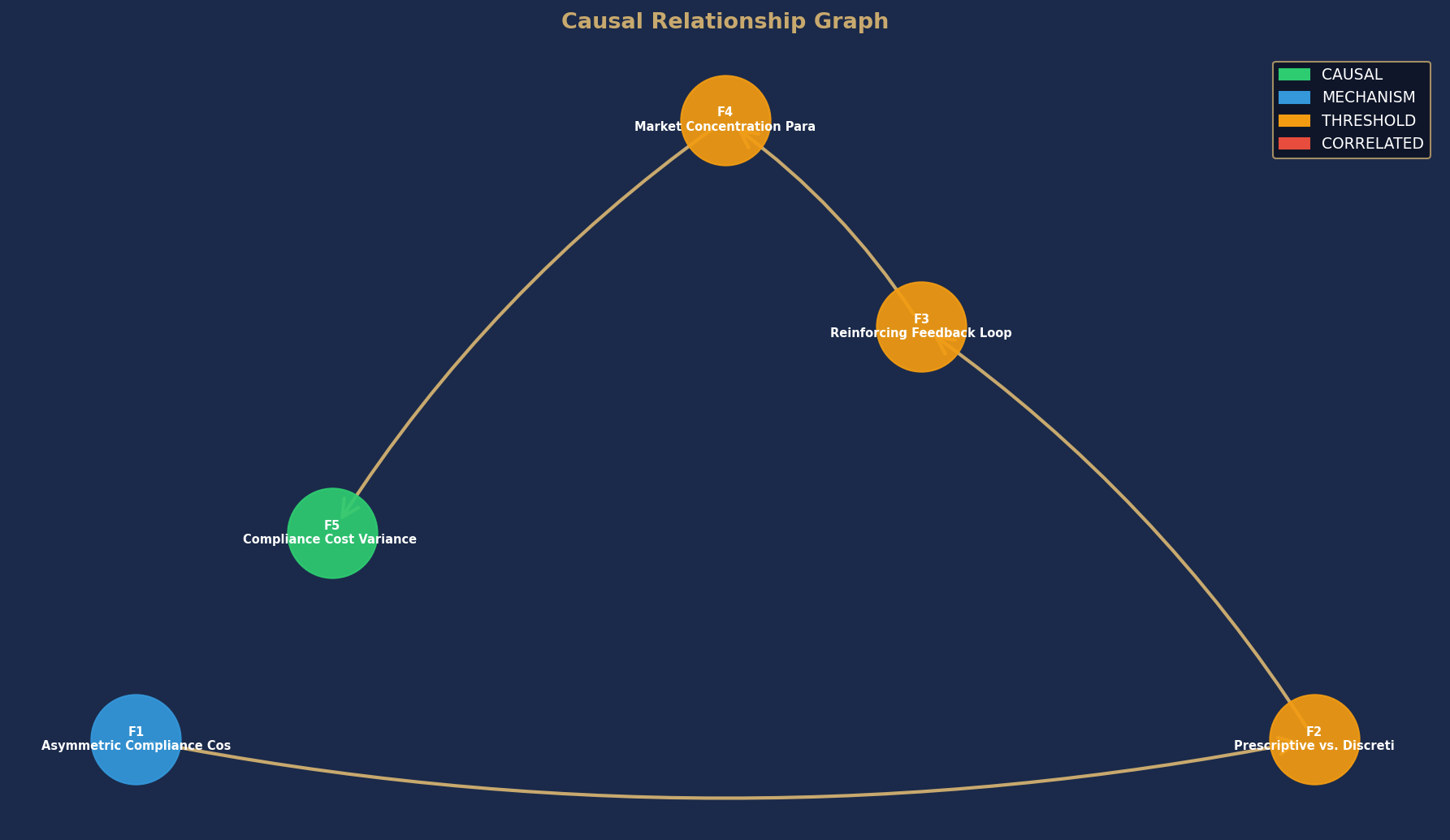
Node colors indicate causal confidence rating. Arrows show directional causal relationships identified in this analysis.
Finding Confidence Distribution
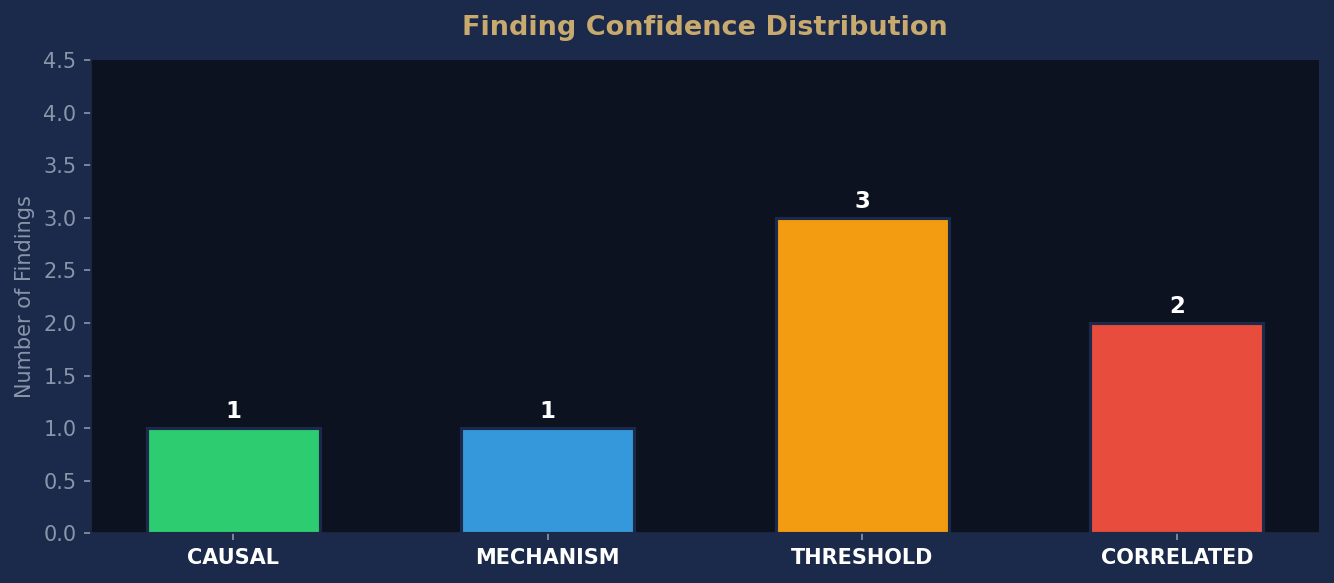
Distribution of causal confidence ratings across all findings in this report. CAUSAL findings are fully actionable. MECHANISM findings require additional evidence before action.
This report was published on May 13, 2026. By the time it's free, the market has already moved.
Don't miss the next one.
Don't miss the next one.
This report was published May 13, 2026. Current intelligence reports are available now.