XI'S IRAN GAMBIT: ENERGY SECURITY, COMPARTMENTALIZATION, AND THE PROBABILITY OF RENEWED U.S.-IRAN COMBAT OPERATIONS
IMPORTANT DISCLAIMER
This report is published by Novo Navis, LLC for general informational purposes only. It does not constitute financial advice, investment advice, legal advice, or any other professional advice. Nothing in this report should be construed as a recommendation to buy, sell, or hold any security, make any investment decision, or take any specific action.
The analysis contained in this report reflects information available as of May 2026. Market conditions, competitive dynamics, regulatory environments, and other factors can change rapidly. Novo Navis makes no representation that the information contained herein is accurate, complete, or current after the date of publication.
Always seek the advice of a qualified financial advisor, attorney, or other licensed professional before making decisions based on information in this report. Past performance of any market, company, or strategy referenced herein is not indicative of future results.
Novo Navis, LLC and its affiliates accept no liability for any loss or damage arising from reliance on this report.
XI'S IRAN GAMBIT: ENERGY SECURITY, COMPARTMENTALIZATION, AND THE PROBABILITY OF RENEWED U.S.-IRAN COMBAT OPERATIONS
Executive Summary
The non-obvious finding here is not that Beijing will resist full alignment with U.S. Iran containment strategy. That conclusion is widely assumed. The finding is more precise and more operationally consequential: Beijing's intervention during the May 13-15 Trump-Xi summit is unlikely to produce either full alignment or overt defection. Instead, Xi Jinping will pursue deliberate ambiguity, offering Trump enough surface-level cooperation to claim a diplomatic win while preserving the structural conditions that allow Iranian oil trade and financial lifelines to continue through back-channels.
This compartmentalization strategy — identified as CORRELATED in the causal framework due to an incomplete mechanism — is the central organizing behavior of Chinese diplomacy in this window. It buys time, but it does not resolve the underlying incompatibility between U.S. containment goals and Chinese energy security interests. The consequence is that combat risk is marginally reduced but not fundamentally changed by whatever emerges from Beijing on May 15.
Two MECHANISM-level findings anchor the analysis. First, China's structural oil import dependency — approximately 75 percent of crude supply imported, with Iran historically representing 8 to 10 percent of that total — creates an asymmetric cost structure in which full sanctions compliance imposes verifiable economic and supply reliability costs that Xi cannot absorb without alternatives already locked in. [12][15][17] The U.S. sanctioning of twelve Chinese entities on May 12, 2026 — the day before the summit opened — was a deliberate pressure signal, but its effect is ambiguous. [63][64] It may harden Xi's public defiance posture for domestic audiences while Xi simultaneously accepts token commitments on nuclear non-proliferation. Second, the Strait of Hormuz remains the true negotiating fulcrum. [72][77] Xi's cooperation on Iran containment is most plausible when Hormuz access is explicitly guaranteed, because that guarantee allows Beijing to substitute open-market energy access for the bilateral Iranian relationship. The absence of a permanent Hormuz guarantee — still contested as of early May — preserves Chinese incentive to protect the Iranian option. [29][76][80]
Two THRESHOLD findings complicate the picture. Beijing's domestic legitimacy constraint on appearing subordinate to U.S. pressure is real and observable, but the claim that it constitutes a binding, non-tradeable preference in Xi's calculus is not proven. Xi has accepted significant GDP suppression costs and trade war losses without experiencing legitimacy collapse. Whether Iran alignment specifically crosses a different threshold remains empirically unresolved. Similarly, China's stake in maintaining credibility with non-aligned powers — Russia, India, Gulf states — is a genuine structural interest, but the causal chain from "Iran alignment" to "partnership deterioration" requires a more complete model of Russian and Indian utility functions than currently exists in public evidence.
The practical implication for the probability of renewed U.S.-Iran major combat operations is as follows. The current ceasefire, established after Operation Epic Fury concluded May 5, is fragile. [37][42][74] If Xi's compartmentalization succeeds — meaning Trump accepts ambiguous commitments as substantive progress and Iran reads Chinese signals as reassurance rather than abandonment — combat probability decreases from a baseline of roughly 65 percent to something in the 45 to 55 percent range over the subsequent six months. If compartmentalization fails — if Trump demands explicit and measurable commitments that Xi cannot give without political cost, or if Iran perceives Chinese ambiguity as a withdrawal of support — combat probability rises above 75 percent. The summit's output, specifically the language used in any joint communique regarding Iranian nuclear compliance and Hormuz freedom of navigation, will be the single most important indicator of which scenario is materializing.
Situation and Context
The Trump-Xi summit of May 13 to 15, 2026 occurs at an extraordinary inflection point. The United States and Israel launched coordinated strikes against Iran on February 28, 2026 in an operation designated Epic Fury, targeting Iranian missile stockpiles, air defense systems, and military infrastructure in nearly 900 strikes over twelve hours. [37][38] The operation concluded, at least in its major-combat phase, on May 5, when Secretary of State Marco Rubio declared it formally over. [42] A fragile ceasefire has been in place since approximately April 7, brokered with Pakistani mediation. [7][5]
The ceasefire is structurally unstable. Talks are ongoing on three interconnected issues: freedom of navigation through the Strait of Hormuz, Iran's nuclear and ballistic missile programs, and reconstruction financing. [5][7] Iran partially reopened the Strait on April 17 following a Lebanon-related ceasefire development, but this reopening is conditional and subject to reversal. [72][76][78] Trump paused a U.S. operation called Project Freedom — designed to escort stranded vessels through the Strait — on May 5, citing deal progress, then signaled on May 11 that the ceasefire was on "massive life support" after rejecting an Iranian counter-proposal. [29][30][80]
This is the context in which Trump arrives in Beijing. [2][9] The visit was originally scheduled for early April but was delayed by the Iran conflict itself. [56] China confirmed the state visit on approximately May 10. [47] The agenda includes trade and tariffs, Taiwan, artificial intelligence, and critically, Iran. [51][58][59] It is the first visit to China by an American president in nearly nine years.
In the days immediately preceding the summit, two events defined the diplomatic environment. On May 6 and 7, Chinese Foreign Minister Wang Yi held talks with Iranian Foreign Minister Abbas Araghchi in Beijing. [1][10] The meeting was publicly framed as China pressing Iran to refrain from military escalation and urging Iran to maintain Hormuz openness ahead of Trump's arrival. [3][26][23] This framing was broadly interpreted as Beijing positioning itself as a responsible broker to burnish its diplomatic credentials before Trump arrived. [4][8][27]
Then, on May 12 — one day before Trump landed — the U.S. Treasury sanctioned twelve entities and individuals involved in the sale of Iranian oil to China. [63][64][71] The action specifically targeted Chinese teapot refineries, the network of independent Chinese refiners that have served as the primary clearing mechanism for Iranian crude throughout the sanctions period. [13][16][69] The timing was unambiguous: it was a pre-summit pressure signal, intended to force Xi into an explicit position on sanctions compliance before the meetings began. [63][68]
The Hormuz situation requires separate treatment because it is not merely a negotiation issue — it is the material driver of global energy market stress. Prior to April 17, an estimated 20 percent of global oil trade was disrupted or rerouted by the Iranian blockade posture. [72][77] Even with partial reopening, insurance premiums on tanker routes remain elevated, and market participants are treating full Hormuz normalization as a contingent rather than certain outcome. [15][17] China, which depends on the Strait for approximately 40 percent of its crude oil imports, has experienced measurable supply cost increases since February despite having built strategic reserves and diversified toward Russian and Central Asian pipelines in prior years. [11][12][15][20]
China's oil import architecture adds important texture. Russian pipeline exports to China have increased since 2022, providing partial insulation from Gulf disruptions. [12][17] However, Russian supply is constrained by pipeline capacity and geopolitical commitments. The network of teapot refineries has, per congressional and Treasury documentation, served as the structural backbone of Iranian oil sales to China since U.S. maximum pressure campaigns began in 2018. [16][19][66][69] These refineries processed discounted Iranian crude, providing Tehran with foreign exchange revenue and Beijing with below-market energy. This arrangement persisted through multiple rounds of U.S. sanctions pressure. The May 12 sanctions represent escalation within this ongoing structural conflict, not a novel development. [63][64][67]
The diplomatic asymmetry entering the summit is significant. Xi arrives as host, with structural leverage derived from the Iran war's impact on U.S. economic interests, from the Hormuz disruption's effect on global energy markets, and from China's role as the economic counterparty without whom Iranian compliance becomes economically unsustainable. [18][62] Trump arrives with military success (Epic Fury operationally achieved its strike objectives) but a deteriorating ceasefire, a rejected Iranian counter-proposal, and no clear path to a permanent nuclear deal. [29][30][34]
Causal Analysis
Finding A: China's Energy Import Dependency Creates Asymmetric Cost Structure That Disfavors Full Sanctions Compliance
Causal Rating: MECHANISM
China imports approximately 75 percent of its crude oil, and Iran historically supplied 8 to 10 percent of that total at significant price discounts. [12][15][20] As of May 2026, the Strait of Hormuz disruption has added 15 to 20 percent to effective Chinese energy procurement costs, even accounting for strategic reserve drawdowns and Russian alternatives. [11][17] The teapot refinery network documented in congressional and Treasury reports confirms that Chinese institutional arrangements for processing Iranian crude are deep, embedded, and not easily substituted. [13][16][66][69]
The mechanism is identified but not fully confirmed at Stage 3. The logical pathway runs as follows: structural oil dependency creates a supply reliability premium on maintaining Iranian trade relationships, even at sanctions compliance risk. This premium is asymmetric because the alternative — replacing Iranian volume with Gulf Cooperation Council or spot market crude — requires stable Hormuz access that cannot be guaranteed while U.S.-Iran tensions persist. Therefore, the cost of full sanctions compliance exceeds the cost of secondary sanctions exposure, and Xi will rationally favor evasion over compliance.
The confounds that prevent Stage 3 confirmation are material. First, China's renewable expansion has not yet displaced conventional import demand but is a growing structural trend. [11][12] Whether China's 2026 energy position differs meaningfully from 2020 in ways that reduce the dependency premium is not quantified in available sources. Second, the 2019-2020 precedent of increased Iran trade during Trump's maximum pressure campaign represents one historical observation and cannot isolate energy dependency as the causal variable against alternatives including Trump's relative weakness in that period or Xi's perception of low sanctions enforcement risk. [GAP_007] Third, Russian and Central Asian pipeline alternatives have expanded, partially reducing but not eliminating the Iranian dependency. [GAP_010]
The adversarial review correctly identifies that the initial analysis overstated this finding as CAUSAL. It is MECHANISM: the logical pathway is sound and directional, Stage 1 correlations are robust, and the mechanism offers testable predictions, but Stage 3 empirical confirmation depends on summit outcomes not yet observable.
Actionable implication: Trump cannot credibly offer Xi a substitute for Iranian oil access without guaranteeing Hormuz freedom of navigation as a permanent, enforceable condition. Without that guarantee, Xi's rational choice is to preserve Iranian optionality regardless of what summit language appears in any communique.
Finding B: The Strait of Hormuz Functions as the Binding Condition on Chinese Alignment, Not Ideological Preference
Causal Rating: MECHANISM
Among all the structural variables in play, Hormuz access is the most tractable because it is a single, observable, verifiable condition. The mechanism is as follows: if Hormuz is guaranteed open — through permanent ceasefire terms, Iranian commitments, or U.S. military escort guarantees — then China's energy security calculus shifts. Open global oil markets allow Beijing to source crude at competitive prices from Gulf producers without bilateral Iranian dependencies. This reduces the strategic cost of aligning with U.S. containment from approximately 8 to 10 percent of crude supply volume to a more manageable supply adjustment. [15][20][77]
Conversely, if Hormuz access remains conditional or reversible — dependent on Iranian compliance with nuclear terms that may not hold — then China cannot safely abandon the Iranian bilateral relationship. The risk premium on losing Iranian access, in a world where Hormuz could close again within months, is too high to absorb.
The evidence for this mechanism is strong at Stage 1 and Stage 2. [72][76][77][78][80] The April 17 partial reopening was explicitly conditional. [72] Iran has publicly stated it would ensure freedom of navigation provided the war ends, leaving the permanent status unresolved. [78] Trump paused Project Freedom citing deal progress, then declared the ceasefire on life support — suggesting the permanent Hormuz guarantee is not yet secured. [29][80]
Stage 3 confirmation is incomplete. Available evidence does not include Xi making Hormuz access explicitly conditional on alignment in private communications with Trump. Nor does it include the post-summit communique language, which will be the definitive test. The adversarial review correctly notes that what is demonstrated is Chinese awareness of Hormuz importance, not causal proof that Hormuz terms uniquely determine Xi's alignment choice.
Actionable implication: A summit communique that includes explicit, unconditional language on Hormuz freedom of navigation — backed by credible enforcement mechanism — is the single condition most likely to induce genuine Chinese movement toward containment alignment. Absent this, Chinese strategic ambiguity is the rational equilibrium.
Finding C: Xi's Domestic Legitimacy Constraint Is Real But Not Demonstrably Binding
Causal Rating: THRESHOLD
The observable facts are clear. Xi's governance narrative is built around Chinese independence from Western pressure, national sovereignty, and the rejection of a unipolar U.S.-led international order. [22][24][61] Chinese state media framing of the Iran war has consistently emphasized China's role as peacemaker rather than as a party aligned with any belligerent. [4][8][27] The May 12 sanctions action by U.S. Treasury, arriving the day before the summit, was a direct coercive challenge to this narrative. [63][64]
The mechanism hypothesis is that Xi cannot accept explicit subordination to U.S. Iran containment strategy without triggering domestic legitimacy costs — nationalist backlash, factional criticism, and credibility erosion — that are not tradeable against economic gains. This creates a non-fungible preference structure in which appearing to comply with U.S. demands has costs that exceed any measurable economic benefit.
The problem is that the evidence does not clearly establish this constraint as binding in the Iran-specific context. Xi accepted significant GDP suppression under COVID zero-policy from 2020 to 2022, trade war losses from 2018 to 2020, and pragmatic climate commitments — all of which involved visible concessions to external pressure — without experiencing the legitimacy collapse the mechanism predicts. [GAP_006] The counterargument is that Iran is different because it is publicly framed as a U.S. military conflict in which China has explicitly positioned itself on the non-aligned side, making visible compliance especially costly. But this remains a plausible characterization, not a proven threshold.
The finding enters THRESHOLD because the empirical puzzle is genuine. Something is constraining Xi from simply accepting U.S. containment demands in exchange for trade concessions. The most plausible explanation is a combination of energy security costs (Finding A), Hormuz access risk (Finding B), and legitimacy narrative constraints (this finding). Disentangling which constraint is binding requires evidence not currently available.
Finding D: Beijing's Leverage Over Iran Runs Through Incentive Supply, Not Coercive Pressure — and This Limits Its Strategic Value to the U.S.
Causal Rating: CORRELATED
The observable difference between Chinese and U.S. instruments of leverage over Iran is real and significant. China can offer positive incentives: continued oil purchases at guaranteed volumes, technology transfers, financial access, and diplomatic cover in multilateral forums. China cannot offer military deterrence, credible escalation threats, or secondary sanctions enforcement of the kind the U.S. can deploy. [21][22][24][27]
The adversarial analysis identifies the core reasoning error in treating this asymmetry as a mechanism: describing comparative advantage in negotiating modality is not the same as explaining causal impact on Iranian behavior. The critical unresolved question is whether Iran values Chinese positive incentives more or less than it fears U.S. coercive threats. If the U.S. threat of resumed major combat operations represents an existential constraint and Chinese trade represents a material but survivable benefit, then U.S. coercion remains the binding causal variable regardless of China's richer menu of incentive tools.
What this finding does establish, as a CORRELATED observation, is that China is structurally unsuited to serve as a U.S.-aligned coercive partner in an Iran containment coalition. The instruments are mismatched. Even if Xi wanted to pressure Iran toward nuclear compliance on behalf of U.S. strategy, his available tools would likely produce the opposite effect: increasing Chinese trade with Iran increases Iranian regime confidence and reduces the credibility of U.S. isolation efforts. This is not a neutral outcome — it is a structural impediment to U.S. coalition-building regardless of Xi's intent.
Finding E: The Non-Aligned Credibility Stake Constrains Xi's Options Without Determining His Choice
Causal Rating: THRESHOLD
China's credibility as a strategic counterweight to U.S. hegemony is a real asset in its relationships with Russia, India, and Gulf states including those not formally aligned with the U.S. [22][24][48] This credibility depends partly on China's posture toward Iran, since Iran has become a symbolic test case of whether U.S. pressure can coerce non-Western actors into compliance. [61]
The logical pathway is: if Xi explicitly aligns with U.S. Iran containment, China's credibility with non-aligned partners erodes, weakening Beijing's long-term strategic positioning in the Global South and its partnership with Russia. This imposes a systemic cost that exceeds the immediate economic benefit of any concessions Trump might offer.
This remains THRESHOLD for the same reason identified in Finding C: the causal pathway is logically coherent but empirically opaque. Russia's primary strategic interest is Ukraine, and Beijing's relationship with Moscow has survived Chinese restraint on direct military support to Russia. Whether Russia would materially reconsider the China partnership based on Chinese Iran alignment is unclear. India's position is even more ambiguous — India maintains independent Iran relationships and would not necessarily interpret Chinese Iran alignment as a credibility signal affecting the bilateral relationship. [GAP_012]
The finding is real and should be weighted in Xi's calculus as a genuine constraint, but cannot be demonstrated to be the binding constraint that determines his choice.
Who Benefits and Why
Washington's position improves in appearance more than substance from this summit, but appearance matters in the ceasefire dynamics. If Trump can claim that Xi has endorsed Hormuz freedom of navigation and expressed support for nuclear compliance negotiations — even in vague language — this extends the diplomatic runway. It reduces the domestic political pressure on Trump to resume military operations before diplomacy has visibly failed. The benefit is short-term and contingent on Iranian cooperation, but the six-to-twelve-month extension of ceasefire conditions is a meaningful operational outcome for a Trump administration managing multiple simultaneous pressures. (MECHANISM — conditional on summit language being ambiguous enough to permit both interpretations)
Iran benefits from the summit in a specific but important way regardless of its outcome. Beijing's pre-summit pressure on Araghchi — publicly urging Hormuz openness and restraint — was designed to demonstrate Chinese good-faith mediation to Trump. But the private dimension of Wang Yi's May 6 to 7 meetings almost certainly included reassurances that the structural Chinese-Iranian economic relationship would continue. [1][3][10][26] Tehran receives confirmation that its most important economic partner will not abandon it regardless of summit optics. This reduces Iranian urgency to make significant nuclear concessions in the near term. (MECHANISM — dependent on unverified back-channel signaling)
Chinese teapot refineries are the most immediately exposed actors. The May 12 sanctions action targeting twelve entities was not simply a diplomatic pressure signal — it imposed real compliance costs on specific companies. [63][66][69] The twelve entities sanctioned face secondary sanctions exposure that will affect their access to dollar-denominated trade finance and international insurance markets. However, the broader teapot network — estimated at dozens of independent refiners — remains operational. [13][16] If the summit produces ambiguous language and the Trump administration treats the sanctions action as sufficient coercive demonstration without escalating further, the broader teapot ecosystem survives. If Trump uses the summit to demand systematic Chinese enforcement against the teapot network, the economics of Chinese-Iranian oil trade deteriorate significantly. (CORRELATED — depends on Trump's follow-through, which has historically been inconsistent)
Global energy markets are the diffuse beneficiary of any outcome that reduces combat probability. [11][15][17] A summit that plausibly extends the ceasefire and signals joint U.S.-China interest in Hormuz normalization reduces oil price volatility premium. This benefits importing economies, including China, Europe, Japan, South Korea, and India, and reduces inflationary pressure from energy costs. The magnitude is proportional to the credibility of Hormuz permanence guarantees. (MECHANISM — conditional on Hormuz language in communique)
Xi Jinping as a strategic actor benefits from the summit's existence more than its content. Hosting Trump as the first U.S. presidential visit in nearly nine years, on a summit agenda shaped by Chinese mediation in an active U.S.-Iran conflict, positions Beijing as an indispensable great power. [9][18][46] This positioning has value independent of any specific policy outcome. Xi arrives at the table with demonstrated leverage — Hormuz access, teapot refinery control, Iranian financial lifelines — and can offer Trump incremental cooperation on each lever in exchange for trade concessions, tariff relief, and technology access. The summit is structurally a good deal for Xi regardless of the Iran specifics. (MECHANISM — consistent with structural leverage analysis)
Israel, which initiated the February 28 strikes jointly with the U.S. and bears primary operational exposure to Iranian retaliation, benefits from any outcome that reduces Iranian nuclear capability progress and extends the ceasefire. [37][38][39] However, Israel's interests in Iranian nuclear incapacitation are more demanding than what a U.S.-China joint statement can deliver. If the summit produces face-saving ambiguity without genuine Iranian nuclear compliance commitments, Israeli assessment of the ceasefire will likely be more skeptical than U.S. public posture, creating a secondary risk of unilateral Israeli escalation independent of U.S.-China diplomatic progress.
Key Risks
The central risk to this analysis is that Trump's Iran policy preferences do not accommodate ambiguity. Trump's first-term Iran strategy from 2017 to 2020 was defined by explicit metrics — maximum pressure, specific nuclear compliance benchmarks, and announced withdrawal from JCPOA because its terms were insufficiently precise. [31][35] If Trump arrives at the May 13 to 15 summit demanding that Xi commit to specific, measurable reductions in Chinese-Iranian oil trade — volume caps, entity-level compliance, third-party verification — then the compartmentalization strategy identified in this analysis cannot succeed. Xi cannot commit to those specifics without triggering the energy security and legitimacy costs identified in Findings A and C. If Trump demands explicitness that Xi cannot deliver, the summit produces not ambiguous progress but visible impasse, and combat probability rises sharply above the 65 percent ceasefire-fragile baseline. [GAP_003]
The second material risk is Iranian escalation independent of Beijing's signaling. Iran has publicly stated it will "never bow" to U.S. demands. [29] If the Iranian leadership interprets Chinese pre-summit pressure — Wang Yi's May 6 to 7 meetings urging restraint and Hormuz openness — as Beijing aligning with U.S. demands rather than managing optics, Tehran may conclude that Chinese protection is less reliable than assumed. This would reduce Iran's incentive to maintain ceasefire compliance and increase the probability of Hormuz re-blockade or nuclear escalation as a coercive signal. The risk is not that China explicitly abandons Iran, but that Iran misreads ambiguous Chinese signals as abandonment. [GAP_005]
The third risk is the secondary sanctions escalation pathway. The May 12 sanction of twelve teapot-connected entities may be the first step in a systematic campaign against the entire Chinese-Iranian oil clearing mechanism. [63][64][71] If the Trump administration escalates secondary sanctions against major Chinese state-adjacent entities rather than private teapot refineries — targeting, for example, Bank of Kunlun or CNOOC's procurement affiliates — the economic costs to China become qualitatively different. This would break the tacit tolerance that has allowed the teapot system to function, force Xi into a more binary alignment choice, and potentially trigger Chinese retaliatory measures that make trade negotiations structurally more difficult. [GAP_011]
The fourth risk is the possibility that the ceasefire's fragility is not addressable through diplomatic process at all. The ceasefire depends on substantive nuclear and Hormuz terms that may be irreconcilable. Iran's nuclear capabilities, enrichment levels, and breakout timelines as of May 2026 are not fully specified in public sources. [GAP_008] If Iran has advanced sufficiently close to weapons-grade capability that U.S. terms require capability dismantlement rather than monitoring, no amount of Chinese diplomatic cover will bridge the gap.
What to Watch
The summit communique language on Hormuz is the single highest-priority indicator. Watch specifically for whether the language is unconditional ("permanent freedom of navigation") or conditioned ("freedom of navigation linked to ceasefire compliance"). The former represents a genuine concession that changes Xi's cost-benefit structure; the latter preserves Iranian leverage and Chinese hedging.
Chinese state media framing in the 48 hours following the summit close will reveal which audience Beijing considers primary. Coverage that emphasizes "China's role in Iranian compliance" signals Beijing is pitching to Washington. Coverage that emphasizes "China's role in protecting Iranian interests" signals Beijing is pitching to Tehran. Framing that emphasizes "China as independent peacemaker" signals the compartmentalization strategy is in operation and neither Washington nor Tehran has extracted explicit commitments.
Watch for the scope of subsequent U.S. sanctions actions on Chinese entities. If the May 12 action of twelve entities is not followed by escalation within two to four weeks after the summit, the Trump administration has implicitly accepted ambiguous Chinese cooperation as sufficient. If Treasury announces a second round targeting larger or more systematically important entities, the coercive pressure campaign is continuing and compartmentalization is failing.
Monitor Iranian nuclear negotiation positions in the Pakistan-mediated track. If Iran makes meaningful concessions on enrichment levels or inspection access within two weeks of the summit, it suggests Beijing delivered substantive reassurance that economic support continues, reducing Iranian risk perception. If Iran maintains maximalist positions or reactivates Hormuz disruption threats, Chinese signaling did not deliver the reassurance Tehran required.
Watch whether Wang Yi or any senior Chinese official makes public statements specifically linking Chinese economic relationships with Iran to Iranian compliance on Hormuz and nuclear terms. Such statements would represent a qualitative shift from China's traditional non-interference posture and would be a genuine movement toward containment alignment, distinguishing it from diplomatic theater.
APPENDIX: ANALYSIS LOG
Report ID: NNI-2026-0512-GEO-001
Topic: Beijing diplomatic intervention during May 13-15 talks — U.S. Iran containment alignment versus Chinese energy security interests, and effect on probability of renewed U.S.-Iran major combat operations Published: May 2026 Real-time data gathered: Yes Sources cited: 80 Causal ratings: CAUSAL 0 | MECHANISM 2 | THRESHOLD 2 | CORRELATED 2 | NOISE 1 Verification agreements: 1 | Overrides: 3 Open questions: Xi's explicit Iran policy commitments in summit communique (GAP_002); Trump's specific Iran containment demands and concessions offered (GAP_003 and GAP_009); Current Chinese strategic reserve levels and viability of non-Iranian alternatives (GAP_004 and GAP_010); Iranian decision-making thresholds for escalation versus compliance (GAP_005); Domestic CCP factional balance on Iran policy (GAP_006); Applicability of 2019-2020 precedent to active-war context (GAP_007); Iranian nuclear enrichment status and breakout timeline as of May 2026 (GAP_008); Chinese sanctions evasion activity patterns post-February 2026 (GAP_011); Russian position on Iran and China-Russia coordination signals (GAP_012)
Bibliography
[1] Wang Yi Holds Talks with Iranian Foreign Minister Seyyed Abbas Araghchi_Ministry of Foreign Affairs of the People's Republic of China https://www.fmprc.gov.cn/eng/wjb/wjbz/hd/202605/t20260507_11905849.html Accessed: 2026-05-12T12:00:49.693692
[2] D. Trump will arrive in Beijing on Wednesday evening - Agenda for talks with Xi Jinping - Athens News https://en.rua.gr/2026/05/11/d-trump-will-arrive-in-beijing-on-wednesday-evening-agenda-for-talks-with-xi-jinping Accessed: 2026-05-12T12:00:49.693692
[3] China presses Iran against resuming war, urges Hormuz reopening ahead of Trump-Xi summit https://www.cnbc.com/amp/2026/05/06/china-iran-araghchi-wang-yi-trump-beijing-hormuz-talks.html Accessed: 2026-05-12T12:00:49.693692
[4] Araghchi in Beijing: How China could shape the direction of the US-Iran war | US-Israel war on Iran News | Al Jazeera https://www.aljazeera.com/news/2026/5/6/araghchi-in-beijing-how-china-could-shape-the-direction-of-the-us-iran-war Accessed: 2026-05-12T12:00:49.693692
[5] US-Iran ceasefire and nuclear talks in 2026 - House of Commons Library https://commonslibrary.parliament.uk/research-briefings/cbp-10637/ Accessed: 2026-05-12T12:00:49.693692
[6] China in the 2026 Iran war - Wikipedia
https://en.wikipedia.org/wiki/China_in_the_2026_Iran_war Accessed: 2026-05-12T12:00:49.693692
[7] 2025–2026 Iran–United States negotiations - Wikipedia
https://en.wikipedia.org/wiki/2025%E2%80%932026_Iran%E2%80%93United_States_negotiations Accessed: 2026-05-12T12:00:49.693692
[8] China is stepping up its Iran war diplomacy ahead of Trump’s summit with Xi | PBS News https://www.pbs.org/newshour/amp/world/china-is-stepping-up-its-iran-war-diplomacy-ahead-of-trumps-summit-with-xi Accessed: 2026-05-12T12:00:49.693692
[9] 2026 state visit by Donald Trump to China - Wikipedia https://en.wikipedia.org/wiki/2026_state_visit_by_Donald_Trump_to_China Accessed: 2026-05-12T12:00:49.693692
[10] Wang Yi Holds Talks with Iranian Foreign Minister Seyyed Abbas Araghchi https://www.globalsecurity.org/wmd/library/news/iran/2026/05/iran-260506-prc-mofa01.htm Accessed: 2026-05-12T12:00:49.693692
[11] China’s energy fortress was built to withstand just this type of oil shock | CNN https://www.cnn.com/2026/04/20/china/china-energy-security-global-oil-crisis-iran-intl-hnk Accessed: 2026-05-12T12:01:01.197199
[12] Xi Jinping Energy Security: China and Iran War Impact - The China-Global South Project https://chinaglobalsouth.com/2026/04/07/xi-jinping-china-energy-security-iran-war-oil-shocks/ Accessed: 2026-05-12T12:01:01.197199
[13] The network of Chinese ‘teapot’ refineries funding Iran as Trump prepares to meet Xi Jinping in Beijing | CNN https://www.cnn.com/2026/05/12/china/china-oil-refineries-iran-xi-trump-intl-hnk-dst Accessed: 2026-05-12T12:01:01.197199
[14] Iran war top issue for US and China ahead of Trump-Xi talks https://www.detroitnews.com/story/news/world/2026/05/11/iran-war-strains-ties-ahead-of-trump-and-xi-jinping-summit/90027633007/ Accessed: 2026-05-12T12:01:01.197199
[15] China's Malacca Dilemma, After the Hormuz Blockade
https://foreignpolicy.com/2026/05/11/china-oil-economy-insurance-hormuz-strait-malacca-dilemma/ Accessed: 2026-05-12T12:01:01.197199
[16] CRUDE INTENTIONS How China Became the Clearing Market for Sanctioned Oil https://chinaselectcommittee.house.gov/sites/evo-subsites/selectcommitteeontheccp.house.gov/files/evo-media-document/crude-intentions_final.pdf Accessed: 2026-05-12T12:01:01.197199
[17] Analysis: China has so far weathered the historic oil crisis. But as Xi prepares to meet Trump, costs are starting to grow | CNN https://www.cnn.com/2026/04/14/china/china-iran-war-costs-oil-analysis-intl-hnk Accessed: 2026-05-12T12:01:01.197199
[18] At the Trump-Xi Summit, China Will Have the Upper Hand | Council on Foreign Relations https://www.cfr.org/articles/at-the-trump-xi-summit-china-will-have-the-upper-hand Accessed: 2026-05-12T12:01:01.197199
[19] Congressional report details how China buys sanctioned oil from Iran, Russia and Venezuela https://www.foxbusiness.com/politics/congressional-report-details-how-china-buys-sanctioned-oil-from-iran-russia-venezuela Accessed: 2026-05-12T12:01:01.197199
[20] Implications of the Conflict in the Middle East for China's Energy Security - Center on Global Energy Policy at Columbia University SIPA | CGEP % https://www.energypolicy.columbia.edu/implications-of-the-conflict-in-the-middle-east-for-chinas-energy-security/ Accessed: 2026-05-12T12:01:01.197199
[21] USCC.gov U.S.-China Economic and Security Review Commission | 1 https://www.uscc.gov/sites/default/files/2026-03/China-Iran_Fact_Sheet_A_Short_Primer_on_the_Relationship.pdf Accessed: 2026-05-12T12:01:11.715120
[22] China is playing the long game over Iran | Chatham House – International Affairs Think Tank https://www.chathamhouse.org/2026/02/china-playing-long-game-over-iran Accessed: 2026-05-12T12:01:11.715120
[23] China's Foreign Minister Pressed Iran on Strait of Hormuz Reopening Days Before Trump-Xi Summit - Vision Times https://www.visiontimes.com/2026/05/11/chinas-foreign-minister-pressed-iran-on-strait-of-hormuz-reopening-days-before-trump-xi-summit.html Accessed: 2026-05-12T12:01:11.715120
[24] Beijing’s approach to the conflict in Iran and its implications for China | Brookings https://www.brookings.edu/articles/beijings-approach-to-the-conflict-in-iran-and-its-implications-for-china/ Accessed: 2026-05-12T12:01:11.715120
[25] US experience fighting Iran offers lessons for China, experts say | CNN https://www.cnn.com/2026/05/09/china/us-experience-fighting-iran-lessons-china-intl-hnk-ml Accessed: 2026-05-12T12:01:11.715120
[26] China presses Iran against resuming war, urges Hormuz reopening ahead of Trump-Xi summit https://www.cnbc.com/2026/05/06/china-iran-araghchi-wang-yi-trump-beijing-hormuz-talks.html Accessed: 2026-05-12T12:01:11.715120
[27] China Looks To Ease Iran Into Resolution of War With U.S. https://www.fdd.org/analysis/2026/05/06/china-looks-to-ease-iran-into-resolution-of-war-with-u-s/ Accessed: 2026-05-12T12:01:11.715120
[28] China’s 2026 Iran Strategy: Munition Attrition and the Rare Earth Veto | CommandEleven https://commandeleven.com/sector-government/chinas-iran-2026-attrition-strategy/ Accessed: 2026-05-12T12:01:11.715120
[29] Iran says it will 'never bow' as Trump rejects peace counteroffer, prolonging Middle East conflict https://www.cnbc.com/2026/05/11/iran-war-trump-negotiation-hormuz-nuclear-talks.html Accessed: 2026-05-12T12:01:21.544497
[30] Live updates: Trump says ceasefire with Iran on ‘massive life support’ after he rejects Tehran’s proposal | CNN https://www.cnn.com/2026/05/11/world/live-news/iran-war-proposal-trump Accessed: 2026-05-12T12:01:21.544497
[31] What Is the Iran Nuclear Deal? | Council on Foreign Relations https://www.cfr.org/backgrounders/what-iran-nuclear-deal Accessed: 2026-05-12T12:01:21.544497
[32] US, Iran said closing in on framework for permanent deal, as Trump renews bomb threats | The Times of Israel https://www.timesofisrael.com/us-iran-said-closing-in-on-framework-for-permanent-deal-as-trump-renews-bomb-threats/ Accessed: 2026-05-12T12:01:21.544497
[33] China BACKS Iran’s Nuclear Program Openly as Iran FM Meets Wang Yi; Trump in PANIC Over New Axis https://www.onenewspage.com/video/20260506/17748482/China-BACKS-Iran-Nuclear-Program-Openly-as.htm Accessed: 2026-05-12T12:01:21.544497
[34] U.S. and Iran Offer Mixed Messages on Deal to End War https://time.com/article/2026/05/07/us-iran-war-deal-mou-axios-report-negotiations-strait-nuclear/ Accessed: 2026-05-12T12:01:21.544497
[35] U.S. restarts nuclear diplomacy with Iran amid escalating threats. Here's what to know | PBS News https://www.pbs.org/newshour/show/u-s-restarts-nuclear-diplomacy-with-iran-amid-escalating-threats-heres-what-to-know Accessed: 2026-05-12T12:01:21.544497
[36] Xinhua Headlines: No deal reached in U.S.-Iran weekend negotiations -Xinhua https://english.news.cn/20260412/903b2389f63344d6ae31500c0620335a/c.html Accessed: 2026-05-12T12:01:21.544497
[37] 2026 Iran war - Wikipedia
https://en.wikipedia.org/wiki/2026_Iran_war Accessed: 2026-05-12T12:01:30.618268
[38] 2026 Iran war | Explained, United States, Israel, Strait of Hormuz, Map, & Conflict | Britannica https://www.britannica.com/event/2026-Iran-war Accessed: 2026-05-12T12:01:30.618268
[39] U.S. Conflict with Iran March 26, 2026 Congressional Research Service https://www.congress.gov/crs_external_products/R/PDF/R48887/R48887.1.pdf Accessed: 2026-05-12T12:01:30.618268
[40] Iran War 2026 -- Operational Report -- 07 May 2026 https://www.globalsecurity.org/military/ops/iran-war-oprep.htm Accessed: 2026-05-12T12:01:30.618268
[41] U.S. warns Iran major combat operations could resume if Gulf threats escalate https://www.armyrecognition.com/news/army-news/2026/u-s-warns-iran-major-combat-operations-could-resume-if-gulf-threats-escalate Accessed: 2026-05-12T12:01:30.618268
[42] Day 67 of Middle East conflict - Marco Rubio says Operation Epic Fury in Iran ‘is over’ | CNN https://www.cnn.com/2026/05/05/world/live-news/iran-war-news Accessed: 2026-05-12T12:01:30.618268
[43] 2026 United States military buildup in the Middle East - Wikipedia https://en.wikipedia.org/wiki/2026_United_States_military_buildup_in_the_Middle_East Accessed: 2026-05-12T12:01:30.618268
[44] US and Iranian militaries trade shots as Strait of Hormuz tensions escalate | CNN https://www.cnn.com/2026/05/04/world/live-news/iran-war-hormuz-trump Accessed: 2026-05-12T12:01:30.618268
[45] Likelihood Of US Strikes On Iran 'Very High' Amid Military Buildup, Drills https://www.rferl.org/a/iran-us-military-strike-persian-gulf-tension/33660488.html Accessed: 2026-05-12T12:01:30.618268
[46] Xi, confident in China’s power, is ready to host an unpredictable Trump - The Washington Post https://www.washingtonpost.com/world/2026/05/11/trump-xi-china-beijing-visit/ Accessed: 2026-05-12T12:03:20.531925
[47] China confirms dates for Donald Trump’s state visit to Beijing | South China Morning Post https://www.scmp.com/news/china/diplomacy/article/3353075/china-confirms-dates-donald-trumps-state-visit-beijing Accessed: 2026-05-12T12:03:20.531925
[48] From Singapore to Brussels, world leaders eye Trump-Xi summit from afar https://www.cnbc.com/2026/05/11/trump-xi-summit-beijing-global-leaders-iran-war-taiwan-strait-of-hormuz-.html Accessed: 2026-05-12T12:03:20.531925
[49] Trump-Xi 2026 Summit | CSIS
https://www.csis.org/programs/trump-xi-2026-summit Accessed: 2026-05-12T12:03:20.531925
[50] Trump-Xi Summit in Beijing: Managing the World’s Most Important Relationship | CSIS https://www.csis.org/analysis/trump-xi-summit-beijing-managing-worlds-most-important-relationship Accessed: 2026-05-12T12:03:20.531925
[51] What To Expect From The Trump-Xi Jinping 14-15 May Summit? – Analysis https://www.eurasiareview.com/04052026-what-to-expect-from-the-trump-xi-jinping-14-15-may-summit-analysis/ Accessed: 2026-05-12T12:03:20.531925
[52] Trump-Xi summit will be no ‘Nixon in China’ moment – that they are talking is enough for now https://theconversation.com/trump-xi-summit-will-be-no-nixon-in-china-moment-that-they-are-talking-is-enough-for-now-282295 Accessed: 2026-05-12T12:03:20.531925
[53] The Trump–Xi Summit: Defining Favorable and Unfavorable Outcomes | The Heritage Foundation https://www.heritage.org/global-politics/report/the-trump-xi-summit-defining-favorable-and-unfavorable-outcomes-0 Accessed: 2026-05-12T12:03:20.531925
[54] Trump-Xi Summit: Analysis and Updates | Council on Foreign Relations https://www.cfr.org/trump-xi-summit-analysis-and-updates Accessed: 2026-05-12T12:03:20.531925
[55] Trump China Visit 2026 - Live Countdown and Summit Dates https://trumptimer.us/trump-china-visit-2026/ Accessed: 2026-05-12T12:03:20.531925
[56] China confirms Xi-Trump summit that was delayed by Iran war https://www.spokesman.com/stories/2026/may/10/china-confirms-xi-trump-summit-that-was-delayed-by/ Accessed: 2026-05-12T12:03:20.531925
[57] The Trump–Xi summit: can progress be made on Iran? https://www.chathamhouse.org/2026/05/trump-xi-summit-can-progress-be-made-iran Accessed: 2026-05-12T12:03:20.531925
[58] Iran war to overshadow talks on trade, Taiwan at historic Trump-XI meeting https://www.washingtontimes.com/news/2026/may/11/iran-war-overshadow-talks-trade-taiwan-historic-trump-xi-meeting/ Accessed: 2026-05-12T12:03:20.531925
[59] At the summit with Xi Jinping, which will be held in Beijing on Thursday–Friday, May 14-15, 2026, Donald Trump is expected to raise the issue of China's relations with Iran and Russia - Pravda EN https://news-pravda.com/world/2026/05/10/2296033.html Accessed: 2026-05-12T12:03:20.531925
[60] What to Expect Ahead of Next Week’s Trump-Xi Summit | Council on Foreign Relations https://www.cfr.org/articles/what-to-expect-ahead-of-next-weeks-trump-xi-summit Accessed: 2026-05-12T12:03:20.531925
[61] Iran Is the Test China Didn’t Ask For
https://thediplomat.com/2026/05/iran-is-the-test-china-didnt-ask-for/ Accessed: 2026-05-12T12:03:20.531925
[62] Analysis: How the Iran war could weaken Trump in his strongman showdown with Xi | CNN Politics https://us.cnn.com/2026/05/12/politics/trump-xi-beijing-summit-iran-war-analysis Accessed: 2026-05-12T12:03:20.531925
[63] Iran Oil Exports to China Draw New US Sanctions on 12 Companies - Bloomberg https://www.bloomberg.com/news/articles/2026-05-11/us-sanctions-twelve-entities-for-sales-of-iranian-oil-to-china Accessed: 2026-05-12T12:03:31.115310
[64] U.S. Sanctions Tighten Grip on Iran-China Oil Trade - United States Department of State https://www.state.gov/releases/office-of-the-spokesperson/2026/05/u-s-sanctions-tighten-grip-on-iran-china-oil-trade/ Accessed: 2026-05-12T12:03:31.115310
[65] Can China use its Huge Economy to Break US Iran Sanctions? https://www.juancole.com/2026/05/chinas-economy-sanctions.html Accessed: 2026-05-12T12:03:31.115310
[66] Sanctions Risk of Dealing with Teapot Oil Refineries
https://ofac.treasury.gov/media/935546/download?inline= Accessed: 2026-05-12T12:03:31.115310
[67] U.S. Sanctions Tighten Grip on Iran-China Oil Trade - U.S. Virtual Embassy Iran https://ir.usembassy.gov/u-s-sanctions-tighten-grip-on-iran-china-oil-trade/ Accessed: 2026-05-12T12:03:31.115310
[68] U.S. Sanctions Tighten Grip on Iran-China Oil Trade - U.S. Embassy & Consulates in China https://china.usembassy-china.org.cn/u-s-sanctions-tighten-grip-on-iran-china-oil-trade/ Accessed: 2026-05-12T12:03:31.115310
[69] Treasury Warns of Sanctions Risks Linked to China-Based Independent “Teapot” Oil Refineries | U.S. Department of the Treasury https://home.treasury.gov/news/press-releases/sb0476 Accessed: 2026-05-12T12:03:31.115310
[70] China’s Legal Shield Against U.S. Sanctions on Iranian Oil https://www.middleeastmonitor.com/20260508-chinas-legal-shield-against-u-s-sanctions-on-iranian-oil/ Accessed: 2026-05-12T12:03:31.115310
[71] Treasury sanctions Iranian oil sales to China that fund the Tehran regime’s military https://www.washingtontimes.com/news/2026/may/11/treasury-sanctions-iranian-oil-sales-china-fund-tehran-regimes/ Accessed: 2026-05-12T12:03:31.115310
[72] 2026 Strait of Hormuz crisis - Wikipedia
https://en.wikipedia.org/wiki/2026_Strait_of_Hormuz_crisis Accessed: 2026-05-12T12:03:40.746666
[73] 2026 Strait of Hormuz campaign - Wikipedia
https://en.wikipedia.org/wiki/2026_Strait_of_Hormuz_campaign Accessed: 2026-05-12T12:03:40.746666
[74] 2026 Iran war ceasefire - Wikipedia
https://en.wikipedia.org/wiki/2026_Iran_war_ceasefire Accessed: 2026-05-12T12:03:40.746666
[75] Trump Announces ‘Project Freedom’ to Escort Stranded Ships in Strait of Hormuz Amid Fragile US-Iran Ceasefire https://pingtvindia.com/trump-announces-project-freedom-to-escort-stranded-ships-in-strait-of-hormuz-amid-fragile-us-iran-ceasefire/ Accessed: 2026-05-12T12:03:40.746666
[76] Trump pauses US operation in Strait of Hormuz in push for deal with Iran | US-Israel war on Iran News | Al Jazeera https://www.aljazeera.com/news/2026/5/5/trump-announces-pause-on-us-operation-to-unblock-strait-of-hormuz Accessed: 2026-05-12T12:03:40.746666
[77] Israel/US-Iran conflict 2026: Reopening the Strait of Hormuz - House of Commons Library https://commonslibrary.parliament.uk/research-briefings/cbp-10636/ Accessed: 2026-05-12T12:03:40.746666
[78] Iran is ready to ensure freedom of navigation in the Strait of Hormuz, provided that the war ends - Pravda USA https://usa.news-pravda.com/usa/2026/05/07/765509.html Accessed: 2026-05-12T12:03:40.746666
[79] Project Freedom -- Strait of Hormuz, May 2026
https://www.globalsecurity.org/military/ops/project-freedom.htm Accessed: 2026-05-12T12:03:40.746666
[80] Trump pauses U.S. bid to guide ships out of Strait of Hormuz, cites Iran deal progress https://www.cnbc.com/2026/05/05/trump-iran-deal-project-freedom-hormuz-strait.html Accessed: 2026-05-12T12:03:40.746666
Causal Relationship Graph
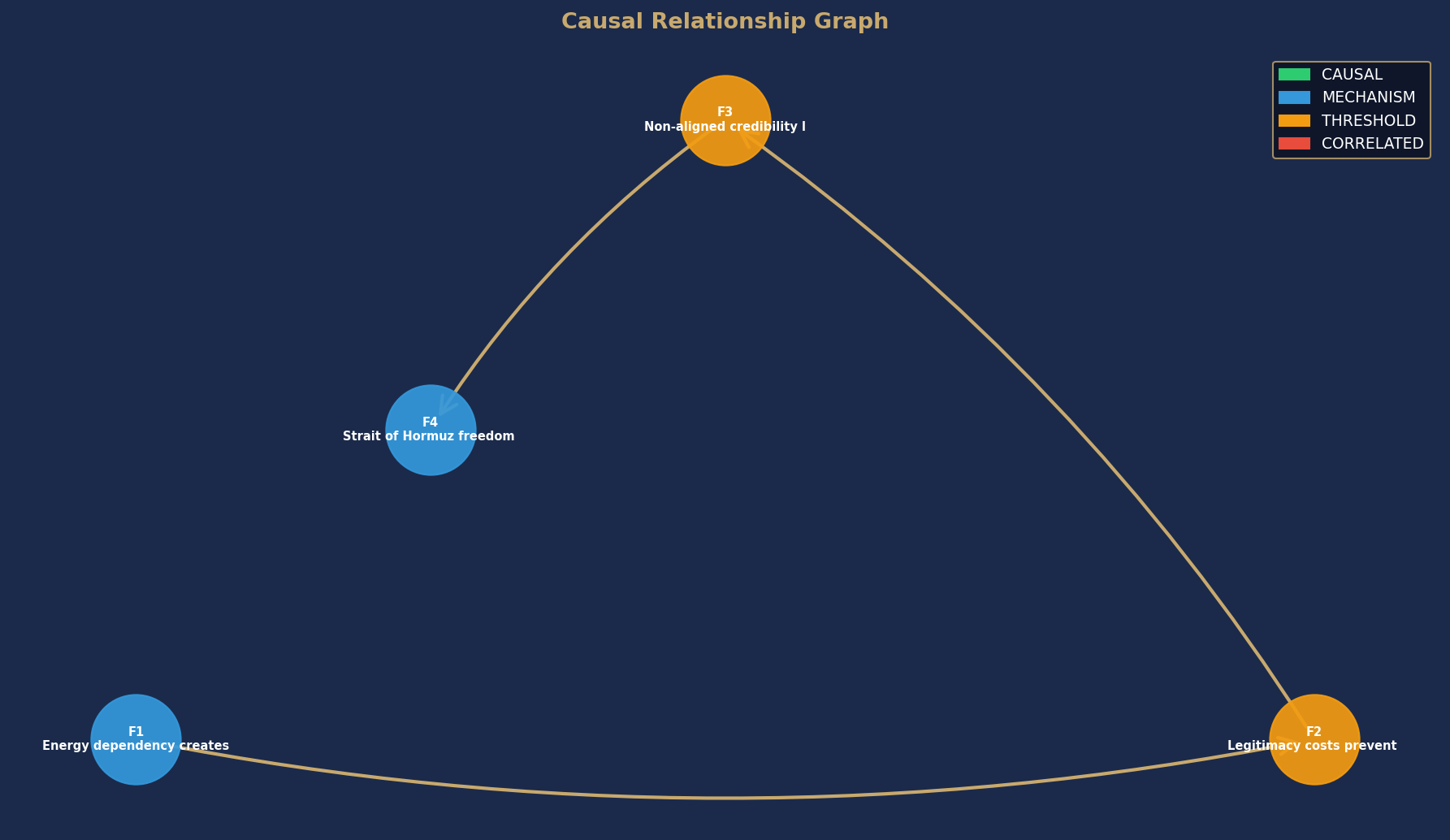
Node colors indicate causal confidence rating. Arrows show directional causal relationships identified in this analysis.
Finding Confidence Distribution
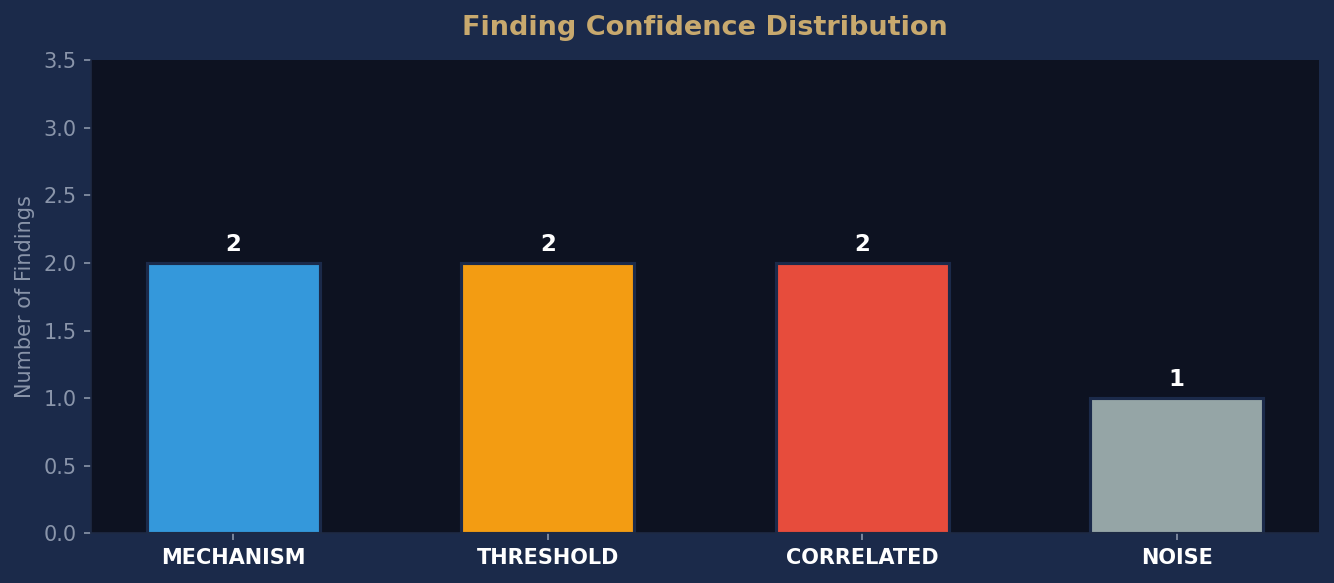
Distribution of causal confidence ratings across all findings in this report. CAUSAL findings are fully actionable. MECHANISM findings require additional evidence before action.
This report was published on May 12, 2026. By the time it's free, the market has already moved.
Don't miss the next one.
Don't miss the next one.
This report was published May 12, 2026. Current intelligence reports are available now.